10-Q
Q3false--12-310001782223http://fasb.org/srt/2026#ChiefExecutiveOfficerMemberhttp://fasb.org/us-gaap/2026#NetIncomeLoss0001782223pyxs:SeriesBConvertiblePreferredStocksMemberpyxs:PfizerLicenseAgreementMember2021-10-012021-10-310001782223pyxs:UniversityLicenseAgreementMember2025-07-012025-09-3000017822232024-12-310001782223pyxs:SeriesBConvertiblePreferredStocksMemberpyxs:PfizerLicenseAgreementMember2021-10-310001782223pyxs:JakobDupontMember2026-07-012026-09-300001782223us-gaap:AccumulatedOtherComprehensiveIncomeMember2026-01-012026-09-300001782223us-gaap:AdditionalPaidInCapitalMember2024-12-310001782223us-gaap:RetainedEarningsMember2026-01-012026-09-300001782223pyxs:SimcereLicenseAgreementMemberpyxs:SaleOfRoyaltyRightsMember2025-12-012025-12-310001782223us-gaap:OperatingSegmentsMember2026-07-012026-09-300001782223us-gaap:RetainedEarningsMember2025-12-310001782223us-gaap:FairValueMeasurementsRecurringMember2025-12-310001782223us-gaap:AdditionalPaidInCapitalMember2025-06-300001782223pyxs:ToraySublicenseAgreementMember2025-07-012025-09-300001782223pyxs:MabwellAgreementMember2025-07-012025-09-300001782223us-gaap:GeneralAndAdministrativeExpense2026-01-012026-09-3000017822232025-11-260001782223pyxs:UniversityLicenseAgreementMember2025-01-012025-09-300001782223pyxs:MilestoneRevenueMember2026-01-012026-09-300001782223pyxs:NonVestedAndUnsettledRestrictedStockUnitsMember2026-01-012026-09-300001782223pyxs:TwothousandtwentytwoequityinducementplanMember2026-09-300001782223us-gaap:ResearchAndDevelopmentExpense2025-07-012025-09-300001782223pyxs:NonVestedAndUnsettledRestrictedStockUnitsMember2025-01-012025-09-300001782223pyxs:SimcereLicenseAgreementMember2025-07-312025-07-310001782223srt:MinimumMember2025-07-012025-09-3000017822232025-06-300001782223us-gaap:ResearchAndDevelopmentExpense2025-01-012025-09-300001782223pyxs:UnderwrittenPublicOfferingMemberpyxs:Pre-FundedWarrantsMemberus-gaap:SubsequentEventMember2026-10-010001782223us-gaap:FairValueInputsLevel1Memberus-gaap:USTreasurySecuritiesMemberus-gaap:FairValueMeasurementsRecurringMember2025-12-310001782223pyxs:JitendraWadhaneMember2026-07-012026-09-300001782223us-gaap:RestrictedStockUnitsRSUMember2026-09-300001782223us-gaap:AccumulatedOtherComprehensiveIncomeMember2025-09-300001782223us-gaap:CommonStockMemberus-gaap:PrivatePlacementMember2026-09-300001782223srt:MaximumMember2026-07-012026-09-300001782223pyxs:TwoThousandTwentyOneEmployeeStockPurchasePlanMember2026-01-012026-09-300001782223pyxs:UnderwrittenPublicOfferingMemberus-gaap:CommonStockMember2026-01-012026-09-300001782223pyxs:ApexigenReplacementWarrantsMember2025-12-310001782223pyxs:MilestoneRevenueMember2026-07-012026-09-300001782223us-gaap:ResearchAndDevelopmentExpense2026-07-012026-09-300001782223us-gaap:AccumulatedOtherComprehensiveIncomeMember2026-09-3000017822232025-12-310001782223us-gaap:RestrictedStockUnitsRSUMember2026-01-012026-09-300001782223us-gaap:MoneyMarketFundsMemberus-gaap:FairValueInputsLevel1Memberus-gaap:FairValueMeasurementsRecurringMember2026-09-300001782223us-gaap:EmployeeStockMember2025-12-3100017822232026-09-300001782223us-gaap:GeneralAndAdministrativeExpense2025-07-012025-09-300001782223us-gaap:AccumulatedOtherComprehensiveIncomeMember2025-06-300001782223pyxs:PfizerLicenseAgreementMember2023-01-012023-01-310001782223us-gaap:RetainedEarningsMember2026-09-300001782223us-gaap:CommonStockMember2026-09-300001782223us-gaap:AdditionalPaidInCapitalMember2025-01-012025-09-300001782223us-gaap:EmployeeStockOptionMember2025-12-310001782223pyxs:PfizerLicenseAgreementMember2026-07-012026-09-300001782223pyxs:BiosionLicenseAgreementMember2025-01-012025-09-300001782223pyxs:MabwellAgreementMember2026-01-012026-09-300001782223pyxs:ToraySublicenseAgreementMember2026-07-012026-09-300001782223pyxs:ApexigenIncMember2023-08-230001782223us-gaap:CommonStockMember2025-12-310001782223us-gaap:RetainedEarningsMember2025-07-012025-09-300001782223us-gaap:MoneyMarketFundsMemberus-gaap:FairValueMeasurementsRecurringMember2025-12-310001782223us-gaap:AdditionalPaidInCapitalMember2025-07-012025-09-300001782223us-gaap:GeneralAndAdministrativeExpense2025-01-012025-09-300001782223us-gaap:RetainedEarningsMember2024-12-310001782223pyxs:TwoThousandTwentyOneEquityIncentivePlanMember2026-09-300001782223pyxs:JulyTwoThousandTwentySixWarrantsMemberus-gaap:CommonStockMemberus-gaap:PrivatePlacementMember2026-07-020001782223us-gaap:FairValueInputsLevel1Memberus-gaap:FairValueMeasurementsRecurringMember2025-12-310001782223us-gaap:PrivatePlacementMember2026-01-012026-09-300001782223us-gaap:EmployeeStockOptionMember2026-09-300001782223pyxs:PfizerLicenseAgreementMember2022-10-060001782223pyxs:UniversityLicenseAgreementMember2026-01-012026-09-300001782223us-gaap:CommonStockMember2026-07-012026-09-300001782223pyxs:BiosionLicenseAgreementMemberus-gaap:ResearchAndDevelopmentExpense2022-03-282022-03-280001782223pyxs:TwoThousandTwentyOneEmployeeStockPurchasePlanMember2025-07-012025-09-300001782223pyxs:MilestoneRevenueMember2025-07-012025-09-300001782223us-gaap:PrivatePlacementMember2025-01-012025-09-300001782223us-gaap:AccumulatedOtherComprehensiveIncomeMember2025-07-012025-09-300001782223us-gaap:CommonStockMember2026-01-012026-09-300001782223us-gaap:OperatingSegmentsMemberpyxs:MilestoneRevenueMember2025-01-012025-09-300001782223us-gaap:USTreasurySecuritiesMemberus-gaap:FairValueMeasurementsRecurringMember2025-12-310001782223pyxs:BiosionLicenseAgreementMember2026-07-012026-09-300001782223pyxs:UnderwrittenPublicOfferingMemberus-gaap:SubsequentEventMember2026-10-012026-10-010001782223us-gaap:AccumulatedOtherComprehensiveIncomeMember2024-12-310001782223pyxs:TwoThousandTwentyOneEmployeeStockPurchasePlanMember2025-01-012025-09-300001782223pyxs:PfizerLicenseAgreementMember2026-01-012026-09-300001782223us-gaap:SubsequentEventMember2026-10-012026-10-010001782223us-gaap:CommonStockMember2025-07-012025-09-300001782223pyxs:TwoThousandTwentyOneEmployeeStockPurchasePlanMember2026-09-300001782223pyxs:BiosionLicenseAgreementMember2025-07-012025-09-300001782223pyxs:PrivatePlacementWarrantsMember2026-09-300001782223pyxs:WarrantTwoMember2026-09-300001782223pyxs:AtTheMarketOfferingProgramMembersrt:MaximumMember2025-12-090001782223us-gaap:CommonStockMember2024-12-310001782223srt:MaximumMember2025-07-012025-09-300001782223us-gaap:GeneralAndAdministrativeExpense2026-07-012026-09-300001782223us-gaap:CommonStockMemberpyxs:PreFundedWarrantsMember2025-01-3100017822232026-01-012026-09-300001782223us-gaap:AdditionalPaidInCapitalMember2026-06-300001782223us-gaap:OperatingSegmentsMember2026-01-012026-09-300001782223pyxs:ApexigenReplacementWarrantsMember2026-09-300001782223us-gaap:RetainedEarningsMember2025-01-012025-09-300001782223us-gaap:MoneyMarketFundsMemberus-gaap:FairValueMeasurementsRecurringMember2026-09-3000017822232026-11-040001782223pyxs:JitendraWadhaneMember2026-09-300001782223pyxs:ToraySublicenseAgreementMember2026-01-012026-09-300001782223us-gaap:RetainedEarningsMember2026-06-300001782223pyxs:PfizerLicenseAgreementMember2025-01-012025-09-300001782223us-gaap:EmployeeStockOptionMember2025-01-012025-09-300001782223us-gaap:OperatingSegmentsMemberpyxs:MilestoneRevenueMember2026-01-012026-09-300001782223us-gaap:USTreasurySecuritiesMember2025-12-310001782223us-gaap:EmployeeStockOptionMember2026-01-012026-09-300001782223us-gaap:OperatingSegmentsMember2025-07-012025-09-300001782223us-gaap:FairValueInputsLevel1Memberus-gaap:USTreasurySecuritiesMemberus-gaap:FairValueMeasurementsRecurringMember2026-09-300001782223pyxs:TwoThousandNineteenEquityIncentivePlanMember2026-09-300001782223pyxs:UniversityLicenseAgreementMember2020-04-012020-04-300001782223pyxs:JakobDupontMember2026-09-3000017822232026-07-012026-09-300001782223pyxs:PfizerLicenseAgreementMemberus-gaap:IPOMember2021-10-012021-10-310001782223pyxs:UnderwrittenPublicOfferingMemberus-gaap:SubsequentEventMember2026-10-010001782223us-gaap:AccumulatedOtherComprehensiveIncomeMember2025-01-012025-09-300001782223pyxs:TwoThousandTwentyOneEmployeeStockPurchasePlanMember2026-07-012026-09-300001782223pyxs:WarrantOneMember2026-09-300001782223us-gaap:FairValueMeasurementsRecurringMember2026-09-300001782223pyxs:ApexigenReplacementWarrantsMember2026-01-012026-09-3000017822232025-01-012025-12-310001782223us-gaap:OperatingSegmentsMemberpyxs:MilestoneRevenueMember2025-07-012025-09-300001782223pyxs:PrivatePlacementWarrantsMember2025-12-310001782223pyxs:PfizerLicenseAgreementMember2021-03-012021-03-310001782223us-gaap:AdditionalPaidInCapitalMember2025-09-300001782223us-gaap:ResearchAndDevelopmentExpense2026-01-012026-09-300001782223us-gaap:RetainedEarningsMember2025-06-300001782223us-gaap:AdditionalPaidInCapitalMember2025-12-310001782223pyxs:PfizerLicenseAgreementMember2025-07-012025-09-300001782223us-gaap:AccumulatedOtherComprehensiveIncomeMember2026-06-300001782223pyxs:SharesReservedForFutureIssuanceMember2025-12-310001782223pyxs:UnderwrittenPublicOfferingMemberus-gaap:CommonStockMemberus-gaap:SubsequentEventMember2026-10-010001782223us-gaap:AccumulatedOtherComprehensiveIncomeMember2025-12-3100017822232026-06-300001782223pyxs:SharesReservedForFutureIssuanceMember2026-09-300001782223us-gaap:CommonStockMember2025-01-012025-09-300001782223us-gaap:CommonStockMemberus-gaap:PrivatePlacementMember2026-07-020001782223us-gaap:OperatingSegmentsMember2025-01-012025-09-300001782223us-gaap:OperatingSegmentsMemberpyxs:MilestoneRevenueMember2026-07-012026-09-300001782223us-gaap:CommonStockMember2025-06-300001782223srt:MinimumMember2026-07-012026-09-300001782223pyxs:PfizerLicenseAgreementMember2023-03-310001782223pyxs:BiosionLicenseAgreementMember2026-01-012026-09-300001782223srt:MaximumMember2026-01-012026-09-300001782223us-gaap:CommonStockMemberus-gaap:PrivatePlacementMember2026-07-022026-07-020001782223us-gaap:EmployeeStockMember2026-09-300001782223pyxs:MilestoneRevenueMember2025-01-012025-09-300001782223us-gaap:CommonStockMember2026-06-300001782223us-gaap:SubsequentEventMember2026-10-210001782223pyxs:ToraySublicenseAgreementMember2025-01-012025-09-300001782223us-gaap:USTreasurySecuritiesMember2026-09-300001782223srt:MinimumMember2026-01-012026-09-300001782223us-gaap:MoneyMarketFundsMemberus-gaap:FairValueInputsLevel1Memberus-gaap:FairValueMeasurementsRecurringMember2025-12-310001782223pyxs:SimcereLicenseAgreementMemberpyxs:SaleOfRoyaltyRightsMember2026-01-012026-09-300001782223us-gaap:RetainedEarningsMember2026-07-012026-09-300001782223pyxs:ApexigenReplacementWarrantsMember2025-01-012025-09-3000017822232023-08-230001782223us-gaap:USTreasurySecuritiesMemberus-gaap:FairValueMeasurementsRecurringMember2026-09-300001782223pyxs:TwoThousandTwentyOneEquityIncentivePlanMemberpyxs:FormerChiefExecutiveOfficerMember2026-01-012026-09-300001782223pyxs:MabwellAgreementMember2026-07-012026-09-300001782223us-gaap:AdditionalPaidInCapitalMember2026-09-3000017822232025-07-012025-09-300001782223pyxs:MabwellAgreementMember2025-01-012025-09-300001782223pyxs:PreFundedWarrantsMember2026-09-3000017822232025-09-300001782223us-gaap:CommonStockMember2025-09-300001782223us-gaap:RestrictedStockUnitsRSUMember2025-12-310001782223us-gaap:AdditionalPaidInCapitalMember2026-01-012026-09-3000017822232025-01-012025-09-300001782223us-gaap:RetainedEarningsMember2025-09-300001782223srt:MaximumMember2025-01-012025-09-300001782223pyxs:UnderwrittenPublicOfferingMemberus-gaap:SubsequentEventMemberpyxs:October2026WarrantsMember2026-10-010001782223srt:MinimumMember2025-01-012025-09-300001782223pyxs:UniversityLicenseAgreementMember2026-07-012026-09-300001782223pyxs:TwoThousandTwentyTwoEquityIncentivePlanMember2026-09-300001782223us-gaap:FairValueInputsLevel1Memberus-gaap:FairValueMeasurementsRecurringMember2026-09-300001782223us-gaap:AdditionalPaidInCapitalMember2026-07-012026-09-3000017822232026-07-022026-07-020001782223pyxs:WarrantThreeMember2026-09-300001782223us-gaap:AccumulatedOtherComprehensiveIncomeMember2026-07-012026-09-30xbrli:purepyxs:Segmentutr:sqftxbrli:sharesiso4217:USD
UNITED STATES
SECURITIES AND EXCHANGE COMMISSION
WASHINGTON, DC 20549
FORM 10-Q
(Mark One)
|
|
☒ |
QUARTERLY REPORT PURSUANT TO SECTION 13 OR 15(d) OF THE SECURITIES EXCHANGE ACT OF 1934 |
For the quarterly period ended September 30, 2026
OR
|
|
☐ |
TRANSITION REPORT PURSUANT TO SECTION 13 OR 15(d) OF THE SECURITIES EXCHANGE ACT OF 1934 |
Commission File Number: 001-40881
Pyxis Oncology, Inc.
(Exact Name of Registrant as Specified in its Charter)
|
|
Delaware |
83-1160910 |
(State or other jurisdiction of incorporation or organization) |
(I.R.S. Employer
Identification No.) |
321 Harrison Avenue Boston, Massachusetts |
02118 |
(Address of principal executive offices) |
(Zip Code) |
Registrant’s telephone number, including area code: (617) 453-3596
Securities registered pursuant to Section 12(b) of the Act:
|
|
|
|
|
Title of each class |
|
Trading Symbol(s) |
|
Name of each exchange on which registered |
Common Stock, par value $0.001 per share |
|
PYXS |
|
Nasdaq Global Select Market |
Indicate by check mark whether the registrant (1) has filed all reports required to be filed by Section 13 or 15(d) of the Securities Exchange Act of 1934 during the preceding 12 months (or for such shorter period that the registrant was required to file such reports), and (2) has been subject to such filing requirements for the past 90 days. Yes ☒ No ☐
Indicate by check mark whether the registrant has submitted electronically every Interactive Data File required to be submitted pursuant to Rule 405 of Regulation S-T (§232.405 of this chapter) during the preceding 12 months (or for such shorter period that the registrant was required to submit such files). Yes ☒ No ☐
Indicate by check mark whether the registrant is a large accelerated filer, an accelerated filer, a non-accelerated filer, smaller reporting company, or an emerging growth company. See the definitions of “large accelerated filer,” “accelerated filer,” “smaller reporting company,” and “emerging growth company” in Rule 12b-2 of the Exchange Act.
|
|
|
|
|
|
|
Large accelerated filer |
|
☐ |
|
Accelerated filer |
|
☐ |
Non-accelerated filer |
|
☒ |
|
Smaller reporting company |
|
☒ |
|
|
|
|
Emerging growth company |
|
☒ |
If an emerging growth company, indicate by check mark if the registrant has elected not to use the extended transition period for complying with any new or revised financial accounting standards provided pursuant to Section 13(a) of the Exchange Act. ☒
Indicate by check mark whether the registrant is a shell company (as defined in Rule 12b-2 of the Exchange Act). Yes ☐ No ☒
As of November 4, 2026, the registrant had 119,607,855 shares of common stock, $0.001 par value per share, outstanding.
SUMMARY RISK FACTORS
You should consider carefully the risks described under “Risk Factors” in Part II, Item 1A of this Quarterly Report on Form 10-Q. References to “Pyxis Oncology,” the “Company,” “we,” “us,” and “our” in this section titled “Summary Risk Factors” refer to Pyxis Oncology, Inc. and its wholly owned subsidiaries. A summary of the risks that could materially and adversely affect our business, financial condition, operating results and prospects include the following:
•We are a clinical stage oncology company with a limited operating history and have incurred significant losses since our inception and anticipate that we will continue to incur losses over at least the next several years and may never achieve or maintain profitability.
•We will require substantial additional capital to finance our operations. If we are unable to raise such capital when needed, or on acceptable terms, we may be forced to delay, reduce or eliminate one or more of our research and product development programs or future commercialization efforts. The warrants that we have issued may never be exercised and we may never receive additional funds from the warrants.
•We are heavily dependent on the success of our lead product candidate, micvotabart pelidotin (MICVO), formerly known as PYX-201, which is in the early stages of clinical development. If our lead product candidate is not successful in clinical trials or does not receive regulatory approval or licensure or is not successfully commercialized, our business will be materially and adversely affected.
•Our product candidate may fail in development or suffer delays that materially and adversely affect its commercial viability. If we or our existing or future collaborators are unable to initiate and complete clinical development of, obtain regulatory approval or licensure for or commercialize our product candidate or experience significant delays in doing so, our business will be materially harmed.
•Our product candidate may cause undesirable and unforeseen side effects or have other properties impacting safety that could halt its clinical development, delay or prevent its regulatory licensure, limit its commercial potential or result in significant negative consequences.
•We may face significant competition from other oncology-focused biotechnology and pharmaceutical entities, and our operating results will suffer if we fail to compete effectively.
•Clinical testing and product development is a lengthy and expensive process with an uncertain outcome. We may incur unexpected costs or experience delays in completing, or ultimately be unable to complete, the clinical testing and the development and commercialization of our product candidate.
•The regulatory licensure and approval processes of the FDA and other comparable foreign regulatory authorities are lengthy, time-consuming and inherently unpredictable and, if we are unable to obtain marketing licensure or approval for our product candidate, our business will be substantially harmed.
•If we fail to attract and retain qualified senior management and key scientific personnel, our business may be materially and adversely affected.
•We rely on third parties to manufacture our product candidate. Any failure by a third party manufacturer to produce acceptable raw materials or product candidate for us or to obtain authorization from the FDA or comparable foreign regulatory authorities relating thereto may delay or impair our ability to initiate or complete our clinical trials, obtain regulatory licensure or approvals or commercialize approved products.
•If we are unable to obtain or protect our intellectual property in and to our product candidates, we may not be able to compete effectively in our markets.
•If we fail to comply with our obligations under any license, collaboration or other agreements, we may be required to pay damages and could lose intellectual property rights that are necessary for developing and protecting our product candidate or we could lose certain rights to grant sublicenses.
•Licensing of intellectual property is of critical importance to our business and involves complex legal, business and scientific issues. If we breach our Pfizer license agreement or any of the other agreements under which we acquired, or will acquire, intellectual property rights covering our product candidate, we could lose the ability to continue the development and commercialization of the related product candidate(s).
•Actual or perceived failures to comply with applicable data protection, privacy and security laws, regulations, standards and other requirements could adversely affect our business, operations and financial condition.
•Our information technology systems, or those of any of our existing or future CROs, manufacturers, other contractors, consultants, or collaborators, may be compromised, which could result in additional costs, significant liabilities, harm to our reputation and material disruption of our operations.
PART I—FINANCIAL INFORMATION
Item 1. Financial Statements.
PYXIS ONCOLOGY, INC.
Condensed Consolidated Balance Sheets
(In thousands, except share and per share amounts)
(Unaudited)
|
|
|
|
|
|
|
|
|
|
|
September 30, 2026 |
|
|
December 31, 2025 |
|
Assets |
|
|
|
|
|
|
Current assets: |
|
|
|
|
|
|
Cash and cash equivalents |
|
$ |
3,856 |
|
|
$ |
15,422 |
|
Marketable debt securities |
|
|
51,716 |
|
|
|
51,435 |
|
Restricted cash |
|
|
1,472 |
|
|
|
1,472 |
|
Prepaid expenses and other current assets |
|
|
2,083 |
|
|
|
3,776 |
|
Total current assets |
|
|
59,127 |
|
|
|
72,105 |
|
Property and equipment, net |
|
|
6,939 |
|
|
|
7,997 |
|
Operating lease right-of-use asset |
|
|
10,704 |
|
|
|
11,418 |
|
Total assets |
|
$ |
76,770 |
|
|
$ |
91,520 |
|
Liabilities and Stockholders’ Equity |
|
|
|
|
|
|
Current liabilities: |
|
|
|
|
|
|
Accounts payable |
|
$ |
8,124 |
|
|
$ |
10,885 |
|
Accrued expenses and other current liabilities |
|
|
9,926 |
|
|
|
8,554 |
|
Operating lease liabilities, current portion |
|
|
1,892 |
|
|
|
1,692 |
|
Total current liabilities |
|
|
19,942 |
|
|
|
21,131 |
|
Operating lease liabilities, net of current portion |
|
|
15,508 |
|
|
|
16,958 |
|
Financing lease liabilities, net of current portion |
|
|
— |
|
|
|
23 |
|
Total liabilities |
|
|
35,450 |
|
|
|
38,112 |
|
Commitments and contingencies (Note 13) |
|
|
|
|
|
|
Stockholders’ equity: |
|
|
|
|
|
|
Preferred stock, par value $0.001 per share, 10,000,000 shares authorized; zero shares issued and outstanding |
|
|
— |
|
|
|
— |
|
Common stock, $0.001 par value per share; 190,000,000 shares authorized; 83,511,500 and 62,690,229 shares issued and outstanding as of September 30, 2026 and December 31, 2025, respectively |
|
|
83 |
|
|
|
63 |
|
Additional paid-in capital |
|
|
553,072 |
|
|
|
496,469 |
|
Accumulated other comprehensive (loss) income |
|
|
(56 |
) |
|
|
53 |
|
Accumulated deficit |
|
|
(511,779 |
) |
|
|
(443,177 |
) |
Total stockholders’ equity |
|
|
41,320 |
|
|
|
53,408 |
|
Total liabilities and stockholders’ equity |
|
$ |
76,770 |
|
|
$ |
91,520 |
|
The accompanying notes are an integral part of these unaudited condensed consolidated financial statements.
PYXIS ONCOLOGY, INC.
Condensed Consolidated Statements of Operations and Comprehensive Loss
(In thousands, except share and per share amounts)
(Unaudited)
|
|
|
|
|
|
|
|
|
|
|
|
|
|
|
|
|
|
|
Three Months Ended September 30, |
|
|
Nine Months Ended September 30, |
|
|
|
2026 |
|
|
2025 |
|
|
2026 |
|
|
2025 |
|
Milestone revenue |
|
$ |
— |
|
|
$ |
— |
|
|
$ |
— |
|
|
$ |
2,820 |
|
Operating expenses: |
|
|
|
|
|
|
|
|
|
|
|
|
Research and development |
|
|
16,556 |
|
|
|
17,808 |
|
|
|
52,596 |
|
|
|
51,985 |
|
General and administrative |
|
|
3,967 |
|
|
|
5,653 |
|
|
|
18,277 |
|
|
|
16,960 |
|
Total operating expenses |
|
|
20,523 |
|
|
|
23,461 |
|
|
|
70,873 |
|
|
|
68,945 |
|
Loss from operations |
|
|
(20,523 |
) |
|
|
(23,461 |
) |
|
|
(70,873 |
) |
|
|
(66,125 |
) |
Other income, net: |
|
|
|
|
|
|
|
|
|
|
|
|
Interest and investment income, net |
|
|
539 |
|
|
|
774 |
|
|
|
1,251 |
|
|
|
3,010 |
|
Sublease income |
|
|
— |
|
|
|
684 |
|
|
|
1,020 |
|
|
|
1,883 |
|
Total other income, net |
|
|
539 |
|
|
|
1,458 |
|
|
|
2,271 |
|
|
|
4,893 |
|
Loss before income taxes |
|
|
(19,984 |
) |
|
|
(22,003 |
) |
|
|
(68,602 |
) |
|
|
(61,232 |
) |
Income tax expense |
|
|
— |
|
|
|
— |
|
|
|
— |
|
|
|
283 |
|
Net loss |
|
$ |
(19,984 |
) |
|
$ |
(22,003 |
) |
|
$ |
(68,602 |
) |
|
$ |
(61,515 |
) |
Net loss per common share - basic and diluted |
|
$ |
(0.24 |
) |
|
$ |
(0.35 |
) |
|
$ |
(0.98 |
) |
|
$ |
(0.99 |
) |
Weighted average shares of common stock outstanding - basic and diluted |
|
|
83,508,174 |
|
|
|
62,557,386 |
|
|
|
70,149,530 |
|
|
|
61,847,245 |
|
Other comprehensive (loss) income: |
|
|
|
|
|
|
|
|
|
|
|
|
Net unrealized (loss) gain on marketable debt securities |
|
|
(52 |
) |
|
|
74 |
|
|
|
(109 |
) |
|
|
(101 |
) |
Other comprehensive (loss) income |
|
|
(52 |
) |
|
|
74 |
|
|
|
(109 |
) |
|
|
(101 |
) |
Comprehensive loss |
|
$ |
(20,036 |
) |
|
$ |
(21,929 |
) |
|
$ |
(68,711 |
) |
|
$ |
(61,616 |
) |
The accompanying notes are an integral part of these unaudited condensed consolidated financial statements.
PYXIS ONCOLOGY, INC.
Condensed Consolidated Statements of Stockholders’ Equity
(In thousands, except share amounts)
(Unaudited)
|
|
|
|
|
|
|
|
|
|
|
|
|
|
|
|
|
|
|
|
|
|
|
|
|
|
|
|
|
|
|
|
|
|
Accumulated |
|
|
|
|
|
|
|
|
|
|
|
|
|
|
Additional |
|
|
Other |
|
|
|
|
|
Total |
|
|
Common Stock |
|
|
Paid-In |
|
|
Comprehensive |
|
|
Accumulated |
|
|
Stockholders’ |
|
For the Three Months Ended September 30, 2026 and 2025 |
Shares |
|
|
Amount |
|
|
Capital |
|
|
Income (Loss) |
|
|
Deficit |
|
|
Equity |
|
Balance at June 30, 2026 |
|
63,434,936 |
|
|
$ |
63 |
|
|
$ |
503,176 |
|
|
$ |
(4 |
) |
|
$ |
(491,795 |
) |
|
$ |
11,440 |
|
Issuance of common stock in private placement, net of offering costs (See Note 7) |
|
19,600,153 |
|
|
|
20 |
|
|
|
48,325 |
|
|
|
— |
|
|
|
— |
|
|
|
48,345 |
|
Issuance of restricted common stock, net of tax withholdings |
|
298,733 |
|
|
|
— |
|
|
|
(35 |
) |
|
|
— |
|
|
|
— |
|
|
|
(35 |
) |
Stock options exercised |
|
177,678 |
|
|
|
— |
|
|
|
275 |
|
|
|
— |
|
|
|
— |
|
|
|
275 |
|
Stock-based compensation |
|
— |
|
|
|
— |
|
|
|
1,331 |
|
|
|
— |
|
|
|
— |
|
|
|
1,331 |
|
Net unrealized loss on marketable debt securities |
|
— |
|
|
|
— |
|
|
|
— |
|
|
|
(52 |
) |
|
|
— |
|
|
|
(52 |
) |
Net loss |
|
— |
|
|
|
— |
|
|
|
— |
|
|
|
— |
|
|
|
(19,984 |
) |
|
|
(19,984 |
) |
Balance at September 30, 2026 |
|
83,511,500 |
|
|
$ |
83 |
|
|
$ |
553,072 |
|
|
$ |
(56 |
) |
|
$ |
(511,779 |
) |
|
$ |
41,320 |
|
|
|
|
|
|
|
|
|
|
|
|
|
|
|
|
|
|
|
Balance at June 30, 2025 |
|
62,018,135 |
|
|
$ |
62 |
|
|
$ |
490,654 |
|
|
$ |
(5 |
) |
|
$ |
(403,068 |
) |
|
$ |
87,643 |
|
Issuance of restricted common stock, net of tax withholdings |
|
131,529 |
|
|
|
— |
|
|
|
(8 |
) |
|
|
— |
|
|
|
— |
|
|
|
(8 |
) |
Stock-based compensation |
|
— |
|
|
|
— |
|
|
|
3,073 |
|
|
|
— |
|
|
|
— |
|
|
|
3,073 |
|
Net unrealized gain on marketable debt securities |
|
— |
|
|
|
— |
|
|
|
— |
|
|
|
74 |
|
|
|
— |
|
|
|
74 |
|
Net loss |
|
— |
|
|
|
— |
|
|
|
— |
|
|
|
— |
|
|
|
(22,003 |
) |
|
|
(22,003 |
) |
Balance at September 30, 2025 |
|
62,149,664 |
|
|
$ |
62 |
|
|
$ |
493,719 |
|
|
$ |
69 |
|
|
$ |
(425,071 |
) |
|
$ |
68,779 |
|
|
|
|
|
|
|
|
|
|
|
|
|
|
|
|
|
|
|
|
|
|
|
|
|
|
|
|
|
|
|
|
|
|
|
|
|
|
|
|
|
|
|
|
|
|
|
|
|
|
|
|
|
|
|
|
|
|
|
|
|
|
|
|
|
Accumulated |
|
|
|
|
|
|
|
|
|
|
|
|
|
|
Additional |
|
|
Other |
|
|
|
|
|
Total |
|
|
Common Stock |
|
|
Paid-In |
|
|
Comprehensive |
|
|
Accumulated |
|
|
Stockholders’ |
|
For the Nine Months Ended September 30, 2026 and 2025 |
Shares |
|
|
Amount |
|
|
Capital |
|
|
Income (Loss) |
|
|
Deficit |
|
|
Equity |
|
Balance at December 31, 2025 |
|
62,690,229 |
|
|
$ |
63 |
|
|
$ |
496,469 |
|
|
$ |
53 |
|
|
$ |
(443,177 |
) |
|
$ |
53,408 |
|
Issuance of common stock in private placement, net of offering costs (See Note 7) |
|
19,600,153 |
|
|
|
20 |
|
|
|
48,325 |
|
|
|
— |
|
|
|
— |
|
|
|
48,345 |
|
Issuance of restricted common stock and other awards, net of tax withholdings |
|
1,014,734 |
|
|
|
— |
|
|
|
(113 |
) |
|
|
— |
|
|
|
— |
|
|
|
(113 |
) |
Stock options exercised |
|
206,384 |
|
|
|
— |
|
|
|
322 |
|
|
|
— |
|
|
|
— |
|
|
|
322 |
|
Stock-based compensation |
|
— |
|
|
|
— |
|
|
|
8,069 |
|
|
|
— |
|
|
|
— |
|
|
|
8,069 |
|
Net unrealized loss on marketable debt securities |
|
— |
|
|
|
— |
|
|
|
— |
|
|
|
(109 |
) |
|
|
— |
|
|
|
(109 |
) |
Net loss |
|
— |
|
|
|
— |
|
|
|
— |
|
|
|
— |
|
|
|
(68,602 |
) |
|
|
(68,602 |
) |
Balance at September 30, 2026 |
|
83,511,500 |
|
|
$ |
83 |
|
|
$ |
553,072 |
|
|
$ |
(56 |
) |
|
$ |
(511,779 |
) |
|
$ |
41,320 |
|
|
|
|
|
|
|
|
|
|
|
|
|
|
|
|
|
|
|
Balance at December 31, 2024 |
|
59,967,814 |
|
|
$ |
60 |
|
|
$ |
484,077 |
|
|
$ |
170 |
|
|
$ |
(363,556 |
) |
|
$ |
120,751 |
|
Exercise of pre-funded warrants |
|
1,611,215 |
|
|
|
2 |
|
|
|
— |
|
|
|
— |
|
|
|
— |
|
|
|
2 |
|
Issuance of restricted common stock, net of tax withholdings |
|
541,016 |
|
|
|
— |
|
|
|
(77 |
) |
|
|
— |
|
|
|
— |
|
|
|
(77 |
) |
Issuance of common stock under employee stock purchase plan (ESPP) |
|
29,619 |
|
|
|
— |
|
|
|
— |
|
|
|
— |
|
|
|
— |
|
|
|
— |
|
Stock-based compensation |
|
— |
|
|
|
— |
|
|
|
9,719 |
|
|
|
— |
|
|
|
— |
|
|
|
9,719 |
|
Net unrealized loss on marketable debt securities |
|
— |
|
|
|
— |
|
|
|
— |
|
|
|
(101 |
) |
|
|
— |
|
|
|
(101 |
) |
Net loss |
|
— |
|
|
|
— |
|
|
|
— |
|
|
|
— |
|
|
|
(61,515 |
) |
|
|
(61,515 |
) |
Balance at September 30, 2025 |
|
62,149,664 |
|
|
$ |
62 |
|
|
$ |
493,719 |
|
|
$ |
69 |
|
|
$ |
(425,071 |
) |
|
$ |
68,779 |
|
|
|
|
|
|
|
|
|
|
|
|
|
|
|
|
|
|
|
|
|
|
|
|
|
|
|
|
|
|
|
|
|
|
|
|
|
The accompanying notes are an integral part of these unaudited condensed consolidated financial statements.
PYXIS ONCOLOGY, INC.
Condensed Consolidated Statements of Cash Flows
(In thousands)
(Unaudited)
|
|
|
|
|
|
|
|
|
|
|
Nine Months Ended September 30, |
|
|
|
2026 |
|
|
2025 |
|
Operating activities |
|
|
|
|
|
|
Net loss |
|
$ |
(68,602 |
) |
|
$ |
(61,515 |
) |
Adjustments to reconcile net loss to net cash used in operating activities: |
|
|
|
|
|
|
Depreciation and amortization |
|
|
1,059 |
|
|
|
1,614 |
|
Stock-based compensation |
|
|
8,069 |
|
|
|
9,719 |
|
Non-cash operating lease expense |
|
|
714 |
|
|
|
605 |
|
Accretion of discount on marketable debt securities |
|
|
(771 |
) |
|
|
(2,585 |
) |
Changes in operating assets and liabilities: |
|
|
|
|
|
|
Prepaid expenses and other current assets |
|
|
1,693 |
|
|
|
(1,308 |
) |
Accounts payable |
|
|
(2,761 |
) |
|
|
4,897 |
|
Accrued expenses and other current liabilities |
|
|
1,372 |
|
|
|
(3,375 |
) |
Operating lease liabilities |
|
|
(1,250 |
) |
|
|
(1,070 |
) |
Other |
|
|
(23 |
) |
|
|
(57 |
) |
Net cash used in operating activities |
|
|
(60,500 |
) |
|
|
(53,075 |
) |
Investing activities |
|
|
|
|
|
|
Redemption of marketable debt securities |
|
|
63,739 |
|
|
|
149,610 |
|
Purchase of marketable debt securities |
|
|
(63,359 |
) |
|
|
(107,005 |
) |
Purchase of property and equipment |
|
|
— |
|
|
|
(9 |
) |
Net cash provided by investing activities |
|
|
380 |
|
|
|
42,596 |
|
Financing activities |
|
|
|
|
|
|
Proceeds from issuance of common stock in private placement, net of offering costs |
|
|
48,345 |
|
|
|
— |
|
Proceeds from exercise of pre-funded warrants |
|
|
— |
|
|
|
2 |
|
Proceeds from the exercise of stock options |
|
|
322 |
|
|
|
— |
|
Tax withholding payments related to net settlement of restricted common stock |
|
|
(113 |
) |
|
|
(77 |
) |
Net cash provided by (used in) financing activities |
|
|
48,554 |
|
|
|
(75 |
) |
Net decrease in cash, cash equivalents and restricted cash |
|
|
(11,566 |
) |
|
|
(10,554 |
) |
Cash, cash equivalents and restricted cash at beginning of year |
|
|
16,894 |
|
|
|
20,945 |
|
Cash, cash equivalents and restricted cash at end of period |
|
$ |
5,328 |
|
|
$ |
10,391 |
|
Reconciliation of cash, cash equivalents and restricted cash: |
|
|
|
|
|
|
Cash and cash equivalents |
|
$ |
3,856 |
|
|
$ |
8,919 |
|
Restricted cash |
|
|
1,472 |
|
|
|
1,472 |
|
Total cash, cash equivalents and restricted cash shown in the statement of cash flows |
|
$ |
5,328 |
|
|
$ |
10,391 |
|
The accompanying notes are an integral part of these unaudited condensed consolidated financial statements.
PYXIS ONCOLOGY, INC.
Notes to Condensed Consolidated Financial Statements
(Unaudited)
1. Description of Business
Nature of Business
Pyxis Oncology, Inc. (the “Company”), a Delaware corporation, was founded in June 2018 and launched its operations in July 2019. The Company is a clinical stage oncology company executing on a development strategy designed to address unmet medical needs in patients with solid tumors with a specific focus on head and neck squamous cell carcinoma (HNSCC) tumors.
2. Basis of Presentation and Summary of Significant Accounting Policies
Basis of Presentation
The Company’s fiscal year ends on December 31 and its first three fiscal quarters end on March 31, June 30 and September 30. The accompanying condensed consolidated financial statements are unaudited. The unaudited condensed consolidated financial statements of the Company have been prepared in accordance with generally accepted accounting principles in the United States of America (GAAP) and follow the requirements of the Securities and Exchange Commission (SEC) for interim financial reporting. Accordingly, they do not include all of the information and disclosures required by U.S. GAAP for complete financial statements as certain footnotes or other financial information that are normally required by U.S. GAAP can be condensed or omitted. The unaudited condensed consolidated financial statements have been prepared on the same basis as the audited consolidated financial statements. The unaudited condensed consolidated financial statements include the accounts of the Company and its wholly-owned subsidiaries. The Company has no unconsolidated subsidiaries. All intercompany balances and transactions have been eliminated in consolidation. Any reference in these notes to applicable guidance is meant to refer to the authoritative U.S. GAAP as found in the Accounting Standards Codification (ASC) and Accounting Standards Updates (ASU) of the Financial Accounting Standards Board (FASB).
In the opinion of management, the unaudited condensed consolidated financial statements include all normal and recurring adjustments that are considered necessary for the fair statement of results for the interim periods. The results for the three and nine months ended September 30, 2026 are not necessarily indicative of those expected for the year ending December 31, 2026 or for any future period. The condensed consolidated balance sheet as of December 31, 2025 included herein was derived from the audited consolidated financial statements as of that date. These unaudited condensed consolidated financial statements should be read in conjunction with the Company’s audited consolidated financial statements and the related notes thereto for the year ended December 31, 2025, included in the Company’s Annual Report on Form 10-K filed with the SEC on March 23, 2026 (Fiscal 2025 10-K).
Liquidity
The Company has incurred losses and negative cash flows from operations since inception, including net losses of $20.0 million and $22.0 million for the three months ended September 30, 2026 and 2025, respectively, and net losses of $68.6 million and $61.5 million for the nine months ended September 30, 2026 and 2025, respectively. As of September 30, 2026, the Company had an accumulated deficit of $511.8 million and cash, cash equivalents, and marketable debt securities of $55.6 million.
On July 2, 2026, the Company closed a private placement with certain institutional accredited investors (the “Private Placement”) and received gross proceeds of approximately $50.0 million before deducting placement agent fees and offering expenses directly related to the Private Placement.
Subsequent to the balance sheet date, on October 1, 2026, the Company closed a registered public offering (the "Public Offering") and received gross proceeds of approximately $110.0 million before deducting underwriting discounts and commissions and other expenses directly related to the Public Offering. The Company currently expects that its cash, cash equivalents, and marketable debt securities as of September 30, 2026 together with the net proceeds from the Public Offering will be sufficient to fund its operating expenses and capital expenditure requirements for at least twelve months from the date these unaudited condensed consolidated financial statements are issued. At the time of these unaudited condensed consolidated financial statements, the previously reported going concern uncertainty has been alleviated based on the completion of the Public Offering. See Note 14, Subsequent Events, for further details regarding the Public Offering.
The Company plans to continue to fund its losses from operations and capital funding needs through public or private equity, convertible or debt financing or other sources. If the Company is not able to secure adequate additional funding, the Company may be forced to make reductions in spending, extend payment terms with suppliers, liquidate assets where possible, or suspend or curtail planned programs. Any of these actions could materially harm the Company’s business, results of operations and future prospects.
Use of Estimates
The preparation of unaudited condensed consolidated financial statements in conformity with GAAP requires management to make estimates and assumptions that affect the reported amounts of assets, liabilities, expense and related disclosures. The Company regularly evaluates estimates and assumptions related to assets, liabilities, stock-based compensation, operating leases, assessment of the useful lives of property and equipment, marketable debt securities and research and development costs, including clinical trial accruals. The Company bases its estimates and assumptions on historical experience and on various other factors that it believes to be reasonable under the circumstances, the results of which form the basis for making judgments about the carrying values of assets and liabilities that are not readily apparent from other sources.
Actual results could differ from those estimates and there may be changes to management’s estimates in future periods.
Risks and Uncertainties
The Company is subject to risks common to early clinical stage companies in the biopharmaceutical industry including, but not limited to, uncertainties related to commercialization of products, regulatory approvals, dependence on key suppliers for active ingredients and third party service providers such as contract research organizations (CROs) and contract development and manufacturing organizations (CDMOs), protection of intellectual property rights and the ability to make milestone, royalty or other payments due under any license, collaboration or supply agreements.
Concentration of Credit Risks
Financial instruments which potentially subject the Company to significant concentration of credit risk consist of cash and cash equivalents, restricted cash and marketable debt securities.
The Company invests its excess cash primarily in money market funds and highly liquid United States (U.S.) Treasury securities. The Company has adopted an investment policy that includes guidelines relative to credit quality, diversification and maturities to preserve principal and liquidity.
Significant Accounting Policies
There have been no significant changes to the Company’s significant accounting policies disclosed in “Note 2 – Basis of Presentation and Summary of Significant Accounting Policies” of the Company’s Fiscal 2025 10-K.
Recently Issued Accounting Pronouncements
In November 2024, the FASB issued ASU 2024-03, Income Statement - Reporting Comprehensive Income - Expense Disaggregation Disclosures (Subtopic 220-40): Disaggregation of Income Statement Expenses. The amendment requires disaggregated disclosure of (i) certain costs and expenses, (ii) certain already required disclosures must be included in the same disclosure as the new disaggregation requirements and (iii) a qualitative description of the amounts not separately disaggregated. The amendments are effective for annual periods beginning after December 15, 2026, and interim periods beginning after December 15, 2027. Early adoption is permitted. The Company is currently evaluating the impact of the new standard on the Company's consolidated financial statements and related disclosures.
3. Fair Value Measurements
The following tables present the financial instruments carried at fair value on a recurring basis as of September 30, 2026 and December 31, 2025, respectively, in accordance with the FASB ASC 820 hierarchy (in thousands):
|
|
|
|
|
|
|
|
|
|
|
|
|
|
|
|
|
September 30, 2026 |
|
|
Level 1 |
|
|
Level 2 |
|
|
Level 3 |
|
|
Total |
|
Cash equivalents |
|
|
|
|
|
|
|
|
|
|
|
Money market funds |
$ |
1,180 |
|
|
$ |
— |
|
|
$ |
— |
|
|
$ |
1,180 |
|
Marketable debt securities |
|
|
|
|
|
|
|
|
|
|
|
U.S. Treasury securities |
|
51,716 |
|
|
|
— |
|
|
|
— |
|
|
|
51,716 |
|
Total |
$ |
52,896 |
|
|
$ |
— |
|
|
$ |
— |
|
|
$ |
52,896 |
|
|
|
|
|
|
|
|
|
|
|
|
|
|
December 31, 2025 |
|
|
Level 1 |
|
|
Level 2 |
|
|
Level 3 |
|
|
Total |
|
Cash equivalents |
|
|
|
|
|
|
|
|
|
|
|
Money market funds |
$ |
673 |
|
|
$ |
— |
|
|
$ |
— |
|
|
$ |
673 |
|
Marketable debt securities |
|
|
|
|
|
|
|
|
|
|
|
U.S. Treasury securities |
|
51,435 |
|
|
|
— |
|
|
|
— |
|
|
|
51,435 |
|
Total |
$ |
52,108 |
|
|
$ |
— |
|
|
$ |
— |
|
|
$ |
52,108 |
|
The Company’s cash equivalents represent deposits in a short-term money market fund quoted in an active market and are classified as Level 1 assets. Marketable debt securities include investments in United States Treasury securities and are classified as Level 1 assets as they are valued using quoted prices in active markets. There were no transfers between Level 1 and Level 2 of the fair value hierarchy during the periods presented.
4. Marketable Debt Securities
Marketable debt securities, all of which were classified as available-for-sale, consist of the following (in thousands):
|
|
|
|
|
|
|
|
|
|
|
|
|
|
|
|
|
|
|
September 30, 2026 |
|
|
|
Amortized
Cost |
|
|
Unrealized
Gains |
|
|
Unrealized
Losses |
|
|
Aggregate
Fair Value |
|
Marketable debt securities |
|
|
|
|
|
|
|
|
|
|
|
|
U.S. Treasury securities |
|
$ |
51,772 |
|
|
$ |
— |
|
|
$ |
(56 |
) |
|
$ |
51,716 |
|
Total |
|
$ |
51,772 |
|
|
$ |
— |
|
|
$ |
(56 |
) |
|
$ |
51,716 |
|
|
|
|
|
|
|
|
|
|
|
|
|
|
|
|
December 31, 2025 |
|
|
|
Amortized
Cost |
|
|
Unrealized
Gains |
|
|
Unrealized
Losses |
|
|
Aggregate
Fair Value |
|
Marketable debt securities |
|
|
|
|
|
|
|
|
|
|
|
|
U.S. Treasury securities |
|
$ |
51,382 |
|
|
$ |
53 |
|
|
$ |
— |
|
|
$ |
51,435 |
|
Total |
|
$ |
51,382 |
|
|
$ |
53 |
|
|
$ |
— |
|
|
$ |
51,435 |
|
As of September 30, 2026, and December 31, 2025, the remaining contractual terms of the U.S. Treasury securities were less than 12 months.
To date, the Company has not recognized any allowances for credit losses or impairments in relation to its marketable securities as these securities are comprised of high credit quality, investment grade securities that the Company does not intend or expect to be required to sell prior to their anticipated recovery, and the decline in fair value of these securities is attributable to factors other than credit losses.
Interest and investment income consists of the following (in thousands):
|
|
|
|
|
|
|
|
|
|
|
|
|
|
|
|
|
Three Months Ended September 30, |
|
|
Nine Months Ended September 30, |
|
|
2026 |
|
|
2025 |
|
|
2026 |
|
|
2025 |
|
Interest income |
$ |
201 |
|
|
$ |
242 |
|
|
$ |
480 |
|
|
$ |
425 |
|
Accretion of discount, net |
|
338 |
|
|
|
532 |
|
|
|
771 |
|
|
|
2,585 |
|
Total interest and investment income |
$ |
539 |
|
|
$ |
774 |
|
|
$ |
1,251 |
|
|
$ |
3,010 |
|
5. Segment Disclosure
Operating segments are defined as components of an enterprise for which separate discrete information is available for evaluation by the chief operating decision maker, or decision making group, in deciding how to allocate resources in assessing performance. The Company has one reportable segment related to the development of clinical and preclinical product candidates focused on addressing unmet medical needs in patients with solid tumors with a specific focus on HNSCC tumors. The Company’s chief operating decision maker (CODM) is the Chief Executive Officer.
The accounting policies of the single segment are the same as those described in the Company’s significant accounting policies disclosed in “Note 2 – Basis of Presentation and Summary of Significant Accounting Policies” of the Company’s Fiscal 2025 10-K. The CODM assesses performance for the segment based on net loss, which is reported on the accompanying unaudited condensed consolidated statements of operations and comprehensive loss as net loss. The measure of segment assets is reported on the accompanying unaudited condensed consolidated balance sheets as total assets.
To date, the Company has not generated any product revenue. The Company expects to continue to incur significant expenses and operating losses for the foreseeable future as it advances its product candidates through all stages of development and clinical trials and, ultimately, seeks regulatory approval.
As such, the CODM uses cash forecast models in deciding how to allocate resources. Such cash forecast models are reviewed to assess the entity-wide operating results and performance. Net loss is used to monitor budget versus actual results. Monitoring budgeted versus actual results is used in assessing performance of the segment and in establishing management’s compensation, along with cash forecast models.
The table below summarizes segment net loss, including significant expenses for the three and nine months ended September 30, 2026 and 2025 (in thousands):
|
|
|
|
|
|
|
|
|
|
|
|
|
|
|
|
|
Three Months Ended September 30, |
|
|
Nine Months Ended September 30, |
|
|
2026 |
|
|
2025 |
|
|
2026 |
|
|
2025 |
|
Milestone revenue |
$ |
— |
|
|
$ |
— |
|
|
$ |
— |
|
|
$ |
2,820 |
|
Operating expenses: |
|
|
|
|
|
|
|
|
|
|
|
Research and development |
|
|
|
|
|
|
|
|
|
|
|
Clinical product candidates |
|
9,062 |
|
|
|
6,727 |
|
|
|
27,342 |
|
|
|
16,261 |
|
Clinical product manufacturing |
|
992 |
|
|
|
4,582 |
|
|
|
6,151 |
|
|
|
14,160 |
|
Personnel-related expenses, excluding stock-based compensation |
|
3,867 |
|
|
|
3,738 |
|
|
|
12,398 |
|
|
|
11,967 |
|
Stock-based compensation |
|
364 |
|
|
|
698 |
|
|
|
1,170 |
|
|
|
2,389 |
|
Depreciation and amortization |
|
239 |
|
|
|
454 |
|
|
|
869 |
|
|
|
1,385 |
|
Other (i) |
|
2,032 |
|
|
|
1,609 |
|
|
|
4,666 |
|
|
|
5,823 |
|
Total research and development expenses |
|
16,556 |
|
|
|
17,808 |
|
|
|
52,596 |
|
|
|
51,985 |
|
General and administrative |
|
|
|
|
|
|
|
|
|
|
|
Personnel-related expenses, excluding stock-based compensation |
|
1,532 |
|
|
|
1,519 |
|
|
|
5,708 |
|
|
|
4,070 |
|
Stock-based compensation |
|
967 |
|
|
|
2,375 |
|
|
|
6,899 |
|
|
|
7,330 |
|
Professional and consultant fees |
|
639 |
|
|
|
713 |
|
|
|
2,667 |
|
|
|
2,390 |
|
Other (ii) |
|
829 |
|
|
|
1,046 |
|
|
|
3,003 |
|
|
|
3,170 |
|
Total general and administrative expenses |
|
3,967 |
|
|
|
5,653 |
|
|
|
18,277 |
|
|
|
16,960 |
|
Total operating expenses |
|
20,523 |
|
|
|
23,461 |
|
|
|
70,873 |
|
|
|
68,945 |
|
Other segment income (iii) |
|
539 |
|
|
|
1,458 |
|
|
|
2,271 |
|
|
|
4,893 |
|
Income tax expense |
|
— |
|
|
|
— |
|
|
|
— |
|
|
|
283 |
|
Segment net loss |
$ |
(19,984 |
) |
|
$ |
(22,003 |
) |
|
$ |
(68,602 |
) |
|
$ |
(61,515 |
) |
Reconciliation of profit or loss |
|
|
|
|
|
|
|
|
|
|
|
Adjustments and reconciling items |
|
— |
|
|
|
— |
|
|
|
— |
|
|
|
— |
|
Consolidated net loss |
$ |
(19,984 |
) |
|
$ |
(22,003 |
) |
|
$ |
(68,602 |
) |
|
$ |
(61,515 |
) |
(i)Other research and development segment items include facilities expenses, lab services, professional services and technology costs.
(ii)Other general and administrative segment items include facilities expenses, technology costs, insurance and depreciation.
(iii)Other segment income for the three months ended September 30, 2026 consisted of $0.5 million of interest and investment income, and for the three months ended September 30, 2025 consisted of $0.8 million of interest and investment income and $0.7 million of sublease income. For the nine months ended September 30, 2026 and 2025, other segment income consisted of $1.3 million and $3.0 million of interest and investment income and $1.0 million and $1.9 million of sublease income, respectively.
6. Licensing Agreements
The University of Chicago Agreement
In April 2020, the Company entered into a license agreement (the “University License Agreement”), as well as a sponsored research agreement, with the University of Chicago (the “University”). Under the terms of the license, the Company has the global right to develop and commercialize products that are covered by a valid claim of a licensed patent, incorporate or use the licensed know-how and materials or are known to assess, modulate or utilize the activity of certain specified biological targets. In partial consideration for the license from the University, the Company issued to the University 48,919 shares of its common stock in 2020.
Pursuant to the University License Agreement, the Company is obligated to pay potential development and commercial milestones as well as running royalties on net sales of licensed products at varying rates. The Company assessed the milestone and royalty events under the University License Agreement during the three and nine months ended September 30, 2026 and 2025, and determined that no such milestone or royalty events occurred.
Pfizer Inc. Agreement
In December 2020, the Company entered into a license agreement (as amended, the “Pfizer License Agreement”) with Pfizer Inc. (“Pfizer”) for worldwide development and commercialization rights to ADC product candidates directed to certain licensed targets, including micvotabart pelidotin (“MICVO”) and PYX-203, and products containing the ADC product candidates. The Company’s rights are exclusive with respect to certain patents owned or controlled by Pfizer covering the licensed ADCs. The initial licensed targets include CD123 and Extradomain-B Fibronectin (“EDB+FN”) and the Company has the option to expand the scope of its license to add additional licensed targets that have not been licensed to a third party or are not the subject of a Pfizer ADC development program. The Pfizer License Agreement became effective in March 2021 and the Company paid a combined $25.0 million for the license fee, consisting of an upfront cash payment of $5.0 million and issued 12,152,145 shares of Series B convertible preferred stock, which was converted into 1,911,015 shares of its common stock upon the initial public offering (“IPO”) in October 2021, with a value of $20.0 million to Pfizer.
On October 6, 2022, the Company entered into an amended and restated license agreement (the “A&R License Agreement”) with Pfizer, which amends and restates the Pfizer License Agreement. Pursuant to the A&R License Agreement, Pfizer granted to the Company exclusive worldwide rights under Pfizer’s Flexible Antibody Conjugation Technology (“FACT”) Platform technology to develop and commercialize ADC product candidates directed to certain licensed targets, including MICVO and PYX-203, and products containing the ADC product candidates. Additional ADC targets may be licensed for a nominal upfront payment and milestones. In accordance with the terms of the A&R License Agreement, the Company issued 2,229,654 shares of its common stock to Pfizer in October 2022, paid $8.0 million to Pfizer in January 2023 and issued 1,811,594 shares of its common stock to Pfizer in March 2023.
Further, pursuant to the A&R License Agreement, the Company is obligated to pay future contingent payments including development, regulatory and commercial milestones as well as running royalties on net sales of licensed products at varying rates. The Company assessed the milestone and royalty events under the A&R License Agreement during the three and nine months ended September 30, 2026 and 2025, and determined that no milestone or royalty events occurred.
Biosion USA, Inc. Agreement
On March 28, 2022, the Company entered into a license agreement (the “Biosion License Agreement”) with Biosion USA, Inc. (“Biosion”), pursuant to which the Company obtained an exclusive, worldwide (other than Greater China (mainland China, Hong Kong, Macau and Taiwan)) license for development, manufacturing and commercialization rights for BSI-060T, a Siglec-15 targeting antibody, an IO product candidate (now referred to as PYX-106), and products containing the licensed compound.
Pursuant to the Biosion License Agreement, the Company paid an upfront license fee of $10.0 million in March 2022. Further, the Company is also obligated to pay future contingent payments including development, regulatory and commercial milestones as well as running royalties on net sales of licensed products and sublicensing revenues at varying rates. In December 2024, the Company paused the clinical development of PYX-106. In May 2026, the Company provided Biosion with a 90-day notice of termination under the Biosion License Agreement, and the termination became effective in August 2026. As of the effective date of termination, the Company assessed the milestone and royalty provisions of the Biosion License Agreement and determined that no such milestone or royalty events occurred. Biosion and the Company are currently negotiating the wind down and transfer of the PYX-106 program from the Company to Biosion.
Acquired Out-Licensing Agreements
In August 2023, the Company completed the acquisition of Apexigen, Inc. (“Apexigen”) and assumed all out-licensing agreements of Apexigen upon the acquisition.
Simcere License and Collaboration Agreement
In December 2008, Epitomics, Inc. (“Epitomics”) (Apexigen’s predecessor) and Jiangsu Simcere Pharmaceutical R&D Co., Ltd. (“Simcere”) entered into a license and collaboration agreement (the “Simcere Agreement”) for the development and commercialization of suvemcitug (BD0801) for oncology in China.
In July 2025, Simcere paid $2.8 million of regulatory approval milestone ($3 million upon achievement of the regulatory milestone less $0.2 million of withholding tax) to the Company. Further, in December 2025, the Company sold its rights to royalties from the commercialization of Enzeshu® (suvemcitug for injection) to Simcere for a one-time cash payment of $11 million and four semi-annual installments of $175,000 each. During the nine months ended September 30, 2026, the Company received the first $175,000 installment payment. As of September 30, 2026, there are no obligations under the Simcere Agreement.
T-Mab/Mabwell Agreement
In May 2008, Epitomics and Jiangsu T-Mab Biotechnology Ltd., Co. (“T-Mab”) entered into a license, co-development and contract manufacture agreement (the “T-Mab Agreement”) for the development and commercialization of therapeutic candidates, each directed to a specified target for specified fields, including VEGF for the treatment of ocular diseases, in China. Mabwell (Shanghai) Bioscience Co., Ltd. (“Mabwell”) acquired T-Mab in 2015.
Under the T-Mab Agreement, Mabwell was granted an exclusive, royalty-bearing, perpetual license (without the right to sublicense) to rights in certain intellectual property to develop and commercialize such therapeutic candidates. Mabwell is obligated to pay the Company a mid-single-digit percentage royalty on net sales of such therapeutic candidates in China. During the three and nine months ended September 30, 2026 and 2025, the Company assessed the milestone and royalty provisions of the T-Mab Agreement and determined that no milestone or royalty events were triggered.
Toray Sublicense Agreement
In May 2012, Epitomics and Toray Industries, Inc. (“Toray”), entered into a non-exclusive sublicense agreement (the “Toray Agreement”) under which Epitomics granted Toray a non-exclusive, worldwide sublicense, with the right to grant further sublicenses, to develop and commercialize drug product candidates that Toray developed using antibodies created using Apexigen’s antibody-discovery platform (the “APXiMAB Platform”) that target certain molecules to use in the development of its drug product candidates. Under the Toray Agreement, Toray paid an upfront fee, and agreed to pay certain development and regulatory related milestone payments and a low single-digit percentage royalty on net sales of licensed products by Toray or its affiliates, and a mid-teens percentage of certain payments received by Toray from sublicensees. During the three and nine months ended September 30, 2026 and 2025, the Company assessed the milestone and royalty provisions of the Toray Agreement and determined that no milestone or royalty events were triggered.
7. Stockholders’ Equity
Shelf Registration Statement and ATM Offering Program
On November 26, 2025, the Company filed a registration statement on Form S-3 with the SEC for the issuance of common stock, preferred stock, warrants, debt securities, rights and units with an aggregate offering price of up to $350.0 million. On December 9, 2025, the registration statement was declared effective by the SEC. The registration statement included an at-the-market offering program (the “ATM”) for the sale of up to $150.0 million of shares of the Company’s common stock. On September 29, 2026, the Company filed a prospectus supplement to terminate the ATM effective the same day.
During the three and nine months ended September 30, 2026 and 2025, the Company did not sell any shares of common stock under the ATM offering program.
Private Placement
On June 30, 2026, the Company entered into a securities purchase agreement (the “Securities Purchase Agreement”) for the Private Placement with certain institutional accredited investors (the “Purchasers”).
Pursuant to the Securities Purchase Agreement, on July 2, 2026, the Company issued and sold to the Purchasers an aggregate of (i) 19,600,153 shares of common stock at a purchase price of $2.551 per share and (ii) common warrants (the “July 2026 Warrants”) to purchase up to an equal number of shares of common stock at an exercise price of $3.289 per share (see Note 8, Common Stock Warrants).
The Company received gross proceeds of approximately $50.0 million and net proceeds of $48.3 million after deducting placement agent fees and offering expenses. The Company may receive up to an additional $64.5 million of gross proceeds, before deducting placement agent fees, if the July 2026 Warrants are exercised in full for cash.
Preferred Stock
There were no issued and outstanding shares of preferred stock as of September 30, 2026 and December 31, 2025.
Common Stock
As of September 30, 2026 and December 31, 2025, the Company was authorized to issue up to 190,000,000 shares of common stock, par value $0.001 per share. As of September 30, 2026 and December 31, 2025, 83,511,500 and 62,690,229 shares, respectively, were issued and outstanding.
See Note 14, Subsequent Events, for further details regarding the issuance of 36,047,919 shares of common stock in the registered public offering completed subsequent to the balance sheet date.
Voting—Each holder of outstanding shares of common stock shall be entitled to one vote in respect of each share.
Reserved Shares—The Company reserved the following shares of common stock for issuance:
|
|
|
|
|
|
|
|
|
September 30, 2026 |
|
|
December 31, 2025 |
|
Stock options outstanding |
|
18,107,266 |
|
|
|
12,468,296 |
|
Restricted stock units outstanding |
|
968,512 |
|
|
|
1,634,519 |
|
Shares reserved for future issuance |
|
2,400,703 |
|
|
|
4,925,963 |
|
Private placement warrants |
|
19,600,153 |
|
|
|
— |
|
Apexigen replacement warrants |
|
1,003,191 |
|
|
|
1,003,191 |
|
Employee stock purchase plan |
|
715,570 |
|
|
|
605,490 |
|
Total |
|
42,795,395 |
|
|
|
20,637,459 |
|
8. Common Stock Warrants
Apexigen Replacement Warrants
Upon the acquisition of Apexigen, each outstanding warrant issued by Apexigen was assumed and converted into a warrant to acquire the Company’s common stock, on substantially similar terms and conditions as were applicable under the applicable Apexigen warrant agreements. The Company replaced 5,815,613 Apexigen warrants with 1,003,191 Pyxis Oncology warrants.
As of September 30, 2026, there were 344,259 warrants outstanding with an exercise price of $8.12 per share, 17,212 warrants outstanding with an exercise price of $10.14 per share, and 641,720 warrants outstanding with an exercise price of $66.67 per share. The warrants with an exercise price of $66.67 per share expire on July 29, 2027, or earlier upon redemption or liquidation. The warrants with exercise prices of $8.12 per share and $10.14 per share expire on July 30, 2028, or earlier upon redemption or liquidation.
Private Placement Warrants
In January 2025, the holder of the Company’s pre-funded warrants exercised such warrants in full, and the Company issued 1,611,215 shares of common stock upon such exercise. As of September 30, 2026, no pre-funded warrants were outstanding.
In connection with the Private Placement, the Company issued the July 2026 Warrants to purchase up to 19,600,153 shares of common stock at an exercise price of $3.289 per share. The July 2026 Warrants are exercisable on or after the earlier of (i) the date on which the Company first publicly discloses clinical data from its MICVO Phase 1 monotherapy study in second line and beyond recurrent / metastatic HNSCC, which occurred on September 9, 2026, or (ii) October 1, 2026, and expire on July 2, 2029. As of September 30, 2026, the July 2026 Warrants to purchase 19,600,153 shares of common stock were outstanding.
The Company determined that the July 2026 Warrants and Apexigen Replacement Warrants met all of the criteria for equity classification. Accordingly, the warrants were recorded as a component of additional paid-in capital within the accompanying unaudited condensed consolidated balance sheets.
See Note 14, Subsequent Events, for further details regarding the common warrants issued in the Public Offering subsequent to the balance sheet date.
9. Stock-Based Compensation
The Company grants stock-based incentive awards pursuant to the 2021 Equity Incentive Plan (the “2021 Plan”), the 2019 Equity Incentive Plan (the “2019 Plan”), the 2022 Equity Incentive Plan (the “2022 Plan”) and the 2022 Equity Inducement Plan (the “2022 Inducement Plan”). As of September 30, 2026, there were 1,243,171 shares, 264,691 shares, 525,665 shares and 367,176 shares, respectively, available for future issuance under the 2021 Plan, 2019 Plan, 2022 Plan and 2022 Inducement Plan.
Stock Options
The following table summarizes stock option activity for the nine months ended September 30, 2026:
|
|
|
|
|
|
|
|
|
|
|
|
|
|
|
|
|
Number of Options |
|
|
Weighted Average
Exercise Price |
|
|
Weighted Average
Remaining Contractual
Term (Years) |
|
|
Aggregate
Intrinsic Value
(in thousands) |
|
Outstanding at January 1, 2026 |
|
12,468,296 |
|
|
$ |
3.99 |
|
|
|
7.8 |
|
|
$ |
595 |
|
Granted |
|
6,299,457 |
|
|
|
2.47 |
|
|
|
|
|
|
|
Exercised |
|
(206,384 |
) |
|
|
1.56 |
|
|
|
|
|
|
|
Expired |
|
(8,668 |
) |
|
|
1.62 |
|
|
|
|
|
|
|
Forfeited |
|
(445,435 |
) |
|
|
2.17 |
|
|
|
|
|
|
|
Outstanding at September 30, 2026 |
|
18,107,266 |
|
|
$ |
3.54 |
|
|
|
7.0 |
|
|
$ |
9,597 |
|
Options exercisable at September 30, 2026 |
|
11,026,427 |
|
|
$ |
4.23 |
|
|
|
5.5 |
|
|
$ |
5,924 |
|
The aggregate intrinsic value is calculated as the difference between the exercise price of all outstanding and exercisable stock options and the fair value of the Company’s common stock of $2.33 per share as of September 30, 2026. The aggregate intrinsic value of stock options exercised during the three and nine months ended September 30, 2026 was $0.3 million and $0.4 million, respectively. No stock options were exercised during the three and nine months ended September 30, 2025.
The Company has an aggregate $12.6 million of gross unrecognized stock-based compensation expense as of September 30, 2026, remaining to be amortized over a weighted average period of 3.6 years.
The weighted-average grant-date fair value of options granted during the three and nine months ended September 30, 2026 was $3.10 and $1.91 per share, respectively, and $1.69 and $0.89 per share, respectively, during the three and nine months ended September 30, 2025. The grant-date fair value of each option granted was calculated using the following key input assumptions in the Black-Scholes option-pricing model:
|
|
|
|
|
|
|
|
|
Three Months Ended September 30, |
|
Nine Months Ended September 30, |
|
2026 |
|
2025 |
|
2026 |
|
2025 |
Expected volatility |
97.11% - 97.91% |
|
98.68% - 99.03% |
|
97.11% - 103.00% |
|
93.92% - 101.51% |
Risk-free interest rate |
4.37% - 4.61% |
|
3.74% - 3.91% |
|
3.86% - 4.61% |
|
3.74% - 4.45% |
Expected dividend yield |
0.00% |
|
0.00% |
|
0.00% |
|
0.00% |
Expected term (in years) |
5.06 - 6.08 |
|
5.13 - 6.08 |
|
5.06 - 6.08 |
|
5.00 - 6.08 |
Restricted Stock Units (RSU) and Other Awards
The following table summarizes restricted stock units activity for the nine months ended September 30, 2026:
|
|
|
|
|
|
|
|
|
Number of Units |
|
|
Weighted Average
Grant Date Fair Value |
|
Outstanding at January 1, 2026 |
|
1,634,519 |
|
|
$ |
2.61 |
|
Granted |
|
143,708 |
|
|
|
1.38 |
|
Forfeited |
|
(117,849 |
) |
|
|
0.12 |
|
Vested and settled |
|
(691,866 |
) |
|
|
2.46 |
|
Outstanding at September 30, 2026(1) |
|
968,512 |
|
|
$ |
2.83 |
|
(1) Includes 644,000 RSUs which are vested but not settled at September 30, 2026.
During the nine months ended September 30, 2026, the Company issued 633,667 shares of its common stock from the settlement of 691,866 restricted stock units, with the remaining shares withheld for taxes. The Company has an aggregate $0.9 million of gross unrecognized restricted stock-based compensation expense as of September 30, 2026, remaining to be amortized over a weighted average period of 1.5 years.
During the nine months ended September 30, 2026, the Company issued 381,067 shares of common stock as other awards under the 2021 Plan to the former Chief Executive Officer (CEO), as part of a separation agreement between the Company and the former CEO, and the compensation cost has been recorded within general and administrative expense in the accompanying unaudited condensed consolidated statements of operations and comprehensive loss.
Summary of Stock-Based Compensation Expense
The following table summarizes the total stock-based compensation expense for the three and nine months ended September 30, 2026 and 2025, respectively (in thousands):
|
|
|
|
|
|
|
|
|
|
|
|
|
|
|
|
|
Three Months Ended September 30, |
|
|
Nine Months Ended September 30, |
|
|
2026 |
|
|
2025 |
|
|
2026 |
|
|
2025 |
|
General and administrative |
$ |
967 |
|
|
$ |
2,375 |
|
|
$ |
6,899 |
|
|
$ |
7,330 |
|
Research and development |
|
364 |
|
|
|
698 |
|
|
|
1,170 |
|
|
|
2,389 |
|
Total |
$ |
1,331 |
|
|
$ |
3,073 |
|
|
$ |
8,069 |
|
|
$ |
9,719 |
|
2021 Employee Stock Purchase Plan (“2021 ESPP”)
The Company maintains the 2021 ESPP. The Company did not issue any shares during the three and nine months ended September 30, 2026. The Company issued no shares and 29,619 shares under the 2021 ESPP during the three and the nine months ended September 30, 2025, respectively. As of September 30, 2026, 715,570 shares are available for issuance under the 2021 ESPP.
10. Operating Leases
The Company leases its office and facilities in Boston, Massachusetts under a non-cancellable operating lease agreement that continues through December 31, 2032. Cash paid for operating lease liabilities was $0.8 million during the three months ended September 30, 2026 and 2025, and $2.5 million during the nine months ended September 30, 2026 and 2025. Cash paid for operating lease liabilities is included in operating cash flows within the accompanying unaudited condensed consolidated statements of cash flows. The components of operating lease expense were as follows (in thousands):
|
|
|
|
|
|
|
|
|
|
|
|
|
|
|
|
|
Three Months Ended September 30, |
|
Nine Months Ended September 30, |
|
|
|
2026 |
|
|
2025 |
|
2026 |
|
|
2025 |
|
|
Lease cost |
|
|
|
|
|
|
|
|
|
|
|
Operating lease cost |
$ |
650 |
|
|
$ |
663 |
|
$ |
1,990 |
|
|
$ |
1,990 |
|
|
Variable lease cost |
|
336 |
|
|
|
312 |
|
|
910 |
|
|
|
742 |
|
|
Total operating lease cost |
$ |
986 |
|
|
$ |
975 |
|
$ |
2,900 |
|
|
$ |
2,732 |
|
|
The Company subleased approximately 17,729 square feet of office and laboratory space in the building located at 321 Harrison Avenue, Boston, Massachusetts. The Company was jointly and severally liable under the head lease and has accounted for the sublease as an operating lease. The sublease term commenced on March 24, 2023 and ended on May 23, 2026. The Company recognized no sublease income and $0.7 million of sublease income for the three months ended September 30, 2026 and 2025, respectively, and $1.0 million and $1.9 million of sublease income for the nine months ended September 30, 2026 and 2025, respectively.
11. Income Taxes
The Company’s effective tax rate from continuing operations was 0% for the three and nine months ended September 30, 2026 and 2025. The Company has not recorded a federal income tax provision for the three and nine months ended September 30, 2026 and 2025. The Company recorded a nominal state and local income tax provision for the nine months ended September 30, 2026. For the nine months ended September 30, 2025, the Company recorded $0.3 million of foreign tax related to the Simcere milestone revenue in China, as well as a nominal state and local income tax provision.
The Company assesses the realizability of its deferred tax assets at each reporting date. The Company continues to maintain a full valuation allowance for its U.S. federal and state deferred tax assets, which consist primarily of net operating losses and tax credits. If certain substantial changes in the entity’s ownership occur, there may be an annual limitation on the amount of the carryforwards that can be utilized. The Company will continue to assess the need for a valuation allowance on its deferred tax assets.
12. Net Loss per Common Share
The following potentially dilutive securities have been excluded from the calculation of diluted net loss per common share due to their anti-dilutive effect:
|
|
|
|
|
|
|
|
|
September 30, |
|
|
2026 |
|
|
2025 |
|
Stock options outstanding |
|
18,107,266 |
|
|
|
12,580,264 |
|
Non-vested and unsettled restricted stock units |
|
324,512 |
|
|
|
1,800,089 |
|
Private placement warrants |
|
19,600,153 |
|
|
|
— |
|
Apexigen replacement warrants |
|
1,003,191 |
|
|
|
1,003,191 |
|
Total |
|
39,035,122 |
|
|
|
15,383,544 |
|
13. Commitments and Contingencies
Legal Proceedings
From time to time, the Company may become involved in various legal proceedings that arise in the ordinary course of business. The Company is not currently a party to any material legal proceedings and is not aware of any pending or threatened legal proceeding against it that the Company believes could have an adverse effect on its business, operating results or financial condition.
Commitments
In the normal course of business, the Company enters into agreements with various third parties for clinical trials, preclinical research studies and testing, manufacturing and other services and products for operating purposes, which are generally cancellable by the Company at any time, subject to payment of remaining obligations under binding purchase orders and, in certain cases, nominal early-termination fees. These commitments are not deemed significant.
14. Subsequent Events
Public Offering
On October 1, 2026, the Company closed an underwritten public offering (the “Public Offering”) of (i) 36,047,919 shares of its common stock and (ii) pre-funded warrants to purchase 1,883,121 shares of its common stock, in each case together with accompanying common warrants to purchase an aggregate of 49,310,352 shares of common stock (the “October 2026 Warrants”). The combined public offering price was $2.90 per share of common stock and accompanying October 2026 Warrants and $2.899 per pre-funded warrant and accompanying October 2026 Warrants. The pre-funded warrants have an exercise price of $0.001 per share. The October 2026 Warrants have an exercise price of $3.50 per share, will become exercisable only following stockholder approval of, and the effectiveness of, an amendment to the Company’s certificate of incorporation to increase the number of authorized shares of common stock, and will expire on the earlier of (i) the fifth anniversary of the effective date of such amendment and (ii) the 30th calendar day following the later of such effective date and the public release of overall survival data from the Company’s MICVO Phase 1 monotherapy study in second line and beyond recurrent / metastatic HNSCC, which the Company expects to report in the first half of 2027.
The Company received gross proceeds of approximately $110.0 million, before deducting underwriting discounts and commissions and offering expenses, and may receive up to approximately $172.6 million of additional gross proceeds if all of the October 2026 Warrants and pre-funded warrants are exercised in full for cash.
Special Meeting of Stockholders
On October 21, 2026, the Company filed a definitive proxy statement for a special meeting of stockholders to consider an amendment to the Company’s certificate of incorporation to increase the number of authorized shares of common stock from 190,000,000 to 380,000,000. As described above, the October 2026 Warrants will not become exercisable unless and until such amendment is approved by stockholders and becomes effective. The Company has sufficient authorized and unissued shares to satisfy all other outstanding equity instruments, including the pre-funded warrants issued in the Public Offering.
Item 2. Management’s Discussion and Analysis of Financial Condition and Results of Operations.
You should read the following discussion and analysis of our financial condition and results of operations together with our (1) unaudited condensed consolidated financial statements and related notes thereto included elsewhere in this Quarterly Report on Form 10-Q, and (2) consolidated financial statements and related notes and management’s discussion and analysis of financial condition and results of operations for the fiscal year ended December 31, 2025, included in our Fiscal 2025 10-K. Unless the context requires otherwise, references in this Quarterly Report on Form 10-Q to “Pyxis Oncology,” the “Company,” “we,” “us,” and “our” refer to Pyxis Oncology, Inc. and its subsidiaries.
Forward-Looking Statements
This Quarterly Report on Form 10-Q contains “forward-looking statements” within the meaning of Section 27A of the Securities Act of 1933, as amended, or the Securities Act, and Section 21E of the Securities Exchange Act of 1934, as amended. These statements are often identified by the use of words such as “anticipate,” “believe,” “can,” “continue,” “could,” “estimate,” “expect,” “intend,” “likely,” “may,” “might,” “objective,” “ongoing,” “plan,” “potential,” “predict,” “project,” “should,” “to be,” “will,” “would,” or the negative or plural of these words, or similar expressions or variations, although not all forward-looking statements contain these words. We cannot assure you that the events and circumstances reflected in the forward-looking statements will be achieved or occur and actual results could differ materially from those expressed or implied by these forward-looking statements.
Factors that could cause or contribute to such differences include, but are not limited to, those identified herein, and those discussed in the section titled “Risk Factors” set forth in Part II, Item 1A. of this Quarterly Report on Form 10-Q and in our other filings with the SEC. These risks are not exhaustive. New risk factors emerge from time to time and it is not possible for our management to predict all risk factors, nor can we assess the impact of all factors on our business or the extent to which any factor, or combination of factors, may cause actual results to differ materially from those contained in any forward-looking statements. In addition, statements that “we believe” and similar statements reflect our beliefs and opinions on the relevant subject. These statements are based upon information available to us as of the date of this Quarterly Report on Form 10-Q, and while we believe such information forms a reasonable basis for such statements, such information may be limited or incomplete, and our statements should not be read to indicate that we have conducted an exhaustive inquiry into, or review of, all potentially available relevant information. These statements are inherently uncertain and investors are cautioned not to unduly rely upon these statements. Except as required by law, we undertake no obligation to update any forward-looking statements to reflect events or circumstances after the date of such statements.
Overview
Pyxis Oncology is a clinical-stage oncology company advancing a development strategy focused on addressing unmet medical needs in patients with solid tumors with an immediate focus on head and neck squamous cell carcinoma (HNSCC).
Our lead product candidate, micvotabart pelidotin (MICVO, formerly PYX-201), is an investigational novel antibody-drug conjugate (ADC) that uniquely targets the splice variant of fibronectin, extradomain-B of fibronectin (EDB+FN), a non-cellular structural component of the extracellular matrix (ECM) in the tumor microenvironment (TME). EDB+FN is an isoform of fibronectin present in tumors that is negligibly expressed in normal adult tissues and facilitates cancer progression by playing multiple roles including promoting cell proliferation, adhesion, and migration, activating the integrin signaling pathway, stimulating angiogenesis and vascular remodeling, driving epithelial-mesenchymal transition (EMT), and establishing the pre-metastatic niche. We believe EDB+FN is a compelling target for cancer therapeutics as the physiological expression of EDB+FN is very low in healthy adult tissues, yet it is found to be highly expressed in a variety of solid tumors.
Our ADC, MICVO, consists of a fully human IgG1 monoclonal antibody that is site-specifically conjugated to a cleavable linker with an optimized auristatin (Aur0101) microtubule inhibitor payload. Unlike conventional ADCs which bind to an antigen on the surface of a cancer cell, MICVO is designed to bind to EDB+FN in the tumor ECM, where extracellular proteases under acidic conditions cleave the linker to release the Aur0101 payload. The payload diffuses through the membrane of cancer cells to kill them directly, which is the first component of MICVO’s three-pronged mechanism of action (MOA). The dying cancer cells release the payload which diffuses into nearby cancer cells and kills them via the bystander effect, representing the second component of MICVO’s MOA. The dying cancer cells also release neoantigens which trigger immunogenic cell death (ICD), the final component of its MOA. Together with its purpose-built design and postulated three-pronged MOA, MICVO has the potential for improved stability and anti-tumor activity compared to conventional ADCs.
MICVO is currently being studied as monotherapy in recurrent and metastatic head and neck squamous cell carcinoma (R/M HNSCC) and in combination with KEYTRUDA® (pembrolizumab) in first-line/second-line and beyond (1L/2L+) R/M HNSCC and other solid tumors. In September 2026, we reported positive updated data from our Phase 1 monotherapy study in second-line and beyond (2L+) R/M HNSCC, which we believe support the advancement of MICVO into a pivotal program, and we plan to initiate HeadlinerSM, our global pivotal Phase 3 monotherapy trial in 2L+ R/M HNSCC, in mid-2027.
MICVO Monotherapy
PYX-201-101 Phase 1 (Part 1) Monotherapy Dose Escalation Study
Our ongoing global Phase 1 monotherapy study, referred to as PYX-201-101, is a multi-part study. Part 1 was a dose escalation study evaluating MICVO monotherapy in patients with advanced solid tumors known to express EDB+FN, and Part 2 is a dose expansion study which includes 2L+ R/M HNSCC. In November 2024, we reported positive preliminary results from the Part 1 dose escalation study, which included a total of 80 patients dosed across nine solid tumor types at doses ranging from 0.3 mg/kg to 8 mg/kg, with a data cut-off of October 4, 2024. Of the nine solid tumor types included in the study, the strongest tumor regression response was observed in R/M HNSCC. Among the six efficacy evaluable heavily pre-treated patients with R/M HNSCC, the confirmed objective response rate (ORR) was 50% per RECIST v1.1 at the therapeutically active dose response range of 3.6 mg/kg – 5.4 mg/kg administered intravenously every three weeks (IV Q3W), including one confirmed complete response (CR) and two confirmed partial responses (PRs), with a disease control rate (DCR) of 100%. Based on these observations, 5.4 mg/kg IV Q3W was selected for dose expansion as the dose presenting the optimal benefit-risk profile within the efficacious dose range, and subsequent translational data showing a reduction in circulating tumor DNA (ctDNA) tumor fraction (TF) after treatment with MICVO, particularly at the 5.4 mg/kg dose, further supported this dose selection.
PYX-201-101 Phase 1 (Part 2) Monotherapy Dose Expansion in 2L+ R/M HNSCC
In January 2025, we initiated the dose expansion portion (Part 2) of the Phase 1 PYX-201-101 monotherapy study to further evaluate MICVO as a monotherapy at a dose of 5.4 mg/kg IV Q3W and to assess preliminary efficacy in R/M HNSCC. The Part 2 dose-expansion phase includes the following two cohorts:
•Arm 1: MICVO monotherapy for second line (2L) and third line (3L) R/M HNSCC patients who have received prior platinum-based chemotherapy and prior PD-(L)1 inhibitor therapy; and
•Arm 2: MICVO monotherapy for 2L and 3L R/M HNSCC patients who have received prior epidermal growth factor receptor (EGFR) directed therapy and prior PD-(L)1 inhibitor therapy.
In December 2025, we reported positive preliminary data, based on a November 3, 2025 data cut-off, for the 18 R/M HNSCC patients treated at 5.4 mg/kg based on total body weight (TBW) in Part 1 and Part 2, of whom 13 were efficacy evaluable. Among the 13 efficacy evaluable patients, the confirmed ORR was 46% (6/13) per RECIST v1.1, including one confirmed CR, and the DCR was 92% (12/13); confirmed responses were observed in both dose expansion cohorts and regardless of human papillomavirus (HPV) status. MICVO was generally well tolerated, with Grade ≥3 treatment-related adverse events (TRAEs) reported in 56% (10/18) of patients, TRAEs leading to treatment discontinuation in 28% (5/18) of patients, and no Grade 4 ADC payload TRAEs of interest or Grade 5 events. All five patients who discontinued treatment due to TRAEs had high body weight (defined as at least 10% above adjusted ideal body weight, or AIBW), consistent with the association of patient body weight, systemic drug exposure and tolerability that has been observed with several approved ADCs and addressed through modified weight-based dosing such as dose capping or AIBW dosing. In December 2025, we implemented a dose cap.
Updated Phase 1 Monotherapy Data in 2L+ R/M HNSCC (September 2026)
In September 2026, we reported positive updated data from PYX-201-101, based on an August 18, 2026 data cut-off, for the 35 patients with 2L+ R/M HNSCC who had been treated at 5.4 mg/kg IV Q3W with a dose equivalent to or below the dose cap (the dose cap population), of whom 33 were efficacy evaluable. The dose cap population included heavily pre-treated patients from both dose expansion cohorts: patients had received a median of three prior lines of systemic therapy (range one to five), including a median of two prior lines in the recurrent or metastatic setting; all patients had received prior platinum-based therapy and prior anti-PD-(L)1 therapy; 71% had received a prior taxane; and 57% had received a prior EGFR inhibitor, including five patients previously treated with the novel EGFR-targeting agents petosemtamab or ficerafusp alfa. Approximately half of the patients (51%) had HPV-positive oropharyngeal squamous cell carcinoma and the remainder (49%) had HPV-unrelated disease. Patient demographics and the prior treatment characteristics of treated patients are illustrated in Table 1 below.
Demographics
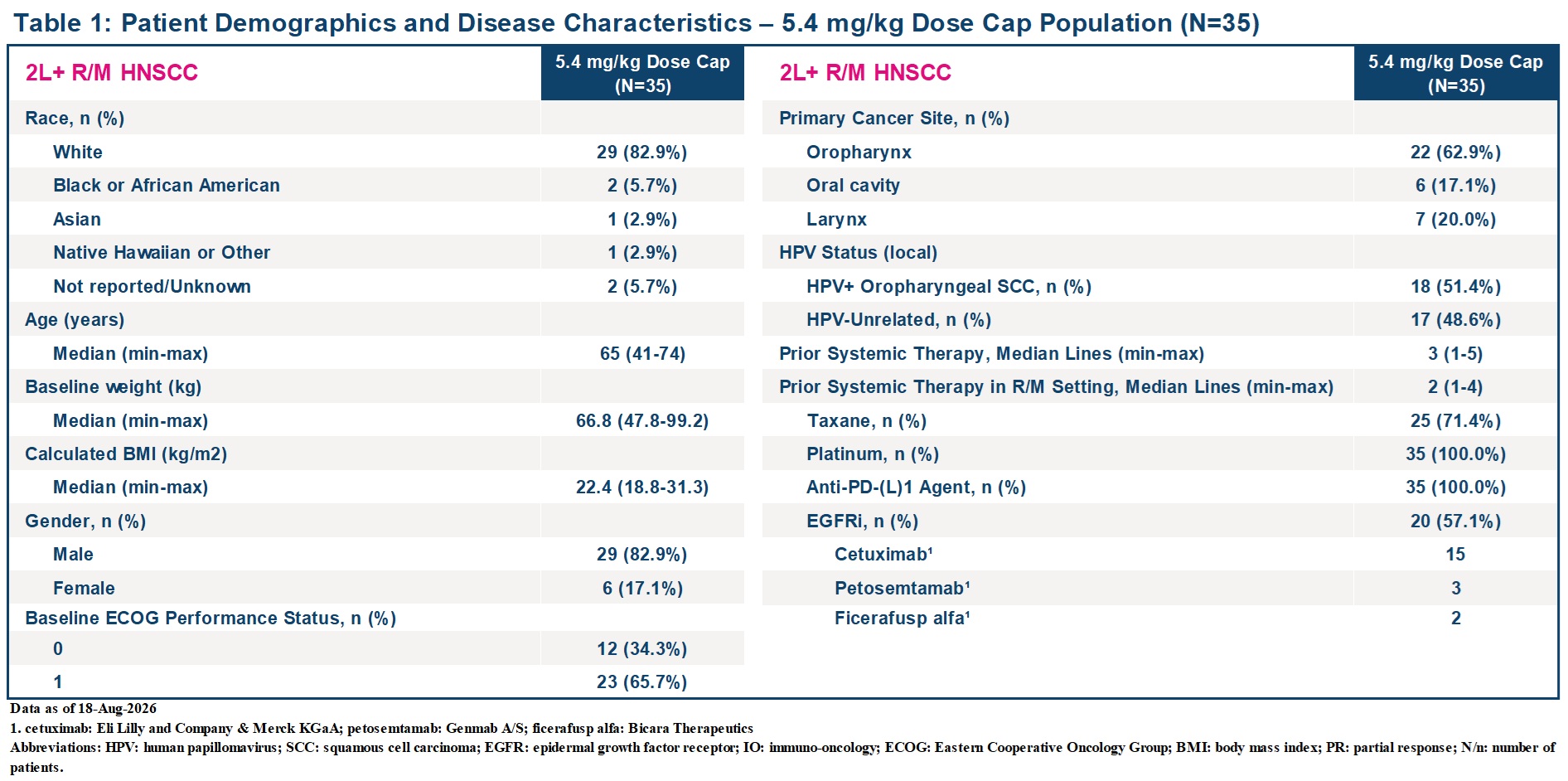
Efficacy Data
Among the 33 efficacy evaluable patients, the confirmed ORR per RECIST v1.1 was 36% (12/33) and the DCR was 94% (31/33). Responses were rapid and deep: 75% of responders achieved a response by the first scan at six weeks, and 83% of responders achieved a greater than 50% reduction in tumor burden from baseline. Median progression-free survival (PFS) was 6.2 months (95% confidence interval (CI): 4.8 to 8.8 months), the 12-month overall survival (OS) probability was 79% (95% CI: 58.1% to 90.3%), and median OS had not been reached as of the data cut-off. A summary of the efficacy data is provided in Table 2 below.
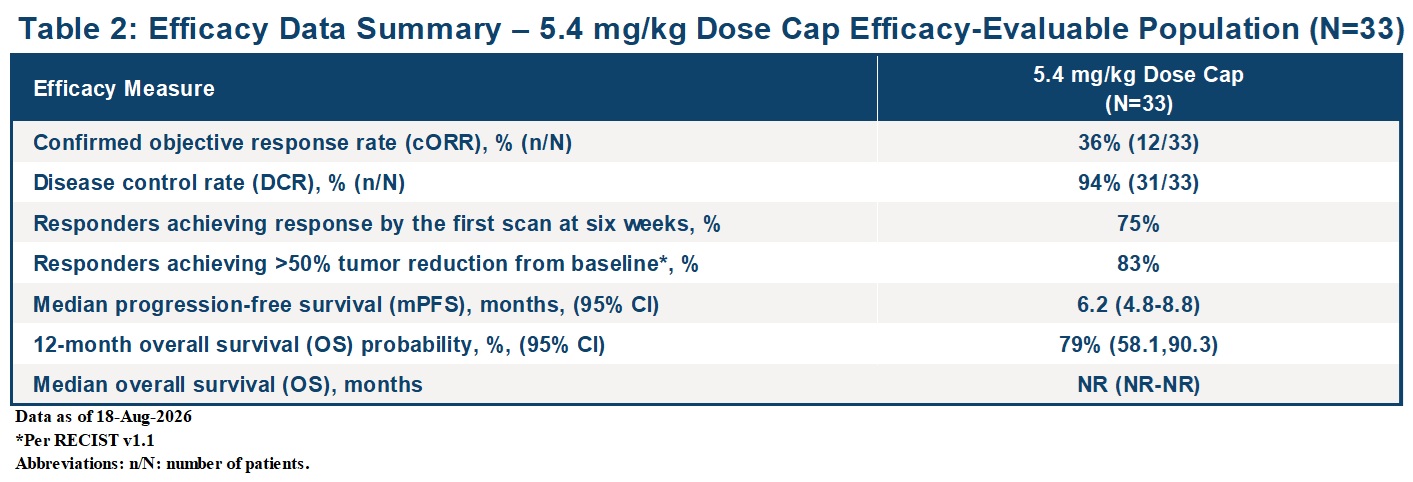
Clinical activity was observed across key patient subgroups, with a confirmed ORR of 35% in patients with HPV-positive oropharyngeal disease (n=17) and 38% in patients with HPV-unrelated disease (n=16); 28% in patients who had received a prior EGFR inhibitor (n=18), including 40% in the subset previously treated with a novel EGFR-targeting agent (n=5), and 47% in patients who had not received a prior EGFR inhibitor (n=15); and 35% in patients who had received a prior taxane (n=23) and 40% in those who had not (n=10). Efficacy data by patient subgroup are provided in Table 3 below.
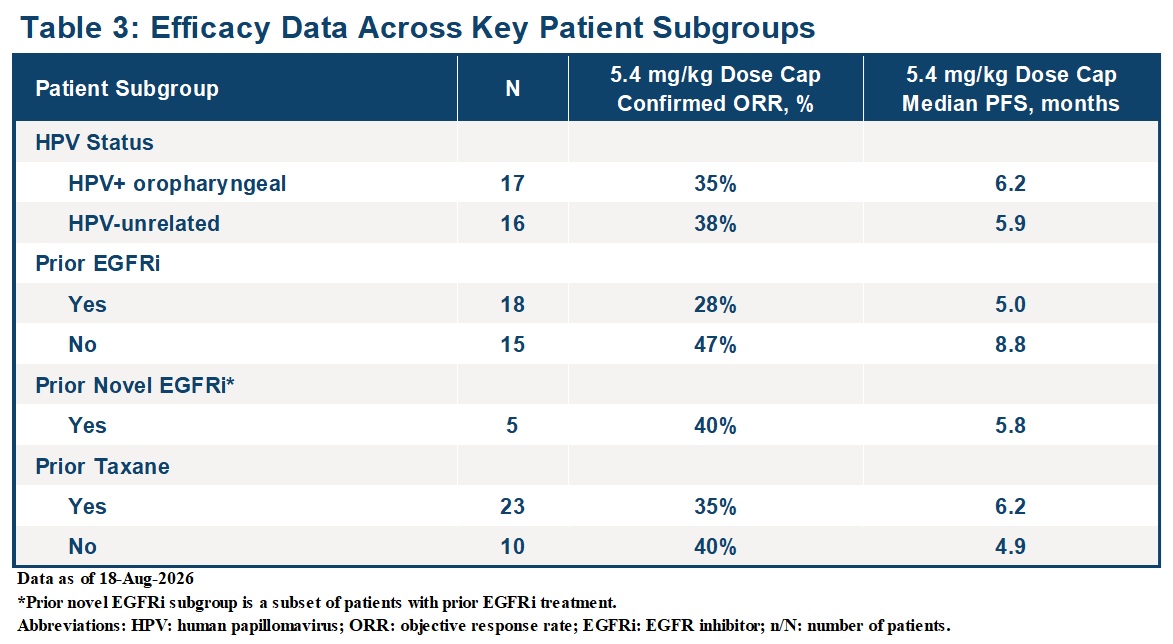
Safety Data
No new safety signals were observed, and the tolerability profile was consistent with that of other ADCs with auristatin payloads and was generally manageable. The median duration of treatment was 120 days (range 21 to 470 days). TRAEs of any grade were reported in 91% (32/35) of patients, Grade ≥3 TRAEs in 54% (19/35), non-hematologic CTCAE Grade ≥3 TRAEs in 43% (15/35) and serious TRAEs in 14% (5/35). TRAEs led to dose reduction in 40% (14/35) of patients and to treatment discontinuation in 14% (5/35) of patients (three due to peripheral neuropathy, one due to an ocular event and one due to muscle weakness), with discontinuations occurring at a median of 162 days after the start of treatment (min – max, 104-212). There were no treatment-related deaths. ADC payload TRAEs of interest were predominantly Grade 1/2 and Grade 3 events, respectively: cutaneous 49% (17/35) and 6% (2/35), peripheral neuropathy 40% (14/35) and 17% (6/35), ocular events in 29% (10/35) and 6% (2/35) and pneumonitis in 11% (4/35) and 0%. Adverse events of interest, including peripheral neuropathy, generally occurred after patients had experienced evidence of benefit and after prolonged duration of treatment, with a median time to onset of 82 days (range 3 to 157) for Grade 1 or 2 peripheral neuropathy and 166 days (range 85 to 197) for Grade 3 peripheral neuropathy. The data indicated that dose capping reduced the frequency and severity of adverse events in high body weight patients, which we believe validates our dose capping strategy of maintaining clinical activity while mitigating the risk of safety events. Table 4 below summarizes key TRAEs observed as of the August 18, 2026 data cut-off date.
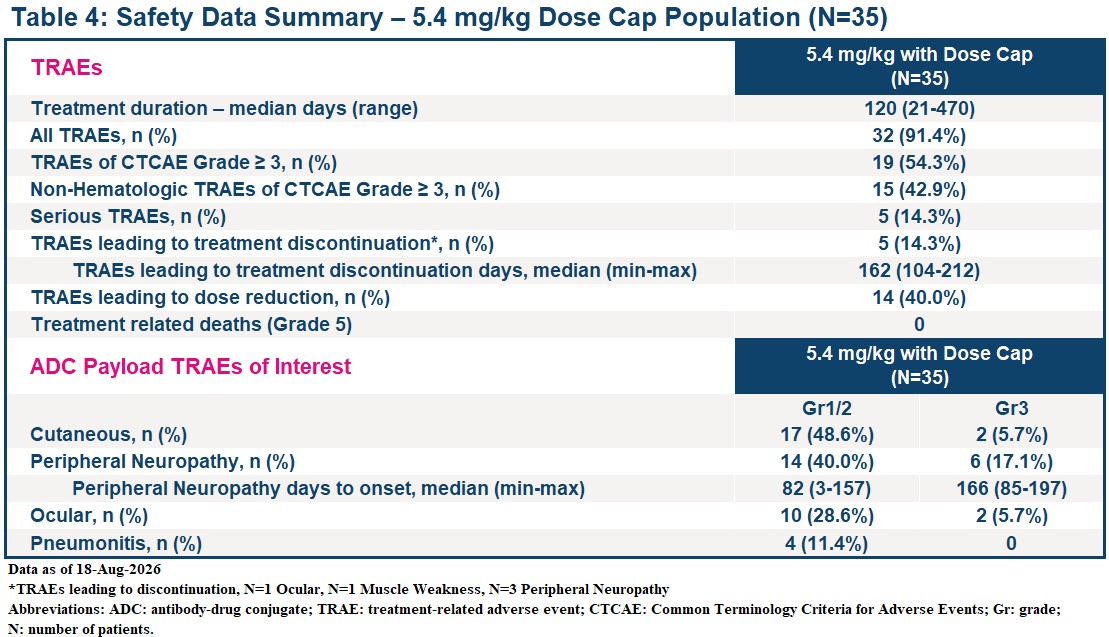
MICVO Combination Therapy
In November 2024, we announced a Clinical Trial Collaboration and Supply Agreement with Merck & Co., Inc. or Merck (known as MSD outside of the United States and Canada), for a Pyxis Oncology-sponsored study of MICVO in combination with Merck’s anti-PD-1 therapy, KEYTRUDA® (pembrolizumab). In January 2025, we initiated the Phase 1/2 combination study with KEYTRUDA® (pembrolizumab), PYX-201-102, and are actively enrolling and dosing patients in this study. PYX-201-102 is a Phase 1/2 open-label, global, multicenter dose escalation and dose expansion study designed to evaluate the safety, tolerability, pharmacokinetics (PK), pharmacodynamics (PD) and preliminary efficacy of MICVO in combination with pembrolizumab in patients with advanced solid tumors. Patients with histologically or cytologically confirmed advanced solid tumors, including 1L R/M HNSCC, 2L+ R/M HNSCC, cervical cancer, gastric cancer, HR+/HER2- breast cancer, and locally advanced or metastatic triple-negative breast cancer (TNBC), are eligible to enroll.
PYX-201-102 Phase 1/2 Preliminary Combination Data in R/M HNSCC
In December 2025, we reported positive preliminary data from this study, evaluating MICVO at 3.6 mg/kg and 4.4 mg/kg IV Q3W, each administered in combination with a fixed 200 mg dose of pembrolizumab Q3W, in patients with 1L/2L+ R/M HNSCC. As of the data cut-off date of November 3, 2025, seven patients had been treated, including four patients at 3.6 mg/kg and three patients at 4.4 mg/kg of MICVO, each in combination with pembrolizumab. All treated patients had received prior systemic therapy, including four patients with 1L R/M HNSCC (median of one prior systemic therapy administered in the neoadjuvant or adjuvant setting) and three patients with 2L+ R/M HNSCC (median of three prior lines of therapy, some of which were administered prior to the R/M setting). Among the seven efficacy-evaluable patients, the confirmed ORR was 71% (5/7, one patient confirmed response after November 3, 2025 data cut-off) and the DCR was 100% (7/7), with all seven patients demonstrating meaningful tumor regression. Responses were observed across a range of PD-L1 combined positive scores (CPS), from CPS≥1 to CPS>20, and included responses in patients who had previously received checkpoint inhibitor treatment and had experienced disease progression while receiving checkpoint inhibitor treatment. Preliminary safety data indicated that MICVO in combination with pembrolizumab was generally well tolerated, with no Grade 3 or Grade 4 ADC payload TRAEs of interest and no Grade 5 events reported. TRAEs were reported in 86% (6/7) of patients. No TRAEs led to treatment discontinuation, and, as of the data cut-off date, no overlapping toxicities between MICVO and pembrolizumab (KEYTRUDA®) had been observed.
Our Clinical Pipeline
The following table summarizes our clinical pipeline
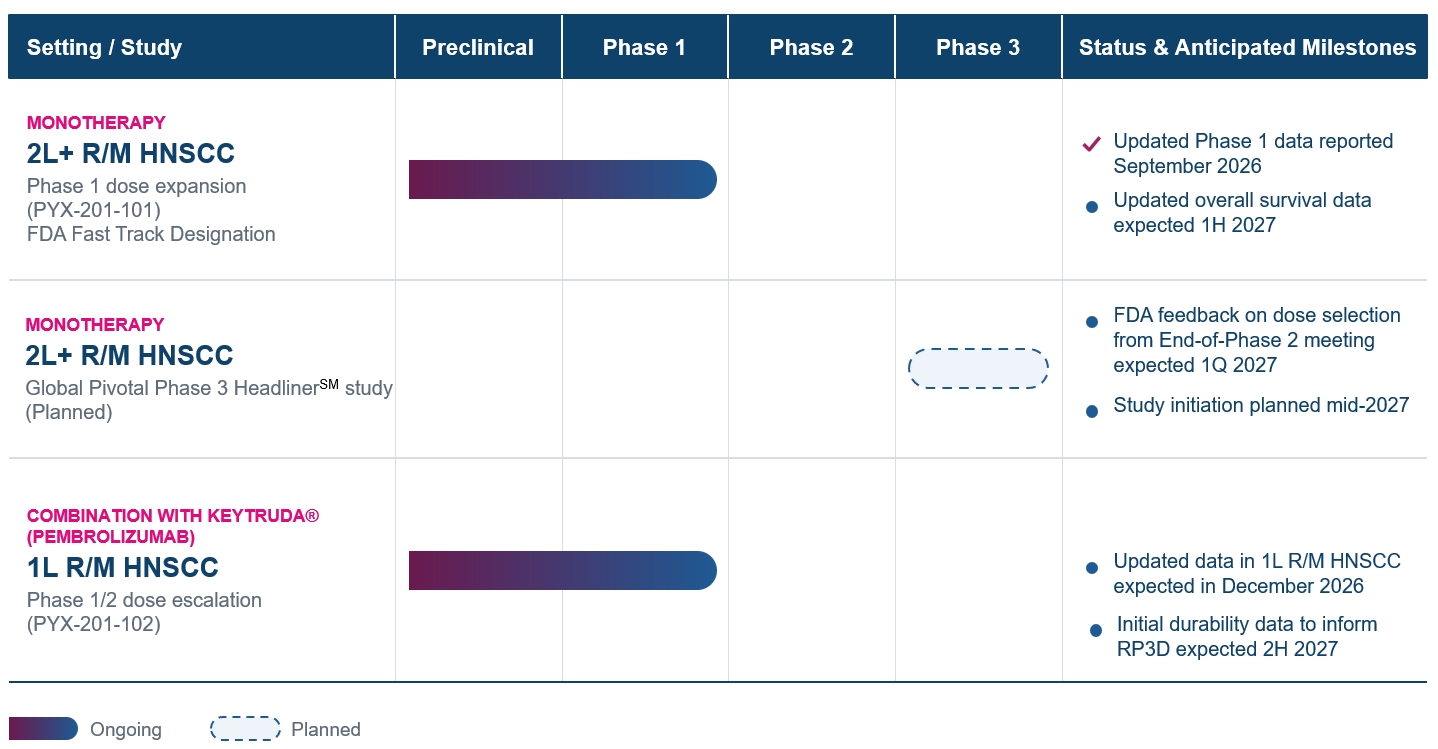
MICVO Monotherapy Next Stage of Development
In September 2026, we reported updated clinical data from both cohorts for patients treated with MICVO at 5.4 mg/kg IV Q3W with a dose equivalent to or below a dose cap (see “Updated Phase 1 Monotherapy Data in 2L+ R/M HNSCC (September 2026)” above). We expect to report updated OS data from this study in the first half of 2027.
In November 2026, data from our Phase 1 monotherapy study in previously treated R/M HNSCC are expected to be presented in a late-breaking oral presentation at the 38th EORTC-NCI-AACR Symposium on Molecular Targets and Cancer Therapeutics, where we also expect to present preclinical findings in two poster presentations further characterizing MICVO’s extracellular mechanism of action and evaluating MICVO in combination with EGFR-targeted therapy.
Dose capping and AIBW are both well-established approaches to modified weight-based dosing and have demonstrated improved tolerability without sacrificing clinical activity in studies of other ADCs. In December 2025, we implemented a dose cap for higher body weight patients. Based on internal PK simulation modeling indicating that MICVO exposure with dose capping and AIBW dosing are comparable, dose capping was prioritized for its operational simplicity and ease of implementation. A protocol amendment permitting AIBW dosing has since been approved, and AIBW dosing has begun in ongoing clinical studies. AIBW will be selected as a go-forward dose strategy only if it offers a superior profile to dose capping.
We have aligned with feedback from the U.S. Food and Drug Administration (FDA) and the European Medicines Agency (EMA) on the design of HeadlinerSM, our planned global pivotal Phase 3 monotherapy trial of MICVO in patients with 2L+ R/M HNSCC whose disease has progressed following treatment with both platinum-based chemotherapy and an anti-PD-1 therapy. The randomized, open-label, two-arm trial is expected to enroll approximately 500 patients, randomized 1:1 to MICVO or investigator’s choice of cetuximab, docetaxel or methotrexate, with co-primary endpoints of overall response rate and overall survival. We are advancing the clinical development of MICVO through Project Optimus, the FDA’s initiative focused on dose optimization and dose selection in oncology drug development, and in February 2025 the FDA granted Fast Track Designation for MICVO for the treatment of adult patients with R/M HNSCC whose disease has progressed following treatment with platinum-based chemotherapy and an anti-PD-(L)1 therapy. We expect to receive FDA feedback on dose selection from our End-of-Phase 2 meeting in the first quarter of 2027, and plan to initiate our global pivotal Phase 3 trial, HeadlinerSM, in mid-2027 following alignment with the FDA on dose selection.
MICVO Combination Therapy Pipeline
Our Phase 1/2 combination study with KEYTRUDA® (pembrolizumab) (PYX-201-102) is ongoing and we are conducting the dose escalation phase of PYX-201-102 across multiple tumor types with the objective of identifying the Recommended Phase 2 Dose (RP2D) of MICVO in combination with pembrolizumab. We are currently enrolling and dosing patients across several dose levels between 3.6 mg/kg and 5.4 mg/kg of MICVO, in combination with pembrolizumab at the fixed dose of 200 mg IV Q3W, in order to accurately characterize the RP2D for MICVO in combination with pembrolizumab, subject to ongoing safety review, enrollment progress, and clinical data evaluation.
We plan to provide a corporate update in December 2026 that we expect will outline a comprehensive development strategy for MICVO in R/M HNSCC, including how emerging combination data inform potential opportunities across treatment settings, and will include updated efficacy and safety data from the ongoing PYX-201-102 Phase 1/2 dose escalation study evaluating MICVO in combination with KEYTRUDA® (pembrolizumab) across multiple doses in 1L R/M HNSCC. The update is expected to include data from a total of at least 20 patients with 1L R/M HNSCC treated with MICVO at the 3.6 mg/kg and 4.4 mg/kg dose levels in combination with a fixed dose of 200 mg of pembrolizumab. We expect to report additional data evaluating initial durability and supporting selection of the recommended Phase 3 dose for the 1L combination in the second half of 2027.
Since our inception, we have focused substantially all of our resources on conducting research and development activities, undertaking preclinical studies and clinical trials, organizing and staffing our company, business planning, raising capital, establishing and maintaining our intellectual property portfolio and identifying potential product candidates. We do not have any products approved for sale and have not generated any revenue from product sales. We have incurred significant operating losses since our inception. We reported net losses of $68.6 million and $61.5 million for the nine months ended September 30, 2026 and 2025, respectively. As of September 30, 2026, we had an accumulated deficit of $511.8 million, net equity of $41.3 million, and cash, cash equivalents and marketable debt securities of $55.6 million. On October 1, 2026, we closed an underwritten public offering of common stock, pre-funded warrants and accompanying common warrants and received upfront gross proceeds of approximately $110.0 million, before deducting underwriting discounts and commissions and other offering expenses. We expect that our existing cash, cash equivalents and marketable debt securities, together with the net upfront proceeds from the public offering, will be sufficient to fund our operating expenses and capital expenditure requirements into the first half of 2028. We expect to continue to incur significant expenses and operating losses for the foreseeable future. We expect that our operating expenses and capital expenditures will increase substantially in connection with our ongoing activities. Our operations to date have been financed primarily through the sale of equity securities and additional funding will be necessary to fund future clinical and preclinical activities.
Components of Our Results of Operations
Revenues
To date, we have not generated any revenues from product sales and do not expect to generate any revenues from product sales in the foreseeable future. We record revenues from research and development agreements, including amounts related to upfront receipt for license fees, royalties, milestones and other contingent receipts and fees for research and development services.
Our ability to generate product revenues will depend upon our ability to successfully develop, obtain regulatory approval and commercialize our product candidate. Due to the numerous risks and uncertainties associated with product development and regulatory approval, we are unable to predict the amount, timing or whether we will be able to obtain product revenues.
Operating Expenses
Research and Development Expenses
Research and development expenses consist of costs incurred for our research activities, including our discovery efforts and research work to support clinical development, and the development of our programs. Research and development expenses are separated into program-specific costs and unallocated costs.
Program-specific costs include:
•direct third party costs, which include expenses incurred under agreements with contract research organizations (CROs), and the cost of consultants who assist with the development of our product candidate on a program-specific basis, investigator grants, sponsored research, and any other third party expenses directly attributable to the development of the product candidates;
•costs of acquiring, developing, manufacturing and testing clinical and preclinical materials, including costs incurred under agreements with contract development and manufacturing organizations (CDMOs) to the extent they can be allocated to a specific program;
•license fees and milestone payments related to the acquisition and retention of certain licensed technology and intellectual property rights for a specific product candidate; and
•costs associated with preclinical and clinical activities that are directly attributable to the development of the product candidates.
Unallocated costs include:
•employee-related expenses for research and development personnel, including salaries, bonus, payroll taxes, related benefits, severance and other staff-related expenses;
•stock-based compensation expenses for employees engaged in research and development activities;
•facilities and other costs, which include allocated expenses for rent and maintenance of facilities, depreciation of leasehold improvements and equipment, laboratory supplies, third party cost for discovery research and the cost of consultants who assist with our research and development and costs related to contract manufacturing, but are not allocated to a specific program.
We expense research and development costs as incurred. Non-refundable advance payments that we make for goods or services to be received in the future for use in research and development activities are recorded as prepaid expenses. The prepaid amounts are expensed as the related goods are delivered or the services are performed, or when it is no longer expected that the goods will be delivered, or the services rendered.
We expect that our research and development expenses will increase substantially in connection with our ongoing and planned preclinical and clinical development activities related to our product candidate in the near term and in the future. The successful development of our product candidate is highly uncertain. At this time, we cannot accurately estimate or know the nature, timing and costs of the efforts that will be necessary to complete the preclinical and clinical development of our product candidate and we may never succeed in obtaining regulatory approval for our product candidate.
General and Administrative Expenses
General and administrative expenses consist primarily of salaries and personnel-related costs, including stock-based compensation, and severance for our personnel in executive, legal, finance and accounting, human resources and other administrative functions. General and administrative expenses also include professional fees for auditing, tax, and legal services, as well as insurance, board of director compensation, consulting, other administrative expenses and facility costs not otherwise included in research and development expenses.
Other Income, Net
Other income, net primarily consists of interest earned on our invested cash and cash equivalent balances, accretion of discounts associated with our marketable debt securities and sublease income under our former sublease, which ended in May 2026.
Results of Operations
Comparison of the Three Months Ended September 30, 2026 and 2025
The following table summarizes our results of operations for the three months ended September 30, 2026 and 2025 (in thousands):
|
|
|
|
|
|
|
|
|
|
|
|
|
Three Months Ended September 30, |
|
|
|
|
|
2026 |
|
|
2025 |
|
|
Change |
|
Operating expenses: |
|
|
|
|
|
|
|
|
Research and development |
$ |
16,556 |
|
|
$ |
17,808 |
|
|
$ |
(1,252 |
) |
General and administrative |
|
3,967 |
|
|
|
5,653 |
|
|
|
(1,686 |
) |
Total operating expenses |
|
20,523 |
|
|
|
23,461 |
|
|
|
(2,938 |
) |
Loss from operations |
|
(20,523 |
) |
|
|
(23,461 |
) |
|
|
2,938 |
|
Other income, net |
|
|
|
|
|
|
|
|
Interest and investment income, net |
|
539 |
|
|
|
774 |
|
|
|
(235 |
) |
Sublease income |
|
— |
|
|
|
684 |
|
|
|
(684 |
) |
Total other income, net |
|
539 |
|
|
|
1,458 |
|
|
|
(919 |
) |
Net loss |
$ |
(19,984 |
) |
|
$ |
(22,003 |
) |
|
$ |
2,019 |
|
Research and Development Expenses
The following table summarizes our research and development expenses for the three months ended September 30, 2026 and 2025 (in thousands):
|
|
|
|
|
|
|
|
|
|
|
|
|
Three Months Ended September 30, |
|
|
|
|
|
2026 |
|
|
2025 |
|
|
Change |
|
Program-specific costs: |
|
|
|
|
|
|
|
|
MICVO |
$ |
9,633 |
|
|
$ |
10,343 |
|
|
$ |
(710 |
) |
PYX-106 |
|
310 |
|
|
|
697 |
|
|
|
(387 |
) |
Other program costs |
|
111 |
|
|
|
269 |
|
|
|
(158 |
) |
Total program costs |
|
10,054 |
|
|
|
11,309 |
|
|
|
(1,255 |
) |
Unallocated costs: |
|
|
|
|
|
|
|
|
Personnel-related expenses including stock-based compensation |
|
4,231 |
|
|
|
4,436 |
|
|
|
(205 |
) |
Other costs |
|
2,271 |
|
|
|
2,063 |
|
|
|
208 |
|
Total research and development expenses |
$ |
16,556 |
|
|
$ |
17,808 |
|
|
$ |
(1,252 |
) |
Research and development expenses decreased by $1.3 million, from $17.8 million for the three months ended September 30, 2025 to $16.6 million for the three months ended September 30, 2026.
MICVO program-specific research and development costs decreased by $0.7 million, primarily due to a reduction of $3.6 million in manufacturing costs, partially offset by a $3.0 million increase in clinical trial-related expenses due to an increased number of patients dosed in the MICVO monotherapy and combination therapy trials.
PYX-106 program-specific research and development costs decreased by $0.4 million, reflecting lower program-related expenses following the pause in clinical development of PYX-106-101 in December 2024 and the termination of our license agreement with Biosion USA, Inc., effective August 2026.
Unallocated research and development costs remained flat year over year.
General and Administrative Expenses
The following table summarizes our general and administrative expenses for the three months ended September 30, 2026 and 2025 (in thousands):
|
|
|
|
|
|
|
|
|
|
|
|
|
Three Months Ended September 30, |
|
|
|
|
|
2026 |
|
|
2025 |
|
|
Change |
|
Personnel-related expenses including stock-based compensation |
$ |
2,499 |
|
|
$ |
3,894 |
|
|
$ |
(1,395 |
) |
Professional and consultant fees |
|
639 |
|
|
|
713 |
|
|
|
(74 |
) |
Facilities, insurance and other costs |
|
829 |
|
|
|
1,046 |
|
|
|
(217 |
) |
Total general and administrative expenses |
$ |
3,967 |
|
|
$ |
5,653 |
|
|
$ |
(1,686 |
) |
General and administrative expenses decreased by $1.7 million, from $5.7 million for the three months ended September 30, 2025 to $4.0 million for the three months ended September 30, 2026. This decrease was primarily attributable to lower stock-based compensation expense of $1.4 million.
Other Income, Net
Other income, net for the three months ended September 30, 2026 and 2025 was $0.5 million and $1.5 million, respectively. The decrease of $0.9 million was due to lower interest and investment income and the absence of sublease income following the end of the sublease term in May 2026.
Comparison of the Nine Months Ended September 30, 2026 and 2025
The following table summarizes our results of operations for the nine months ended September 30, 2026 and 2025 (in thousands):
|
|
|
|
|
|
|
|
|
|
|
|
|
Nine Months Ended September 30, |
|
|
|
|
|
2026 |
|
|
2025 |
|
|
Change |
|
Milestone revenue |
$ |
— |
|
|
$ |
2,820 |
|
|
$ |
(2,820 |
) |
Operating expenses: |
|
|
|
|
|
|
|
|
Research and development |
|
52,596 |
|
|
|
51,985 |
|
|
|
611 |
|
General and administrative |
|
18,277 |
|
|
|
16,960 |
|
|
|
1,317 |
|
Total operating expenses |
|
70,873 |
|
|
|
68,945 |
|
|
|
1,928 |
|
Loss from operations |
|
(70,873 |
) |
|
|
(66,125 |
) |
|
|
(4,748 |
) |
Other income, net |
|
|
|
|
|
|
|
|
Interest and investment income, net |
|
1,251 |
|
|
|
3,010 |
|
|
|
(1,759 |
) |
Sublease income |
|
1,020 |
|
|
|
1,883 |
|
|
|
(863 |
) |
Total other income, net |
|
2,271 |
|
|
|
4,893 |
|
|
|
(2,622 |
) |
Loss before income taxes |
|
(68,602 |
) |
|
|
(61,232 |
) |
|
|
(7,370 |
) |
Income tax expense |
|
— |
|
|
|
283 |
|
|
|
(283 |
) |
Net loss |
$ |
(68,602 |
) |
|
$ |
(61,515 |
) |
|
$ |
(7,087 |
) |
Milestone Revenue
We recognized no revenue for the nine months ended September 30, 2026, compared to $2.8 million for the nine months ended September 30, 2025. The prior-year revenue related to a regulatory milestone achieved under the Simcere out-licensing and collaboration agreement.
Research and Development Expenses
The following table summarizes our research and development expenses for the nine months ended September 30, 2026 and 2025 (in thousands):
|
|
|
|
|
|
|
|
|
|
|
|
|
Nine Months Ended September 30, |
|
|
|
|
|
2026 |
|
|
2025 |
|
|
Change |
|
Program-specific costs: |
|
|
|
|
|
|
|
|
MICVO |
$ |
31,772 |
|
|
$ |
27,114 |
|
|
$ |
4,658 |
|
PYX-106 |
|
1,148 |
|
|
|
2,221 |
|
|
|
(1,073 |
) |
Other program costs |
|
573 |
|
|
|
1,086 |
|
|
|
(513 |
) |
Total program costs |
|
33,493 |
|
|
|
30,421 |
|
|
|
3,072 |
|
Unallocated costs: |
|
|
|
|
|
|
|
|
Personnel-related expenses including stock-based compensation |
|
13,568 |
|
|
|
14,356 |
|
|
|
(788 |
) |
Other costs |
|
5,535 |
|
|
|
7,208 |
|
|
|
(1,673 |
) |
Total research and development expenses |
$ |
52,596 |
|
|
$ |
51,985 |
|
|
$ |
611 |
|
Research and Development Expenses
Research and development expenses increased by $0.6 million, from $52.0 million for the nine months ended September 30, 2025 to $52.6 million for the nine months ended September 30, 2026.
MICVO program-specific research and development costs increased by $4.7 million, primarily due to a $10.8 million increase in clinical trial-related expenses due to an increased number of patients dosed in the MICVO monotherapy and combination therapy trials, as well as a $2.1 million increase in research and preclinical studies, partially offset by a reduction in manufacturing expense of $7.9 million.
PYX-106 program-specific research and development costs decreased by $1.1 million, reflecting lower program-related expenses following the pause in clinical development of PYX-106-101 in December 2024 and the termination of our license agreement with Biosion USA, Inc., effective August 2026.
Unallocated research and development costs decreased by $2.5 million primarily due to decreased stock-based compensation expense of $1.2 million, decreased employee recruitment costs of $0.7 million and lower depreciation and amortization expense of $0.5 million.
General and Administrative Expenses
The following table summarizes our general and administrative expenses for the nine months ended September 30, 2026 and 2025 (in thousands):
|
|
|
|
|
|
|
|
|
|
|
|
|
Nine Months Ended September 30, |
|
|
|
|
|
2026 |
|
|
2025 |
|
|
Change |
|
Personnel-related expenses including stock-based compensation |
$ |
12,607 |
|
|
$ |
11,400 |
|
|
$ |
1,207 |
|
Professional and consultant fees |
|
2,667 |
|
|
|
2,390 |
|
|
|
277 |
|
Facilities, insurance and other costs |
|
3,003 |
|
|
|
3,170 |
|
|
|
(167 |
) |
Total general and administrative expenses |
$ |
18,277 |
|
|
$ |
16,960 |
|
|
$ |
1,317 |
|
General and administrative expenses increased by $1.3 million, from $17.0 million for the nine months ended September 30, 2025 to $18.3 million for the nine months ended September 30, 2026. This increase was primarily attributable to a $1.2 million increase in personnel-related expenses, primarily due to an increase in severance costs of $0.7 million, and a $0.3 million increase in professional and consultant fees.
Other Income, Net
Other income, net for the nine months ended September 30, 2026 and 2025 was $2.3 million and $4.9 million, respectively. The decrease of $2.6 million was primarily due to lower interest and investment income and lower sublease income, following the end of the sublease term in May 2026.
Liquidity and Capital Resources
We had cash, cash equivalents and marketable debt securities of $55.6 million as of September 30, 2026. For the three months ended September 30, 2026 and 2025, we had net losses of $20.0 million and $22.0 million, respectively. For the nine months ended September 30, 2026 and 2025, we had net losses of $68.6 million and $61.5 million, respectively. As of September 30, 2026, we had an accumulated deficit of $511.8 million and net equity of $41.3 million.
On November 26, 2025, we filed a registration statement on Form S-3 with the SEC for the issuance of common stock, preferred stock, warrants, debt securities, rights and units with an aggregate offering price of up to $350.0 million. On December 9, 2025, the registration statement was declared effective by the SEC. The registration statement included an at-the-market (“ATM”) offering program for the sale of up to $150.0 million of shares of our common stock. During the nine months ended September 30, 2026, we did not sell any shares under the ATM program, and on September 29, 2026, we terminated the ATM program.
On July 2, 2026, we completed a private placement (the “Private Placement”) with certain institutional accredited investors (the “Purchasers”) and issued and sold to the Purchasers an aggregate of (i) 19,600,153 shares of common stock at a purchase price of $2.551 per share, and (ii) common warrants (the “July 2026 Warrants”) to purchase up to an equal number of shares of common stock at an exercise price of $3.289 per share. The July 2026 Warrants became exercisable on September 9, 2026, the date on which we first publicly disclosed clinical data from our MICVO Phase 1 monotherapy study in 2L+ R/M HNSCC, and will expire on July 2, 2029. We received gross proceeds from the Private Placement of approximately $50.0 million, before deducting placement agent fees and offering expenses, and net proceeds of $48.3 million after deducting such fees and expenses.
On October 1, 2026, we completed an underwritten public offering (the “Public Offering”) of (i) 36,047,919 shares of our common stock and (ii) pre-funded warrants to purchase 1,883,121 shares of our common stock, in each case together with accompanying common warrants to purchase an aggregate of 49,310,352 shares of common stock (the “October 2026 Warrants”). The combined public offering price was $2.90 per share of common stock and accompanying October 2026 Warrants and $2.899 per pre-funded warrant and accompanying October 2026 Warrants. The pre-funded warrants have an exercise price of $0.001 per share. The October 2026 Warrants have an exercise price of $3.50 per share, will become exercisable only following stockholder approval of, and the effectiveness of, an amendment to our certificate of incorporation to increase the number of authorized shares of common stock, and will expire on the earlier of (i) the fifth anniversary of the effective date of such amendment and (ii) the 30th calendar day following the later of such effective date and the public release of overall survival data from our MICVO Phase 1 monotherapy study in second line and beyond recurrent / metastatic HNSCC. We do not currently have sufficient authorized shares of common stock to permit the exercise of the October 2026 Warrants. On October 21, 2026, we filed a definitive proxy statement for a special meeting of stockholders to be held on November 13, 2026, at which stockholders will vote on an amendment to increase the number of authorized shares of common stock from 190,000,000 to 380,000,000.
We received gross proceeds of approximately $110.0 million, before deducting underwriting discounts and commissions and offering expenses. These amounts exclude any proceeds we may receive from the October 2026 Warrants or the pre-funded warrants. We may receive up to approximately $172.6 million of additional gross proceeds if all of the October 2026 Warrants and pre-funded warrants are exercised in full for cash. See Note 14, Subsequent Events, to our unaudited condensed consolidated financial statements included in Part I, Item 1 of this Quarterly Report on Form 10-Q.
We expect our expenses to increase substantially in connection with our ongoing activities, particularly as we advance further clinical trials for MICVO. The timing and amount of our funding requirements will depend on many factors, including:
•the cost associated with ongoing monotherapy and combination therapy clinical trials for MICVO;
•the cost associated with our planned Phase 3 HeadlinerSM trial;
•the manufacture of drug products and drug substance for MICVO;
•the timing and progress of our other preclinical and clinical development activities;
•the progress of the development efforts of parties with whom we have entered, or may in the future enter into, in-licensing, collaborations and research and development agreements;
•the costs and timing of future commercialization activities, including product manufacturing, marketing, sales and distribution, for our product candidate for which we receive marketing licensure;
•our ability to maintain our current licenses and research and development programs and to establish new collaboration arrangements;
•the costs involved in prosecuting, maintaining and enforcing patent and other intellectual property rights;
•the cost and timing of regulatory licenses; and
•insurance, legal and other regulatory compliance expenses to operate as a public company.
Until such time, if ever, we can generate substantial product revenues, we expect to continue to finance our operations through a combination of equity offerings, debt financings, collaborations, strategic alliances and marketing, distribution or licensing arrangements. To the extent that we raise additional capital through the sale of equity or convertible debt securities, your ownership interest will be diluted, and the terms of these securities may include liquidation or other preferences that adversely affect your rights as a common stockholder. Debt financing and preferred equity financing, if available, may involve agreements that include covenants limiting or restricting our ability to take specific actions, such as incurring additional debt, making acquisitions, engaging in acquisition, merger or collaboration transactions, selling or licensing our assets, making capital expenditures, redeeming our stock, making certain investments or declaring dividends.
If we raise additional funds through collaborations, strategic alliances or marketing, distribution or licensing arrangements with third parties, we may have to relinquish valuable rights to our technologies, future revenue streams, research programs or product candidate, or grant licenses on terms that may not be favorable to us. If we are unable to raise additional funds through equity or debt financings when needed, we may be required to delay, limit, reduce or terminate our product development or future commercialization efforts or grant rights to develop and market our product candidate that we would otherwise prefer to develop and market ourselves.
Cash Flows
The following table provides information regarding our cash flows for the periods presented (in thousands):
|
|
|
|
|
|
|
|
|
Nine Months Ended September 30, |
|
|
2026 |
|
|
2025 |
|
Net cash used in operating activities |
$ |
(60,500 |
) |
|
$ |
(53,075 |
) |
Net cash provided by investing activities |
|
380 |
|
|
|
42,596 |
|
Net cash provided by (used in) financing activities |
|
48,554 |
|
|
|
(75 |
) |
Net decrease in cash, cash equivalents and restricted cash |
$ |
(11,566 |
) |
|
$ |
(10,554 |
) |
Operating Activities
During the nine months ended September 30, 2026, net cash used in operating activities was $60.5 million, which consisted of our net loss of $68.6 million and a net change in our operating assets and liabilities of $1.0 million, partially offset by non-cash charges of $9.1 million. The non-cash charges of $9.1 million were primarily due to $8.1 million of stock-based compensation, $1.1 million of depreciation and amortization expense and $0.7 million of non-cash operating lease expense, partially offset by $0.8 million related to accretion of discounts on marketable debt securities. The net change in our operating assets and liabilities was primarily due to a decrease in accounts payable of $2.8 million related to the timing of vendor payments, and a reduction in operating lease liabilities of $1.3 million, partially offset by a decrease in prepaid expenses and other current assets of $1.7 million and an increase in accrued expenses and other current liabilities of $1.4 million.
During the nine months ended September 30, 2025, net cash used in operating activities was $53.1 million, which consisted of our net loss of $61.5 million and a net change in our operating assets and liabilities of $0.9 million, partially offset by non-cash charges of $9.4 million. The non-cash charges of $9.4 million were primarily due to $9.7 million of stock-based compensation, $1.6 million of depreciation and amortization expense and $0.6 million of non-cash operating lease expense, offset by $2.6 million related to accretion of discounts on marketable debt securities. The net change in our operating assets and liabilities was primarily due to a decrease in accrued expenses and other current liabilities of $3.4 million, an increase in prepaid expenses and other current assets of $1.3 million and a reduction in operating lease liabilities of $1.1 million, partially offset by an increase in accounts payable of $4.9 million, primarily related to the timing of vendor payments and services performed related to our ongoing clinical trials.
Investing Activities
During the nine months ended September 30, 2026, net cash provided by investing activities was $0.4 million, which consisted of redemptions of marketable debt securities of $63.7 million, partially offset by purchases of marketable debt securities of $63.4 million.
During the nine months ended September 30, 2025, net cash provided by investing activities was $42.6 million, which consisted of redemptions of marketable debt securities of $149.6 million, partially offset by purchases of marketable debt securities of $107.0 million.
Financing Activities
During the nine months ended September 30, 2026, net cash provided by financing activities was $48.6 million, which consisted primarily of net proceeds from the Private Placement of $48.3 million and proceeds from the exercise of stock options of $0.3 million, partially offset by tax withholding payments related to net settlement of restricted common stock of $0.1 million.
During the nine months ended September 30, 2025, net cash used in financing activities was $0.1 million, which consisted primarily of tax withholding payments related to the net settlement of restricted common stock.
Outlook
As of September 30, 2026, we had approximately $57.0 million in cash, cash equivalents, restricted cash and marketable debt securities. Additionally, on October 1, 2026, we completed the Public Offering which resulted in gross proceeds of approximately $110.0 million, before deducting underwriting discounts and commissions and offering expenses, and we may receive up to approximately $172.6 million of additional gross proceeds if all of the October 2026 Warrants and pre-funded warrants are exercised in full for cash. Our cash, cash equivalents, restricted cash and marketable debt securities as of September 30, 2026, together with the net proceeds from the Public Offering, will be sufficient to fund our operating expenses and capital expenditure requirements into the first half of 2028. However, we have based this estimate on assumptions that may prove to be incorrect, and our operating plan may change as a result of many factors currently unknown to us. In addition, we may utilize our available capital resources sooner than we expect.
If the October 2026 Warrants are not exercised, these funds will not be sufficient to fully fund our planned global pivotal Phase 3 HeadlinerSM trial and we will need to raise additional capital to fund our operations beyond the first half of 2028 and to complete the development of MICVO, which we may seek through public or private equity or debt financings, collaboration agreements or a combination of these.
Contractual Obligations and Commitments
Operating lease obligation
We lease an office and laboratory space in Boston, Massachusetts with lease payments that continue through December 31, 2032, and have scheduled rent increases each year of 3%. The remaining contractual fixed lease payments over the term of the lease aggregate to $23.3 million. The operating lease obligation is discussed in Note 10, Operating Leases to our unaudited condensed consolidated financial statements included in Part I, Item 1 of this Quarterly Report on Form 10-Q for further information.
Other obligations
We enter into licensing and related agreements in the normal course of business. In accordance with these agreements, we are obligated to pay, among other items, future contingent payments, royalties, and sublicensing revenues in the future, as applicable. We have not included potential future payments due under these licensing and collaboration agreements in contractual obligations because the payment obligations under the agreements are contingent upon future events. Refer to Note 6, Licensing Agreements, to our unaudited condensed consolidated financial statements included in Part I, Item 1 of this Quarterly Report on Form 10-Q for further information.
In addition, we enter into contracts in the normal course of business with CDMOs, CROs, and other third parties for preclinical work and clinical development related work. These contracts do not contain minimum purchase commitments and are cancelable by us upon prior written notice. Payments due upon cancellation consist only of payments for services provided or expenses incurred, including non-cancelable obligations of our service providers, up to the date of cancellation. These payments are not included in the contractual obligations above as the amount and timing of such payments are not known.
Off-Balance Sheet Arrangements
We did not have during the periods presented, and we do not currently have, any off-balance sheet arrangements, as defined in the rules and regulations of the Securities and Exchange Commission.
Critical Accounting Policies and Significant Judgments and Estimates
Our unaudited condensed consolidated financial statements are prepared in accordance with generally accepted accounting principles in the United States. The preparation of our unaudited condensed consolidated financial statements and related disclosures requires us to make estimates and judgments that affect the reported amounts of assets, liabilities, costs and expenses, and the disclosure of contingent assets and liabilities in our unaudited condensed consolidated financial statements. We base our estimates on historical experience, known trends and events, and various other factors that we believe are reasonable under the circumstances, the results of which form the basis for making judgments about the carrying values of assets and liabilities that are not readily apparent from other sources. We evaluate our estimates and assumptions on an ongoing basis. Our actual results may differ from these estimates under different assumptions or conditions.
There have been no significant changes to our critical accounting policies and estimates as compared to those described in “Note 2 – Basis of Presentation and Summary of Significant Accounting Policies” to our audited consolidated financial statements set forth in our Fiscal 2025 10-K.
Recent Accounting Pronouncements
For information with respect to recently issued accounting standards and the impact of these standards on our unaudited condensed consolidated financial statements, refer to Note 2, Basis of Presentation and Summary of Significant Accounting Policies to our unaudited condensed consolidated financial statements included in Part I, Item 1 of this Quarterly Report on Form 10-Q.
Jumpstart Our Business Startups Act
We are an “emerging growth company,” as defined in the Jumpstart Our Business Startups Act of 2012, or the JOBS Act. We are also a “smaller reporting company,” meaning that the market value of our shares held by non-affiliates is less than $700 million and our annual revenues were less than $100 million during the most recently completed fiscal year. We may rely on exemptions from certain disclosure requirements that are available to smaller reporting companies. Specifically, as a smaller reporting company, we may choose to present only the two most recent fiscal years of audited financial statements in our Annual Report on Form 10-K and have reduced disclosure obligations regarding executive compensation, and, similar to emerging growth companies, if we are a smaller reporting company with less than $100 million in annual revenues, we would not be required to obtain an attestation report on internal control over financial reporting issued by our independent registered public accounting firm.
Item 3. Quantitative and Qualitative Disclosures About Market Risk
Under SEC rules and regulations, because we are considered to be a “smaller reporting company”, we are not required to provide the information required by this item in this report.
Item 4. Controls and Procedures
Evaluation of Disclosure Controls and Procedures
Our management, with the participation of our Principal Executive Officer and Principal Financial and Accounting Officer, has evaluated the effectiveness of our disclosure controls and procedures as of the end of the period covered by this Quarterly Report on Form 10-Q. The term “disclosure controls and procedures,” as defined in Rules 13a-15(e) and 15d-15(e) under the Securities Exchange Act of 1934, as amended, or the Exchange Act, means controls and other procedures of a company that are designed to ensure that information required to be disclosed by a company in the reports that it files or submits under the Exchange Act is recorded, processed, summarized, and reported within the time periods specified in the SEC’s rules and forms. Disclosure controls and procedures include, without limitation, controls and procedures designed to provide reasonable assurance that information required to be disclosed by a company in the reports that it files or submits under the Exchange Act is accumulated and communicated to the company’s management, including its principal executive and principal financial officers, or persons performing similar functions, as appropriate to allow timely decisions regarding required disclosure. Based on such evaluation, our Principal Executive Officer and Principal Financial and Accounting Officer concluded that, as of the end of the period covered by this Quarterly Report on Form 10-Q, our disclosure controls and procedures were effective at the reasonable assurance level.
Changes in Internal Control Over Financial Reporting
There were no changes in our internal control over financial reporting identified in connection with the evaluation required by paragraph (d) of Exchange Act Rules 13a-15 or 15d-15 that occurred during the period covered by this Quarterly Report on Form 10-Q that have materially affected, or are reasonably likely to materially affect, our internal control over financial reporting.
Inherent Limitations on Effectiveness of Controls and Procedures
Our management, including our Principal Executive Officer and Principal Financial and Accounting Officer, believes that our disclosure controls and procedures and internal control over financial reporting are designed to provide reasonable assurance of achieving their objectives
and are effective at the reasonable assurance level. However, management does not expect that our disclosure controls and procedures or our internal control over financial reporting will prevent or detect all errors and all fraud. A control system, no matter how well conceived and operated, can provide only reasonable, not absolute, assurance that the objectives of the control system are met. Because of the inherent limitations in all control systems, no evaluation of controls can provide absolute assurance that all control issues and instances of fraud, if any, within the company have been detected.
PART II—OTHER INFORMATION
Item 1. Legal Proceedings.
From time to time, we may become involved in various legal proceedings that arise in the ordinary course of our business. We are not currently a party to any material legal proceedings, and are not aware of any pending or threatened legal proceeding against us that we believe could have an adverse effect on our business, operating results or financial condition.
Item 1A. Risk Factors.
Our business involves a high degree of risk. You should consider and read carefully all of the risks and uncertainties described below, as well as other information included in this Form 10-Q, including our financial statements and related notes appearing in this Form 10-Q. The risks described below are not the only ones facing us. The occurrence of any of the following risks or additional risks and uncertainties not presently known to us or that we currently believe to be immaterial could materially and adversely affect our business, financial condition or results of operations. In such case, the trading price of our common stock could decline, and you may lose all or part of your investment. This Form 10-Q also contains forward-looking statements and estimates that involve risks and uncertainties. Our actual results could differ materially from those anticipated in the forward-looking statements as a result of specific factors, including the risks and uncertainties described below.
Risks Related to Our Financial Position and Need for Additional Capital
We are a clinical stage oncology company with a limited operating history and have incurred significant losses since our inception and anticipate that we will continue to incur losses over at least the next several years and may never achieve or maintain profitability.
Since our inception, we have incurred significant operating losses. We reported net losses of $68.6 million and $61.5 million for the nine months ended September 30, 2026 and 2025, respectively. As of September 30, 2026, we had an accumulated deficit of $511.8 million. To date, we have not generated any revenues from product sales and have financed our operations primarily through equity offerings. As such, we expect that it will be several years, if ever, before we have a product candidate ready for regulatory licensure and commercialization. We may never succeed in these activities and, even if we do, may never generate revenues that are significant enough to achieve profitability. To become and remain profitable, we must succeed in developing, obtaining marketing licensure for and commercializing products that generate significant revenue. This will require us to be successful in a range of challenging activities, including, without limitation, procuring clinical- and commercial-scale manufacturing, successfully completing preclinical studies and clinical trials of our product candidate, establishing arrangements with third parties for the conduct of our clinical trials, obtaining marketing licensure for our product candidate, manufacturing, marketing and selling any products for which we may obtain marketing licensure, discovering or obtaining rights to additional product candidates, identifying collaborators to develop product candidates we identify or additional uses of our existing product candidate and successfully completing development of our product candidate for our collaboration partners.
We expect to continue to incur significant expenses and increasing operating losses for at least the next several years. We anticipate that our expenses will increase substantially if and as we:
•continue to develop, conduct clinical trials and seek regulatory approvals for MICVO;
•scale up external manufacturing capabilities for later stage trials and to commercialize our products;
•expand, maintain and protect our intellectual property portfolio;
•ultimately establish a sales, marketing and distribution infrastructure for products which we may obtain marketing licensure;
•hire additional clinical, regulatory, scientific, operational, financial and management information personnel; and
•continue to operate as a public company.
Our expenses could increase beyond our expectations if we are required by the U.S. Food and Drug Administration (FDA), the European Medicines Agency (EMA) or other comparable regulatory authorities to perform trials in addition to those that we currently expect to perform, or if we experience any delays in establishing appropriate manufacturing arrangements for completing our clinical trials or the clinical development of our product candidate.
Because of the numerous risks and uncertainties associated with pharmaceutical product development, we are unable to accurately predict the timing or amount of increased expenses we will incur or when, if ever, we will be able to achieve profitability. Even if we do achieve profitability, we may not be able to sustain or increase profitability on a quarterly or annual basis. Our failure to become and remain profitable would depress the value of our company and could impair our ability to raise capital, expand our business, maintain our research and development efforts or continue operations. A decline in the value of our company, or in the value of our common stock, could also cause investors to lose all or part of their investment.
Even if we are able to generate revenues from the sale or out-licensing of any approved products, we may not become profitable and may need to obtain additional funding to continue operations.
We may need to raise substantial additional capital in the near term, which may result in dilution to our stockholders or impose additional restrictions on our operations.
Given our current cash position and ongoing clinical development expenses, we may seek additional financing through equity offerings, debt financings, collaborations or other strategic transactions. In addition, we completed a private placement financing in July 2026 and we recently completed the public offering financing subsequent to September 30, 2026, both of which include warrants, and we may seek additional financing in the future to support continued development of MICVO and our operations. Any such financing may result in significant dilution to existing stockholders, impose restrictive covenants, or require us to relinquish rights to our technologies or product candidates. In addition, adverse market conditions or volatility in the biotechnology sector may limit our ability to raise capital on acceptable terms, or at all.
We will require substantial additional capital to finance our operations. If we are unable to raise such capital when needed, or on acceptable terms, we may be forced to delay, reduce or eliminate one or more of our research and product development programs or future commercialization efforts. The warrants that we have issued may never be exercised and we may never receive additional funds from the warrants.
The development of biopharmaceutical products, including conducting preclinical studies and clinical trials, is a very time-consuming, expensive and uncertain process that takes years to complete. Our operations have consumed substantial amounts of cash since inception, and we expect our expenses to increase in connection with our ongoing and planned activities, particularly as we continue our clinical trials for MICVO. As of September 30, 2026, we had approximately $57.0 million in cash, cash equivalents, restricted cash and marketable debt securities. Additionally, on October 1, 2026, we completed the Public Offering, which resulted in gross proceeds of approximately $110.0 million, before deducting underwriting discounts and commissions and offering expenses, and we may receive up to approximately $172.6 million of additional gross proceeds if all of the October 2026 Warrants and pre-funded warrants are exercised in full for cash. Our cash, cash equivalents, restricted cash and marketable debt securities as of September 30, 2026, together with the net proceeds from the Public Offering, will be sufficient to fund our operating expenses and capital expenditure requirements into the first half of 2028. However, we have based this estimate on assumptions that may prove to be incorrect, and our operating plan may change as a result of many factors currently unknown to us. In addition, we may utilize our available capital resources sooner than we expect. If stockholder approval of the increase in our authorized shares of common stock is not obtained or the October 2026 Warrants issued in the Public Offering are otherwise not exercised for cash, these funds will not be sufficient to fully fund our planned Phase 3 HeadlinerSM trial and we will need to raise additional capital to fund our operations beyond the first half of 2028 and to complete the development of MICVO, which we may seek through public or private equity or debt financings, collaboration agreements or a combination of these.
Even if our product candidate is approved for commercial sale, we anticipate incurring significant costs associated with sales, marketing, manufacturing and distribution activities. Our expenses could increase beyond expectations if we are required by the FDA, the EMA or other comparable regulatory authorities to perform clinical trials or preclinical studies in addition to those that we currently anticipate. Other unanticipated costs may also arise. Because the design and outcome of our planned and anticipated clinical trials are highly uncertain, we cannot reasonably estimate the actual amount of resources and funding that will be necessary to successfully complete the development and commercialization of any product candidate we develop. Accordingly, we will need to obtain substantial additional funding in order to continue our operations.
Additionally, changing circumstances, some of which may be beyond our control, including market volatility resulting from global economic developments, political unrest, high inflation and other factors, could cause us to consume capital significantly faster than we currently anticipate, and we may need to seek additional funds sooner than planned.
We intend to use our cash and cash equivalents for development and regulatory activities relating to our product candidate, and other general corporate purposes. Advancing the development of our product candidate will require a significant amount of capital. Our cash and cash equivalents will not be sufficient to fund our product candidate through regulatory licensure. The timing and amount of our operating expenditures will depend largely on:
•the cost associated with our ongoing monotherapy and combination therapy clinical trials for our product candidate;
•the cost associated with our planned Phase 3 HeadlinerSM trial;
•the manufacture of drug products and drug substance for our product candidate;
•the timing and progress of our other preclinical and clinical development activities;
•the costs and timing of future commercialization activities, including product manufacturing, marketing, sales and distribution, for our product candidate for which we receive marketing licensure;
•our ability to maintain our current licenses and research and development programs and to establish new collaboration arrangements;
•the costs involved in prosecuting, maintaining, enforcing and expanding patent and other intellectual property rights;
•the cost and timing of regulatory licenses; and
•insurance, legal and other regulatory compliance expenses to operate as a public company.
If we are unable to obtain funding on a timely basis or on acceptable terms, we may not be able to continue as a going concern, we may have to delay, reduce or terminate our clinical trials, limit strategic opportunities or undergo reductions in our workforce or other corporate restructuring activities. We also could be required to seek funds through arrangements with collaborators or others that may require us to relinquish rights to some of our technologies or our product candidate that we would otherwise pursue on our own. We will be required to seek additional funding in the future and our ability to raise additional funds will depend on financial, economic and other factors, many of which are beyond our control. Additional funds may not be available to us on acceptable terms or at all. For example, market volatility resulting from global economic developments, political unrest, high inflation and other factors could adversely impact our ability to access capital as and when needed. If we raise additional funds by issuing equity securities, our stockholders will suffer dilution and the terms of any financing may adversely affect the rights of our stockholders. In addition, as a condition to providing additional funds to us, future investors may demand, and may be granted, rights superior to those of existing stockholders.
Adverse developments affecting the financial services industry, including events or concerns involving liquidity, defaults or non-performance by financial institutions or transactional counterparties, could adversely affect our business, financial condition or results of operations.
Events involving limited liquidity, defaults, non-performance or other adverse developments that affect financial institutions, transactional counterparties or other companies in the financial services industry or the financial services industry generally, or concerns or rumors about any events of these kinds or other similar risks, have in the past and may in the future lead to market-wide liquidity problems. Although we assess our banking and customer relationships as we believe necessary or appropriate, our access to funding sources and other credit arrangements in amounts adequate to finance or capitalize our current and projected future business operations could be significantly impaired by factors that affect us, the financial services industry or economy in general. These factors could include, among others, events such as liquidity constraints or failures, the ability to perform obligations under various types of financial, credit or liquidity agreements or arrangements, disruptions or instability in the financial services industry or financial markets, or concerns or negative expectations about the prospects for companies in the financial services industry.
In addition, investor concerns regarding the U.S. or international financial systems could result in less favorable commercial financing terms, including higher interest rates or costs and tighter financial and operating covenants, or systemic limitations on access to credit and liquidity sources, thereby making it more difficult for us to acquire financing on acceptable terms or at all. Any decline in available funding or access to our cash and liquidity resources could, among other risks, adversely impact our ability to meet our operating expenses, financial obligations or fulfill our other obligations, result in breaches of our contractual obligations or result in violations of federal or state wage and hour laws. Any of these impacts, or any other impacts resulting from the factors described above or other related or similar factors not described above, could have material adverse impacts on our liquidity and our business, financial condition or results of operations. In addition, changes in global macroeconomic conditions and government trade policies could further increase our operating costs and accelerate our need for additional capital. New or increased tariffs, import surcharges, trade restrictions, retaliatory measures, or other limitations on the movement of goods and services, whether imposed by the United States or other jurisdictions, could increase the cost of materials, equipment and services used in our research, development and manufacturing activities. Such measures could also disrupt global supply chains, increase transportation and logistics costs, and create delays in the delivery of clinical supplies. Any of these developments could materially increase our cash burn, delay development timelines, and adversely affect our ability to obtain additional financing on acceptable terms, or at all.
Risks Related to the Development of our Product Candidate
Clinical testing and product development is a lengthy and expensive process with an uncertain outcome. We may incur unexpected costs or experience delays in completing, or ultimately be unable to complete, the clinical testing and the development and commercialization of our product candidate.
Before obtaining marketing approval from regulatory authorities for the sale of our product candidate, we or our collaborators must conduct extensive trials to demonstrate the safety and efficacy of the product candidate. Clinical testing is expensive, difficult to design and implement, can take many years to complete and is uncertain as to the timing and outcome. A failure of one or more clinical trials can occur at any stage of the process. We may experience numerous unforeseen events during, or as a result of, clinical trials, which could delay or prevent our ability to receive marketing licensure or commercialize our product candidate, including:
•delays in reaching, or the failure to reach, a consensus with regulators on clinical trial design;
•the supply or quality of our product candidate or other materials necessary to conduct clinical trials of our product candidate may be insufficient or inadequate, including as a result of delays in the testing, validation, manufacturing and delivery of product candidate to the clinical sites by us or by third parties with whom we have contracted to perform certain of those functions;
•delays in reaching, or the failure to reach, agreement on acceptable clinical trial contracts or clinical trial protocols with prospective trial sites;
•the failure of regulators or institutional review boards to authorize us or our investigators to commence a clinical trial or conduct a clinical trial at a prospective trial site;
•difficulty in designing clinical trials and in selecting endpoints for diseases that have not been well studied and for which the natural history and course of the disease is poorly understood;
•the selection of certain clinical endpoints that may require prolonged periods of clinical observation or analysis of the resulting data;
•we may receive feedback from regulatory authorities that requires us to modify the design of our clinical trials;
•the number of patients required for clinical trials of our product candidate may be larger than we anticipate, enrollment in these clinical trials may be slower than we anticipate, participants may fail during screening or drop out of these clinical trials at a higher rate than we anticipate or fail to return for post-treatment follow-up or the failure to recruit suitable patients to participate in our clinical trials;
•our product candidate may have undesirable side effects or other unexpected characteristics, causing us or our investigators, regulators or institutional review boards to suspend or terminate our clinical trials;
•we may have to suspend or terminate clinical trials of our product candidate for various reasons, including a finding that the participants are being exposed to unacceptable safety risks or that the benefit-risk ratio is negative;
•the third parties with whom we contract may fail to comply with regulatory requirements or meet their contractual obligations to us in a timely manner, or at all;
•the requirement from regulators or institutional review boards that we or our investigators suspend or terminate clinical trials for various reasons, including noncompliance with regulatory requirements or unacceptable safety risks;
•clinical trials of our product candidate may produce negative or inconclusive results and we may decide, or regulators may require us, to conduct additional clinical trials or abandon product candidate development and discovery programs;
•the cost of clinical trials of our product candidate may be greater than we anticipate;
•imposition of a clinical hold by regulatory authorities as a result of a serious adverse event, concerns with the class of our product candidate or after an inspection of our clinical trial operations, trial sites or manufacturing facilities;
•occurrence of serious adverse events associated with the product candidate that are viewed to outweigh its potential benefits;
•regulators may revise the requirements for approving our product candidate, or such requirements may not be as we anticipate; and
•delays in developing and validating any companion diagnostic to be used in the trial, to the extent we are required to do so.
The FDA, EMA, or comparable foreign regulatory authorities from which we seek marketing licensure may modify or enhance clinical trial requirements which may affect enrollment and retention of patients and may increase costs and delay clinical programs.
If we are required to conduct additional clinical trials or other testing of our product candidate beyond those that we currently contemplate, if we are unable to successfully complete clinical trials of our product candidate or other testing, if the results of these trials or tests are not positive or are only modestly positive or if there are safety concerns, we may:
•be delayed in obtaining marketing licensure for our product candidate;
•not obtain marketing licensure at all;
•obtain licensure for indications or patient populations that are not as broad as intended or desired;
•obtain licensure with labeling that includes significant use or distribution restrictions or safety warnings;
•be required to perform additional clinical trials to support marketing licensure;
•have regulatory authorities withdraw or suspend their license, or impose restrictions on distribution of the product candidate in the form of a modified REMS;
•be subject to additional post-marketing testing requirements or changes in the way the product is administered;
•fail to receive approval of any companion diagnostics that may be required by the FDA or comparable foreign regulatory authorities in connection with approval of our therapeutic product candidate; or
•have our product removed from the market after obtaining marketing licensure.
Our product development costs also will increase if we experience delays in preclinical studies or clinical trials or in obtaining marketing licensure. We do not know whether any of our preclinical studies or clinical trials will need to be restructured or will be completed on schedule, or at all, even if completed, will yield the results that we anticipate or require. Significant preclinical study or clinical trial delays also could shorten any periods during which we may have the exclusive right to commercialize our product candidate, or could allow our competitors to bring products to market before we do and impair our ability to successfully commercialize our product candidate, which may harm our business, results of operations, financial condition and prospects.
Further, cancer therapies sometimes are characterized as first line, second line, third line or later. The FDA often approves or licenses new oncology therapies initially only for third line or later use, meaning for use after two or more other treatments have failed. When cancer is detected early enough, first line therapy, usually hormone therapy, surgery, radiation therapy, immunotherapy or a combination of these, is sometimes adequate to cure the cancer or prolong life without a cure. Second line and third line therapies are administered to patients when prior therapy is not effective. Our clinical trials are, and any future clinical trials will be, with patients with difficult to treat cancer. We expect that we would initially seek regulatory licensure for use of this product candidate in appropriate treatment settings. Subsequently, for those products that prove to be sufficiently beneficial, if any, we would expect to seek licensure potentially as a first line therapy, but any product candidate we develop, even if approved for second line or third line therapy, may not be approved for first line therapy and, prior to seeking and/or receiving any licensures for first line therapy, we may have to conduct additional clinical trials.
We are heavily dependent on the success of our product candidate, MICVO, which is in the early stages of clinical development. If MICVO is not successful in clinical trials or does not receive regulatory approval or licensure or is not successfully commercialized, our business will be materially and adversely affected.
To date, we have invested a significant portion of our efforts and financial resources in the development of MICVO. Our future success is substantially dependent on our ability to successfully initiate and complete clinical development for, obtain regulatory licensure for, and successfully commercialize MICVO, which may never occur. We currently have no products that are approved or licensed for commercial sale and may never be able to develop a marketable product. We expect that a substantial portion of our efforts and expenditures over the next few years will be devoted to the clinical development, management of clinical and manufacturing activities, regulatory licensure, establishing commercial scale manufacturing, and significant sales, marketing, and distribution efforts related to MICVO before we can generate any revenues from any commercial sales. We cannot be certain that we will be able to successfully complete any of these activities or that, even if MICVO receives regulatory licensure, such product will be able to successfully compete against therapies and technologies offered by other companies.
The research, testing, manufacturing, labeling, licensure, sale, packaging, marketing, and distribution of biological products are subject to extensive regulation by the FDA and comparable regulatory authorities in other countries. We are not permitted to market MICVO in the U.S. until we receive licensure of a Biologics License Application (BLA) or a New Drug Application (NDA) from the FDA for such product candidate, as appropriate. Further, we are not permitted to market MICVO in any foreign countries until we receive the requisite licensure or approvals from such countries. We have not submitted a BLA or NDA to the FDA or comparable applications to any other comparable regulatory authorities for MICVO. We will not be in a position to do so for several years, if ever. If we are unable to obtain the necessary regulatory licensure or approvals for MICVO, our financial position will be materially adversely affected, and we may not be able to generate sufficient revenues to continue our business.
Our planned Phase 3 HeadlinerSM trial will be larger and more expensive and complex than any trial we have conducted, and we may not be able to initiate or complete it on our anticipated timeline and at our anticipated expense, or at all.
We plan to initiate HeadlinerSM, a randomized Phase 3 trial expected to enroll approximately 500 patients with 2L+ R/M HNSCC, in mid-2027, following a meeting with the FDA on dose selection. The FDA may not agree with our proposed dose or trial design, which could delay initiation. We have never conducted a Phase 3 trial. If the October 2026 Warrants issued in the Public Offering are not exercised for cash, our existing cash, together with the net proceeds from that offering, will not be sufficient to fully fund HeadlinerSM. In addition, results from our Phase 1 study, including the preliminary overall survival data reported in September 2026, may not be replicated in a randomized trial.
Evolving regulatory expectations for oncology drug development, including with respect to dose optimization and dose selection, could require additional studies and delay or prevent approval of our product candidate.
Regulatory expectations for oncology drug development continue to evolve. In recent years, regulatory authorities, including the U.S. Food and Drug Administration, have placed increased emphasis on dose optimization as part of Project Optimus and dose selection to balance efficacy and safety. These evolving expectations may require additional dose-ranging studies, expanded clinical trial designs, or generation of additional data beyond what we currently anticipate. We expect to align with the FDA on dose selection for our planned Phase 3 HeadlinerSM trial at a milestone meeting; if the FDA does not agree with our proposed dose, initiation of the trial could be delayed beyond mid-2027.
If regulatory authorities impose additional requirements on our development program, we may incur substantial additional expense, experience delays in enrollment or completion of clinical trials, or be required to modify our development plans. Any of these outcomes could delay or prevent regulatory approval and materially adversely affect our business and prospects.
Our product candidate may fail in development or suffer delays that materially and adversely affect its commercial viability. If we or our existing or future collaborators are unable to initiate and complete clinical development of, obtain regulatory approval or licensure for or commercialize our product candidate or experience significant delays in doing so, our business will be materially harmed.
Our ability to achieve and sustain profitability depends on obtaining regulatory licensure for and successfully commercializing our product candidate, either alone or with third parties. Before obtaining regulatory licensure for the commercial distribution of our product candidate, we or an existing or future collaborator must conduct extensive preclinical studies and clinical trials to demonstrate the safety, purity and potency in humans of our product candidate. We may not have the financial resources to continue development of, or to modify existing or enter into new collaborations for, a product candidate if we experience any issues that delay or prevent regulatory licensure of, or our ability to commercialize, a product candidate, including:
•negative or inconclusive results from preclinical studies or clinical trials leading to a decision or requirement to conduct additional preclinical studies or clinical trials or abandon a program;
•product-related side effects experienced by participants in our clinical trials or by individuals using therapeutic biological products similar to our product candidate;
•failure in obtaining the necessary approvals from regulators to commence a clinical trial, or a suspension or termination of a clinical trial once commenced;
•conditions imposed by the FDA, the EMA or other comparable authorities regarding the scope or design of our clinical trials;
•delays in enrolling patients in clinical trials;
•high drop-out rates of patients;
•inadequate supply or quality of product candidate components or materials or other supplies necessary for the conduct of our clinical trials;
•greater than anticipated clinical trial costs;
•poor effectiveness of our product candidate during clinical trials;
•unfavorable FDA, EMA or other comparable regulatory agency inspection and review of a clinical trial site;
•failure of our third party contractors or investigators to comply with regulatory requirements or otherwise meet their contractual obligations in a timely manner, or at all;
•delays and changes in regulatory requirements, policy and guidelines, including the imposition of additional regulatory oversight around clinical testing generally or with respect to our technology in particular;
•varying interpretations of data by the FDA, the EMA and other comparable foreign regulatory authorities; or
•landscape changes around market access and pricing policies that may impact reimbursement and product sales.
If any of the foregoing circumstances occur, we could experience significant delays or an inability to successfully commercialize our product candidate, which could materially harm our business. Moreover, if we do not receive regulatory approvals, we may not be able to continue our operations.
We have no experience as a company completing a clinical trial or submitting a BLA or NDA and may be unable to successfully do so for MICVO.
The conduct of a clinical trial is a long, expensive, complicated and highly regulated process. Although certain of our employees have conducted successful clinical trials and made regulatory submissions in the past across many therapeutic areas while employed at other companies, we, as a company, have not completed any clinical trials, or submitted a BLA or NDA, and as a result may require more time and incur greater costs than we anticipate. Failure to commence or complete, or delays in, our clinical trials or planned regulatory submissions would prevent us from, or delay us in, obtaining regulatory approval of and commercializing MICVO, which would adversely impact our financial performance. Large-scale clinical trials would require significant additional financial and management resources and heavier reliance on third party clinical research organizations (CROs) and consultants. Relying on third party CROs and consultants may cause us to encounter delays or other operational issues that are outside of our control. Although our third parties are required to comply with good laboratory practice (GLP) and good clinical practice (GCP) for any studies or trials we plan to submit to a regulatory authority, and have historically complied, relying on third parties in the conduct of our preclinical studies or clinical trials exposes us to a risk that they may not adequately comply with GLP or GCP in the future. We may be unable to identify and contract with sufficient investigators, CROs and consultants on terms that are acceptable to us on a timely basis or at all.
We may not be able to submit INDs to commence additional clinical trials on the timelines we expect and, even if we are able to, the FDA may not permit us to proceed.
We may submit additional INDs in the future. We may experience manufacturing delays or other delays with IND-enabling studies. Moreover, we cannot be sure that submission of an IND will result in the FDA allowing us to commence clinical trials or that, once begun, issues will not arise that lead to the suspension or termination of our clinical trials. Additionally, even if the applicable regulatory authorities agree with the design and implementation of the clinical trials set forth in our INDs, we cannot guarantee that those regulatory authorities will not change their requirements in the future, such as the IND initiatives under Operation Trialblazer from the U.S. Department of Health and Human Services in 2026, or that circumstances will not arise under which the FDA or other regulatory authorities may place our clinical trials on partial or full clinical hold. These considerations apply to the INDs described above and also to new clinical trials we may submit as amendments to existing INDs or as part of new INDs in the future. Any failure to submit INDs on the timelines we expect or to obtain authorization to proceed with our trials may prevent us from completing our clinical trials or commercializing our products on a timely basis, if at all.
Our preclinical studies and clinical trials may fail to demonstrate adequately the safety, purity and potency of our product candidate, which would prevent or delay development, regulatory approval or licensure and commercialization.
Before obtaining regulatory licensure for the commercial sale of our product candidate we must demonstrate through lengthy, complex and expensive preclinical studies and clinical trials that our product candidate is safe, pure, and potent, as required under a BLA. Preclinical and clinical testing is expensive and can take many years to complete and the outcome of these activities is inherently uncertain. Failure can occur at any time during the preclinical studies and clinical trial processes and, because our product candidate is in an early stage of development, there is a high risk of failure. In addition, any failures or adverse outcomes in preclinical or clinical testing seen by other developers of a similar product candidate could materially impact the success of our program. We may never succeed in developing marketable products.
It is also possible that the results of preclinical studies and early clinical trials of our product candidate may not be predictive of the results of later-stage clinical trials. Although our product candidate may demonstrate promising results in preclinical studies and early clinical trials, it may not prove to be effective in subsequent clinical trials. For example, testing on animals occurs under different conditions than testing in humans and, therefore, the results of animal studies may not accurately predict human experience. There is typically an extremely high rate of attrition from the failure of a product candidate proceeding through preclinical studies and clinical trials. A product candidate in later stages of clinical trials may fail to show the desired safety, purity, and potency profile despite having progressed successfully through preclinical studies and/or initial clinical trials. Likewise, early, smaller-scale clinical trials may not be predictive of eventual safety, purity and potency in large-scale pivotal clinical trials. Many companies in the biopharmaceutical industry have suffered significant setbacks in advanced clinical trials due to lack of potency, insufficient durability of potency or unacceptable safety issues, notwithstanding promising results in earlier trials. Most product candidates that commence preclinical studies and clinical trials are never approved or licensed for commercialization. In addition, preclinical studies or clinical trials we conduct may contradict, undermine or otherwise not replicate or advance the results of the research programs and preclinical studies that were completed prior to our in-licensing or acquisition of our product candidate, which may materially and adversely affect our business, results of operations and prospects.
Additionally, our PYX-201-101 Phase 1 clinical trial is an open label study, where both the patient and investigator know whether the patient is receiving the investigational product candidate. Most typically, open label clinical trials test only the investigational product candidate and sometimes do so at different dose levels. Open-label clinical trials are subject to various limitations that may exaggerate any therapeutic effect as patients in open label clinical trials are aware when they are receiving treatment. In addition, open label clinical trials may be subject to an “investigator bias” where those assessing and reviewing the physiological outcomes of the clinical trials are aware of which patients have received treatment and may interpret the information of the treated group more favorably given this knowledge. For instance, the FDA may also not consider open label clinical trials to be adequate and well controlled trials sufficient to support BLA licensure.
Any preclinical studies or clinical trials that we may conduct may not demonstrate the safety, purity, and potency necessary to obtain regulatory licensure to market our product candidate. If the results of our ongoing or future preclinical studies and clinical trials are inconclusive with respect to the safety, purity, and potency of our product candidate, if we do not meet the clinical endpoints with statistical and clinically meaningful significance or if there are safety concerns associated with our product candidate, we may be prevented or delayed in obtaining marketing licensure for the product candidate. In some instances, there can be significant variability in safety, purity, and potency results between different preclinical studies and clinical trials of the same product candidate due to numerous factors, including changes in trial procedures set forth in protocols, differences in the size and type of the patient populations, changes in and adherence to the clinical trial protocols and the rate of dropout among clinical trial participants. Results of our trials could reveal a high and unacceptable severity and prevalence of these or other side effects. If that were to occur, or if other developers of similar products were to find an unacceptable severity or prevalence of side effects with their candidates, our trials could be suspended or terminated, and the FDA or comparable foreign regulatory authorities could order us to cease further development of or deny licensure of our product candidate for any or all targeted indications. Product-related side effects could also affect patient recruitment or the ability of enrolled patients to complete an ongoing trial or result in potential product liability claims. Any of these occurrences may significantly harm our business, financial condition and prospects.
Further, our product candidate could cause undesirable side effects in clinical trials related to on-target toxicity. If an unacceptable safety profile is observed or if our product candidate has characteristics that are unexpected, we may need to abandon its development or limit development to more narrow uses or subpopulations in which the undesirable side effects or other characteristics are less prevalent, less severe or more acceptable from a risk-benefit perspective. Many compounds that initially showed promise in early stage testing for treating cancer have later been found to cause side effects that prevented further development of the compound.
Interim top-line and preliminary data from our clinical trials that we announce or publish from time to time may change as more patient data become available and are subject to audit and verification procedures that could result in material changes to the final data.
From time to time, we may publish interim top-line or preliminary data from our clinical trials. For example, in December 2025 and September 2026, we announced preliminary data from the dose expansion phase of our Phase 1 clinical trial of MICVO. Preliminary data from clinical trials that we may complete are subject to the risk that one or more of the clinical outcomes may materially change as patient enrollment continues and more patient data become available. Preliminary or top-line data also remain subject to audit and verification procedures that may result in the final data being materially different from the preliminary data we previously published. Preliminary or top-line data may include, for example, data regarding a small percentage of the patients enrolled in a clinical trial, and such preliminary data should not be viewed as an indication, belief or guarantee that other patients enrolled in such clinical trial will achieve similar results or that the preliminary results from such patients will be maintained. As a result, interim and preliminary data should be viewed with caution until the final data is available. Differences between preliminary or interim data and final data could significantly harm our business prospects and may cause the trading price of our common stock to fluctuate significantly. This risk is heightened given the early-stage nature of our clinical data and small patient populations in ongoing studies.
We are parties to and may in the future enter into additional agreements with third parties under which those parties have or will be granted a license to develop product candidates discovered using our APXiMAB Platform. If any such programs are not successful or if disputes arise related to such programs, we may not realize the full commercial benefits from such programs.
Our APXiMAB Platform has enabled the discovery of several product candidates with potential utility in multiple therapeutic areas and has resulted in several programs that have been licensed to third parties, including larger global biopharmaceutical companies and mid-sized regional or China-focused companies. Such arrangements generally allow the licensing parties to control the amount and timing of resources that they dedicate to the development or potential commercialization of any product candidates they develop from the technology we have licensed to them, subject to any territorial or field of use restrictions in the license. Apexigen typically negotiated milestone payments and royalty fees from the licensees that will require various levels of success with their product candidate development program in order for us to generate revenue from them. Our ability to generate revenue from these licensing arrangements will depend on our counterparties’ abilities to successfully develop and commercialize the product candidates they are developing. We cannot predict the success of any licensing program that we have entered, or may enter, into or whether such program will lead to any meaningful milestone or royalty revenue to us.
We may expend our resources to pursue a particular product candidate and fail to capitalize on product candidates that may be more profitable or for which there is a greater likelihood of success.
As a result of our limited financial and managerial resources, we must make strategic decisions as to which targets and product candidate to pursue and may forego or delay pursuit of opportunities with other targets or product candidates or for other indications that later prove to have greater commercial potential. Our resource allocation decisions may cause us to fail to capitalize on viable commercial products or profitable market opportunities. Failure to properly assess a potential product candidate could result in our focus on a product candidate with low market potential, which would harm our business, financial condition, results of operations and prospects. Our spending on current and future research, our product candidate and discovery programs for specific targets or indications may not yield any commercially viable products. If we do not accurately evaluate the commercial potential or target market for a particular product candidate, we may relinquish valuable rights to that product candidate through collaboration, licensing or other royalty arrangements in cases in which it would have been more advantageous for us to retain sole development and commercialization rights to such product candidate.
The market may not be receptive to MICVO because it is based on our novel therapeutic modality, and we may not generate any future revenue from the sale or licensing of this product candidate.
Even if regulatory licensure is obtained for our product candidate, we may not gain sufficient market acceptance among physicians, patients, healthcare payors and others in the medical community. MICVO is based on the FACT Platform. Our future success depends on the successful development of this novel therapeutic approach. Additionally, the regulatory licensure process for a novel product candidate such as ours can be more expensive and take longer than for other, better-known or extensively-studied product candidates. No regulatory authority has granted licensure for any therapeutic using the FACT Platform. As a result of these factors, it is more difficult for us to predict the time and cost of product candidate development. Any development problems we experience in the future related to our program may cause significant delays or unanticipated costs or may prevent the development of a commercially viable product. Advancing our products creates significant challenges for us, including educating medical personnel regarding the potential potency and safety benefits, as well as the challenges, of incorporating our product candidate, if approved, into treatment regimens and establishing the sales and marketing capabilities to gain market acceptance, if approved.
Any of these factors may prevent us from commercializing our product candidate we may develop on a timely or profitable basis, if at all.
Market acceptance of our product candidate will depend on, among other factors:
•the timing of our receipt of any marketing and commercialization licensures;
•the terms of any licensures and the countries in which licensures are obtained;
•the safety, purity, and potency of our product candidate;
•the prevalence and severity of any adverse side effects associated with our product candidate;
•the limitations or warnings contained in any labeling approved by the FDA, or other comparable foreign regulatory authorities;
•the relative convenience and ease of administration of our product candidate;
•the willingness of patients to accept any new methods of administration;
•the success of our physician education programs;
•the availability of adequate government and third party payor reimbursement;
•the pricing of our products, particularly as compared to alternative treatments; and
•the availability of alternative effective treatments for the disease indications our product candidate is intended to treat and the relative risks, benefits and costs of those treatments.
If any product candidate we commercialize fails to achieve market acceptance, it could have a material and adverse effect on our business, financial condition, results of operations and prospects.
We are early in our development efforts. Our lead product candidate, MICVO, is in the early stages of clinical development. The results of preclinical studies and early stage clinical trials may not be predictive of future results in later studies or trials. Initial success in clinical trials may not be indicative of results obtained when these trials are completed or in later-stage clinical trials.
The results of preclinical studies may not be predictive of the results of clinical trials, and the results of any early stage clinical trials that are continuing may not be predictive of the results of the later stage clinical trials. In addition, initial success in clinical trials may not be indicative of results obtained when such trials are completed or in later stage clinical trials. In particular, the small number of patients in our Phase 1 clinical trial may make the result of this trial less predictive of the outcome of later clinical trials. Moreover, preclinical and clinical data often are susceptible to varying interpretations and analyses, and many companies that have believed their product candidate performed satisfactorily in preclinical studies and clinical trials nonetheless have failed to obtain marketing licensure of their products. Our clinical trials may not ultimately be successful or support further clinical development of MICVO. There is a high failure rate for a product candidate proceeding through clinical trials. Many companies in the pharmaceutical and biotechnology industries have suffered significant setbacks in clinical development even after achieving encouraging results in earlier studies. Any such setbacks in our clinical development could materially harm our business, results of operations, financial condition and prospects.
If we or our collaborators experience delays or difficulties in the enrollment of patients in our clinical trials, these clinical trials could be delayed or prevented.
We may not be able to continue clinical trials for our product candidate if we are unable to locate and enroll a sufficient number of eligible patients to participate in these trials, as required by the FDA or other comparable foreign regulatory authorities. Our ability to identify sites who will enroll eligible patients for clinical trials may turn out to be limited or we may be slower in enrolling these trials than we anticipate. In addition, some of our competitors have ongoing clinical trials for product candidates that treat the same indications as our product candidate
and, as a result, patients who would otherwise be eligible for our clinical trials may instead elect to enroll in clinical trials of our competitors’ product candidates. Patient enrollment in clinical trials is also affected by other factors including:
•the severity of the disease under investigation;
•the size and nature of the patient population;
•the eligibility criteria for the trial in question;
•the competing clinical trials or approved therapies which present an attractive alternative to patients and their physicians;
•the perceived risks and benefits of the product candidate under study, including as a result of adverse effects observed in similar or competing therapies;
•the efforts to facilitate timely enrollment in clinical trials;
•the patient referral practices of physicians;
•the burden on patients due to the scope and invasiveness of required procedures under clinical trial protocols, some of which may be inconvenient and/or uncomfortable;
•the ability to monitor patients adequately during and after treatment;
•the proximity and availability of clinical trial sites for prospective patients;
•the risk that a high number of patients fail during screening or enrolled patients will drop out or die before completion of the trial;
•patients failing to complete a clinical trial or returning for post-treatment follow-up; and
•our ability to manufacture the requisite materials for a patient and clinical trial.
Our or our collaborators' inability to timely enroll a sufficient number of patients for our clinical trials, based on the above factors or others, could result in significant delays and could require us to abandon one or more clinical trials altogether. Enrollment delays in our clinical trials may result in increased development costs for our product candidate, which would cause the value of our company to decline and limit our ability to obtain additional financing.
Our product candidate may cause undesirable and unforeseen side effects or have other properties impacting safety that could halt its clinical development, delay or prevent its regulatory licensure, limit its commercial potential or result in significant negative consequences.
Undesirable side effects caused by our product candidate could cause regulatory authorities to interrupt, delay or halt clinical trials and could result in a more restrictive label or the delay or denial of regulatory licensure or approval by the FDA or other regulatory authorities. As is the case with oncology drugs, it is likely that there may be side effects associated with their use. Results of our trials could reveal a high and unacceptable severity and prevalence of these or other side effects. In such an event, our trials could be suspended or terminated, and the FDA or comparable foreign regulatory authorities could order us to cease further development of or deny licensure or approval of our product candidate for any or all targeted indications. Such side effects could also affect patient recruitment or the ability of enrolled patients to complete the trial or result in potential product liability claims. Any of these occurrences may materially and adversely affect our business, financial condition, results of operations and prospects.
Further, clinical trials by their nature utilize a sample of the potential patient population. With a limited number of patients and limited duration of exposure, rare and severe side effects of our product candidate may only be uncovered with a significantly larger number of patients exposed to the product candidate.
In the event that our product candidate receives regulatory licensure or approval and we or others later identify undesirable side effects, any of the following adverse events could occur, which could result in significant negative consequences:
•regulatory authorities may withdraw their licensure or approval of the product or seize the product;
•we may be required to recall the product or change the way the product is administered to patients;
•additional restrictions may be imposed on the marketing of the particular product or the manufacturing processes for the product or any component thereof;
•we may be subject to fines, injunctions or the imposition of civil or criminal penalties;
•regulatory authorities may require the addition of labeling statements, such as a “black box” warning or a contraindication;
•we may be required to create a medication guide outlining the risks of such side effects for distribution to patients;
•we could be sued and held liable for harm caused to patients;
•the product may become less competitive; and
•our reputation may suffer.
If we do not achieve our projected development goals in the timeframes we announce and expect, the commercialization of our products may be delayed and, as a result, our stock price may decline.
From time to time, we estimate the timing of the anticipated accomplishment of various scientific, clinical, regulatory and other product development goals, which we sometimes refer to as milestones. These milestones may include the commencement or completion of preclinical studies and clinical trials and the submission of regulatory filings and may be associated with payments from collaborators. From time to time, we may publicly announce the expected timing of some of these milestones. All of these milestones are and will be based on numerous assumptions. The actual timing of these milestones may vary dramatically compared to our estimates, in some cases for reasons beyond our control. If we do not meet these milestones as publicly announced, or at all, our revenue may be lower than expected, the commercialization of our products may be delayed or never achieved and, as a result, our stock price may decline.
We may face significant competition from other oncology-focused biotechnology and pharmaceutical entities, and our operating results will suffer if we fail to compete effectively.
The development and commercialization of therapeutic biological products is highly competitive. We compete with a variety of multinational biopharmaceutical companies and specialized biotechnology companies, as well as technology being developed at universities and other research institutions. Our competitors have developed, are developing or will develop product candidates and processes competitive with our product candidate. Competitive therapeutic treatments include those that have already been approved or licensed and accepted by the medical community and any new treatments that enter the market. We believe that a significant number of products are currently under development, and may become commercially available in the future, for the treatment of conditions for which we may try to develop a product candidate. The biotechnology and pharmaceutical industries, including the oncology subsector, are characterized by rapidly evolving technologies, intense competition and strong defense of intellectual property and proprietary technologies. Any product candidate that we successfully commercialize may be competitive with currently marketed therapies and any new therapies commercialized in the future.
We are aware of several companies that are developing cancer immunotherapies, ADCs and other therapies for patients with HNSCC and other solid tumors targeted by our development programs. Many of these companies are well-capitalized and, in contrast to us, have significant clinical experience, and may include our existing or future collaborators. In addition, these companies compete with us in recruiting scientific and managerial talent and the patient pool available for participation in clinical trials which could negatively impact our ability to execute our business plan.
Our success will partially depend on our ability to develop and protect therapeutics that are safer, purer, and more potent than competing products. Our commercial opportunity and success will be reduced or eliminated if competing products that are safer, more effective, or less expensive than the therapeutics we develop are commercialized.
If our product candidate is licensed, it will compete with a range of therapeutic treatments that are either in development or currently marketed. Many companies are active across various stages of development in the oncology subsector and are marketing and developing products that employ similar ADC and immunotherapy approaches.
Numerous ADCs and immunotherapies are currently in clinical and preclinical development worldwide for the treatment of various cancer indications, including indications targeted by MICVO. These programs are being developed by both large pharmaceutical companies and emerging biotechnology companies, many of which have substantially greater financial, development, regulatory, manufacturing and commercialization resources than we do. Multiple companies are also involved in the development of ADC therapeutics and immunotherapies, including, but not limited to, AbbVie Inc., Abcure, Inc., ADC Therapeutics SA, Alligator Bioscience AB, Astellas Pharma, Inc., AstraZeneca plc, Celldex Therapeutics, Inc., Daiichi Sankyo Company, Ltd., Eucure Biopharma, a subsidiary of Biocytogen, Genentech, Inc., Gilead Sciences, Inc, GlaxoSmithKline, plc, Johnson & Johnson, Lyvgen Biopharma, Nextcure, Inc., Pfizer, Philogen S.p.A., Merck Sharp & Dohme (MSD), Corbus Pharmaceuticals, and Rakuten Medical, Inc.
We could also face competition with respect to specific targets, including the target of our ADC, MICVO, EDB+FN, by Philogen S.p.A., a Swiss-Italian biotechnology company, focused on generating antibody-cytokine fusions (immunocytokines) against cancers, using the L19 antibody specific to the EDB domain of Fibronectin fused to TNF, a potent inflammatory cytokine, which could pursue similar indications targeting EDB and stand out as the first non-ADC therapy pursuing EDB+FN.
There are other emerging agents in key indications of interest including R/M HNSCC. Genmab’s EGFR and LGR5 targeting biclonal, petosemtamab, Bicara’s EGFR/TGF-beta targeting bifunctional, ficerafusp alfa (BCA101), and Johnson and Johnson’s EGFR and cMET bispecific antibody, amivantamab, are notable competitors that are targeting patient populations of interest to MICVO and pose a potentially significant threat to our clinical development strategy. Several of these competitors are now in, or approaching, registrational development. Genmab is conducting Phase 3 trials of petosemtamab in first-line and previously treated R/M HNSCC; Bicara expects an interim analysis of its pivotal FORTIFI-HN01 trial of ficerafusp alfa in mid-2027 to support potential accelerated approval; and Corbus Pharmaceuticals has received FDA clearance for TEMPO-1, a registrational study of its nectin-4 targeting ADC, CRB-701, in second-line oropharyngeal squamous cell carcinoma. These programs may reach the market before MICVO, may change the standard of care in ways that affect our planned HeadlinerSM trial, and compete with us for patients, investigators and clinical trial sites.
Other competitors may also include agents targeting specific segments such as HPV+ HNSCC, namely NeoTrail Therapeutics (formerly Hookipa)’s and PDS Biotech’s vaccines and agents such as Nanobiotix’s radioenhancer that may be used earlier in the treatment sequence. With the approval of pembrolizumab in the peri-operative setting based on Keynote-689, use of IO in the neoadjuvant and adjuvant settings may shift how HPV patients are treated in earlier lines of therapy. The implementation of using IO in the earlier disease settings could impact patient segmentation and treatment choices in the R/M setting. The treatment landscape for HNSCC continues to evolve rapidly. Changes in standards of care, including increased use of immunotherapy and combination regimens in earlier lines of therapy, may alter patient treatment pathways, reduce the addressable patient population for MICVO in certain settings, increase regulatory expectations, or require us to conduct additional clinical trials to remain commercially competitive.
Furthermore, ADCs such as Gilead’s TROP-2 ADC, sacituzumab govitecan, Pfizer’s Nectin-4 targeting ADC, enfortumab vedotin and AZ’s AZD9592, a dual targeting ADC against EGFR and cMET are in clinical development in HNSCC. Enfortumab vedotin is currently pursuing a 1L HNSCC trial in combination with pembrolizumab thus adding to the crowded landscape of combo studies in the frontline setting. Additional competition may arise from other combination regimens being evaluated including but not limited to ficlatuzumab + cetuximab (2L), ivonescimab + ligufalimab (1L, CPS>1) and LN-145 + pembrolizumab (1L). Additionally, there is a wide array of activity in the development of immunotherapies for oncology which may be competitive with our preclinical discovery programs. Furthermore, if our product candidate is approved in oncology indications such as breast cancer, hematological and other cancers, they may compete with existing approaches to treating cancer including surgery, radiation, and drug therapy, including conventional chemotherapy, biological products, and targeted drug small molecule therapies.
Many of our competitors have significantly greater scientific, research and development capabilities, as well as greater financial, technical, manufacturing, marketing, sales and supply resources or experience than we do. Competitive products may make any products we develop obsolete owing to treatment paradigm shifts or noncompetitive, reducing the addressable market before we recover the expense of developing and commercializing our product candidate. Such competitors could also recruit our employees, which could negatively impact our level of expertise and our ability to execute our business plan.
We believe that our ability to successfully compete will depend on, among other things:
•our ability to develop and protect therapeutics that are more effective and safer than competing products;
•our ability to innovate with rapidly evolving technologies;
•the ease with which our products can be administered and the extent to which patients accept relatively new routes of administration;
•the timing and scope of regulatory licenses for these products;
•the price of our product candidate and whether coverage and adequate levels of reimbursement are available under health insurance plans;
•our ability to utilize any abbreviated licensure pathways; and
•the length of time we are granted market exclusivity for any product candidate we may develop that is licensed as a biological product under a Biologics License Application (BLA).
Our business entails a significant risk of product liability, and if we are unable to obtain sufficient insurance coverage, such failure could have a material and adverse effect on our business, financial condition, results of operations and prospects.
We expect to be exposed to significant product liability risks inherent in the development, testing and manufacturing of our product candidate and products, if approved. Product liability claims could delay or prevent completion of product candidate development programs. If we succeed in marketing products, such claims could result in an FDA investigation of the safety and effectiveness of our products, our third party manufacturer’s processes and facilities or our marketing programs and potentially a recall of our products or more serious enforcement action, including limitations on the approved indications for which our product candidate may be used or suspension or withdrawal of licenses. Regardless of the merits or eventual outcome, liability claims may also result in decreased demand for our products, injury to our reputation, costs to defend the related litigation, a diversion of management’s time and our resources, substantial monetary awards to trial participants or patients and a decline in our stock price. In addition, we may be subject to liability based on the actions of our existing or future collaborators in connection with their development of products using the FACT Platform or the APXiMAB Platform. Furthermore, clinical trial and product liability insurance is becoming increasingly expensive. As a result, we may be unable to maintain sufficient insurance at a reasonable cost to protect us against losses caused by product liability claims that could have a material and adverse effect on our business, financial condition, results of operations and prospects.
Risks Related to Regulatory Licensure or Approval and Other Legal Compliance Matters
The regulatory licensure and approval processes of the FDA and other comparable foreign regulatory authorities are lengthy, time-consuming and inherently unpredictable and, if we are unable to obtain marketing licensure or approval for our product candidate, our business will be substantially harmed.
The time required to obtain approval or licensure by the FDA and other comparable foreign regulatory authorities is unpredictable but typically takes many years following the commencement of clinical trials and depends upon numerous factors, including the substantial discretion of the regulatory authorities. In addition, approval and licensure policies, regulations or the type and amount of clinical data necessary to gain approval or licensure may change during the course of a product candidate’s clinical development and may vary among jurisdictions. We have not obtained marketing approval or licensure for any product candidate, and it is possible that our existing product candidates, or any product candidate we may seek to develop in the future, will never obtain marketing approval or licensure.
Our product candidate could fail to receive marketing licensure in the U.S. for many reasons, including the following:
•the FDA may disagree with the design or implementation of our clinical trials;
•we may be unable to demonstrate to the satisfaction of the FDA that the product candidate is safe, pure, and potent;
•results of clinical trials may not meet the level of statistical significance required by the FDA for licensure;
•we may be unable to demonstrate that a product candidate’s clinical and other benefits outweigh its safety risks;
•the FDA may disagree with our interpretation of data from preclinical studies or clinical trials;
•data collected from clinical trials of our product candidate may not be sufficient to support the submission of a BLA to the FDA or other submission or to obtain marketing licensure in the U.S.;
•the FDA may find deficiencies with or fail to approve the manufacturing processes or facilities of third party manufacturers with which we contract for clinical and commercial supplies; and
•the licensure policies or regulations of the FDA may significantly change in a manner rendering our clinical data insufficient for licensure.
This lengthy licensure process as well as the unpredictability of future clinical trial results may result in our failing to obtain regulatory licensure to market our product candidate, which would significantly harm our business, results of operations, financial condition and prospects. The FDA has substantial discretion in the licensure process and determining when or whether regulatory licensure will be obtained for our product candidate. Even if we believe the preliminary data collected from clinical trials of our product candidate is promising, such preliminary data may not be sufficient to support licensure by the FDA.
In addition, even if we were to obtain licensure, regulatory authorities may approve our product candidate for fewer or more limited indications than we request, may grant a license contingent on the performance of costly post-marketing clinical trials, or may approve or license a product candidate with a label that does not include the labeling claims necessary or desirable for the successful commercialization of that product candidate. Any of the foregoing scenarios could materially harm the commercial prospects for our product candidate.
Even if we receive regulatory licensure of our product candidate, we will be subject to ongoing regulatory obligations and continued regulatory review, which may result in significant additional expense, and we may be subject to penalties if we fail to comply with regulatory requirements or experience unanticipated problems with our product candidate.
If our product candidate is licensed or approved by regulatory authorities, they will be subject to ongoing regulatory requirements for manufacturing, labeling, packaging, storage, advertising, promotion, sampling, record-keeping, conduct of post-marketing studies, track and trace, serialization, post-market adverse event reporting, and submission of safety, purity, potency, efficacy and other post-market information, including both federal and state requirements in the United States and requirements of comparable foreign regulatory authorities.
The FDA and foreign regulatory authorities will continue to monitor closely the safety profile of any product even after approval. If the FDA or foreign regulatory authorities become aware of new safety information after approval of a product candidate, they may require labeling changes or establishment of a Risk Evaluation and Mitigation Strategies (REMS), if not already established in pre-approval, or similar strategy, impose significant restrictions on its indicated uses or marketing, or impose ongoing requirements for potentially costly post approval studies or post-market surveillance.
The FDA and comparable foreign regulatory authorities may conduct periodic inspections for compliance with regulatory requirements and standards. Later discovery of previously unknown problems with our product candidate, may result in consequences including, among other things:
•restrictions and warnings on the labeling of a product;
•restrictions on product distribution or use;
•requirements to conduct post-marketing studies or clinical trials;
•damage to relationships with any potential collaborators;
•unfavorable press coverage and damage to our reputation;
•restrictions on the marketing or manufacturing of our products, withdrawal of the product from the market or voluntary or mandatory product recalls;
•fines, warning letters or holds on clinical trials;
•refusal by the FDA and comparable foreign regulatory authorities to approve pending applications or supplements to approved applications filed by us or suspension or revocation of licenses;
•product seizure or detention or refusal to permit the import or export of our product candidate; and
•injunctions or the imposition of civil or criminal penalties.
We, and any collaborators, must comply with requirements concerning advertising and promotion for our product candidate for which we or they obtain marketing licensure. Promotional communications with respect to prescription biological products are subject to a variety of legal and regulatory restrictions and must be consistent with the information in the product’s approved labeling. Thus, we, and any collaborators, will not be able to promote any products we develop for indications or uses for which the biological product is not licensed. The FDA and other agencies actively enforce the laws and regulations prohibiting the promotion of off-label uses and a company that is found to have improperly promoted off-label uses may be subject to significant liability. However, physicians may, in their independent medical judgment, prescribe legally available products for off-label uses. The FDA does not regulate the behavior of physicians in their choice of treatments.
If we decide to seek additional Breakthrough Therapy Designation and Fast Track Designation, even if granted for our product candidate, may not lead to a faster development, regulatory review or licensure process and do not increase the likelihood that our product candidate will receive marketing licensure.
We may seek additional Breakthrough Therapy Designation and other expedited regulatory designations for our product candidate. For example, in February 2025, the FDA granted Fast Track Designation for use of MICVO in the treatment of adult patients with R/M HNSCC whose disease has progressed following treatment with platinum-based chemotherapy and an anti-PD-(L)1 antibody. The FDA may withdraw the Fast Track Designation if the clinical development program no longer meets the criteria for Fast Track Designation. There is no assurance that the FDA will grant these designations to any of our current or future product candidates. A Breakthrough Therapy is defined as a drug that is intended, alone or in combination with one or more other drugs or biological products, to treat a serious or life-threatening disease or condition and for which preliminary clinical evidence indicates that the drug or biological products may demonstrate substantial improvement over existing therapies on one or more clinically significant endpoints, such as substantial treatment effects observed early in clinical development. For product candidates that have been designated as Breakthrough Therapies, increased interaction and communication between the FDA and the sponsor of the trial can help to identify the most efficient path for clinical development while minimizing the number of patients placed in ineffective control regimens. Drugs designated as Breakthrough Therapies by the FDA may also be eligible for other expedited approval programs, including Accelerated Approval and Priority Review, if they meet regulatory requirements for those other programs.
Marketing applications submitted by sponsors of products in Fast Track development may qualify for Priority Review under the policies and procedures offered by the FDA, but the Fast Track Designation does not assure any such qualification. The FDA may withdraw any Fast Track Designation at any time.
In any event, the receipt of a Breakthrough Therapy Designation and/or Fast Track Designation for a product candidate may not result in a faster development process, review or licensure compared to standard review and do not assure ultimate licensure by the FDA. In addition, even if our product candidate qualifies as a Breakthrough Therapy, the FDA may later decide that the product no longer meets the conditions for qualification. Additionally, the FDA may withdraw Fast Track Designation if it believes that the designation is no longer supported by data from our clinical development program. The FDA may withdraw any Fast Track Designation at any time.
If we decide to seek Orphan Drug Designation for any of our current or future product candidates, we may be unsuccessful or may be unable to maintain the benefits associated with Orphan Drug Designation, including the potential for supplemental market exclusivity.
We may seek Orphan Drug Designation for one or more of our current or future product candidates. For example, in May 2023, the FDA granted Orphan Drug Designation for MICVO in pancreatic cancer. Regulatory authorities in some jurisdictions, including the U.S. and Europe, may designate drugs or biological products for relatively small patient populations as orphan drugs. Under the Orphan Drug Act, the FDA may grant orphan designation to a drug or biological product intended to treat a rare disease or condition, defined as a disease or condition with a patient population of fewer than 200,000 in the U.S., or a patient population greater than 200,000 in the U.S. when there is no reasonable expectation that the cost of developing and making available the drug in the U.S. will be recovered from sales in the U.S. for that drug or biological product. In the U.S., Orphan Drug Designation entitles a party to financial incentives such as opportunities for grant funding towards clinical trial costs, tax advantages and user-fee waivers. After the FDA grants Orphan Drug Designation, the identity of the drug or biological product and its potential orphan use are disclosed publicly by the FDA. Orphan Drug Designation does not convey any advantage in, or shorten the duration of, the regulatory review and licensure process.
If a product that has Orphan Drug Designation subsequently receives the first FDA approval or licensure for a particular active ingredient for the disease for which it has such designation, the product is entitled to orphan product exclusivity, which means that the FDA may not approve any other applications, including an NDA or BLA, to market the same drug or biological product for the same indication for seven years, except in limited circumstances such as a showing of clinical superiority to the product with orphan drug exclusivity or if the FDA finds that the holder of the orphan drug exclusivity has not shown that it can assure the availability of sufficient quantities of the orphan drug to meet the needs of patients with the disease or condition for which the biological product was designated. As a result, even if our product candidate receives orphan exclusivity, the FDA can still approve or license other drugs or biological products that have a different active ingredient for use in treating the same indication or disease. Further, the FDA can waive orphan exclusivity if we are unable to manufacture sufficient supply of our product.
We may seek Orphan Drug Designation for our product candidate in additional orphan indications in which there is a medically plausible basis for the use of this product candidate. Even if we obtain Orphan Drug Designation, exclusive marketing rights in the U.S. may be limited if we seek licensure for an indication broader than the orphan designated indication and may be lost if the FDA later determines that the request for designation was materially defective or if we, through our manufacturer, are unable to assure sufficient quantities of the product to meet the needs of patients with the rare disease or condition. In addition, although we intend to seek Orphan Drug Designation for other product candidates, we may never receive these designations.
It is also possible that current or future litigation or action by Congress could change the scope of available orphan exclusivity. Any changes to the orphan drug provisions could change our opportunities for, or likelihood of success in obtaining, orphan drug exclusivity and would materially adversely affect our business, financial condition, results of operations, cash flows and prospects.
Accelerated Approval by the FDA, even if granted, may not lead to a faster development or regulatory review or approval process and it does not increase the likelihood that our product candidate will receive marketing licensure. If not granted, we may be required to conduct additional non-clinical and clinical studies and trials beyond those that we currently contemplate. Even if we receive Accelerated Approval, if our confirmatory post-marketing trial does not verify clinical benefit, or if we do not comply with rigorous post-marketing requirements, the FDA may seek to withdraw Accelerated Approval.
We plan to seek Accelerated Approval of MICVO and may seek approval of future product candidates through the FDA’s Accelerated Approval Program. For any licensure to market a biological product, we must provide the FDA and comparable foreign regulatory authorities with clinical data that adequately demonstrate the safety, purity, and potency of the product for the indication applied for in the NDA or BLA or other respective regulatory filings. The Accelerated Approval Program is one of several approaches used by the FDA to make prescription drugs or biological products more rapidly available for the treatment of serious or life-threatening diseases. Section 506(c) of the FDCA provides that the FDA may grant Accelerated Approval to “a product for a serious or life-threatening condition upon a determination that the product has an effect on a surrogate endpoint that is reasonably likely to predict clinical benefit, or on a clinical endpoint that can be measured earlier than irreversible morbidity or mortality, that is reasonably likely to predict an effect on irreversible morbidity or mortality or other clinical benefit, taking into account the severity, rarity, or prevalence of the condition and the availability or lack of alternative treatments.” Licensure through the Accelerated Approval Program is subject, however, to the requirement that a sponsor perform adequate and well controlled post-marketing clinical trials to verify and describe the drug’s clinical benefit, where there is uncertainty as to the relationship of the surrogate endpoint to the clinical benefit, or of the observed clinical endpoint to ultimate outcome. Typically, clinical benefit is verified when post-marketing clinical trials show that the biological products provide a clinically meaningful positive therapeutic effect, that is, an effect on how a patient feels, functions, or survives. If required, these confirmatory trials must be underway prior to Accelerated Approval, pursuant to the Food and Drug Omnibus Reform Act of 2022 (FDORA) enacted in 2022 and under FDA’s draft guidance on “Accelerated Approval and Considerations for Determining Whether a Confirmatory Trial is Underway” made available in January 2025. In addition, Section 506(c) of the FDCA provides FDA authority to impose specific conditions on Accelerated Approval, including requiring post-approval study(ies) to verify and describe clinical benefit, and requiring submission of promotional materials during the pre-approval review period and, following approval and for such period thereafter as FDA determines appropriate, at least 30 days prior to dissemination. The statute also requires FDA, by no later than the date of Accelerated Approval, to specify conditions for required post-approval studies, which may include enrollment targets, protocol, and milestones (including a target completion date), and FDA may require such studies to be underway prior to approval or within a specified time period after approval. If such confirmatory post-marketing trials fail to confirm the product’s clinical profile or risks and benefits, or if we fail to conduct any required confirmatory trial with due diligence, or other evidence shows the product is not safe and effective under the conditions of use, the FDA may withdraw Accelerated Approval of the product.
The FDA has broad discretion with regard to licensure through the Accelerated Approval Program and even if we believe that the Accelerated Approval Program is appropriate for one of our products, there is no assurance that the FDA will ultimately agree. The FDA may also change its policies with respect to Accelerated Approval over time. For example, in March 2023, the FDA announced the availability of draft guidance on “Clinical Trial Considerations to Support Accelerated Approval of Oncology Therapeutics,” in which the Agency outlined, and invited public comment on, its “preferred approach” of randomized controlled trials, including those that provide for longer term follow-up that could fulfill a post-marketing requirement to verify clinical benefit. The draft guidance, while not finalized, included statements where the FDA acknowledged that historically, single-arm trial designs and response endpoints have most commonly been used in oncology, but noted that such trials have limitations. Furthermore, even if we do obtain licensure through the Accelerated Approval Program, we may not experience a faster development process, review, or licensure compared to conventional FDA procedures.
Even if the FDA reviews a BLA seeking Accelerated Approval, there can be no assurance that licensure will be granted on a timely basis, or at all. The FDA may disagree with the design of, or results from, our studies supporting Accelerated Approval. Additionally, the FDA could require us to conduct further studies or trials prior to granting licensure of any type, including by determining that licensure through the Accelerated Approval Program is not appropriate and that our clinical trials may not be used to support licensure through the conventional pathway. We might not be able to fulfill the FDA’s requirements in a timely manner, which would cause delays, or licensure might not be granted because our submission is deemed incomplete by the FDA. There also can be no assurance that after subsequent FDA feedback we will continue to pursue licensure through the Accelerated Approval Program. A failure to obtain licensure through the Accelerated Approval Program could result in a longer time period to obtain licensure of our products, could increase the cost of our products’ development, could delay our ability to commercialize our products and could significantly harm our financial position and competitive position in the marketplace.
Even if we receive licensure for one of our products through the Accelerated Approval Program, we will be subject to rigorous post-marketing requirements, including the completion of one or more confirmatory post-marketing trials as the FDA may require, to verify the clinical benefit of the product, and submission to the FDA of all promotional materials prior to their dissemination. These requirements could adversely impact the timing of the commercial launch of the product. Even if we do receive Accelerated Approval, we may not experience a faster development or regulatory review or licensure process. Further, receiving Accelerated Approval does not provide assurance of ultimate full FDA licensure.
The FDA could seek to withdraw Accelerated Approval for multiple reasons, including if we fail to conduct any required confirmatory post-marketing trial with due diligence, our confirmatory post-marketing trial does not confirm the predicted clinical benefit, other evidence shows that the product is not safe, pure, or potent under the conditions of use, or we disseminate promotional materials that are found by the FDA to be false and misleading. Further description of the expedited withdrawal process was released by the FDA in the recent draft guidance Expedited Program for Serious Conditions – Accelerated Approval of Drugs and Biologics (December 2024).
Moreover, under FDORA, the FDA may require, as appropriate, that a confirmatory trial be underway before granting Accelerated Approval. Because our planned Phase 3 HeadlinerSM trial includes overall response rate and overall survival as primary endpoints, the FDA may require that HeadlinerSM be underway before it would consider any Accelerated Approval application for MICVO, which could delay any such approval. In particular, the FDA must specify certain conditions for required post approval studies for products that receive Accelerated Approval, which may include enrollment targets and milestones, including the target date for study completion, by the time the drug is approved. The FDA may also require post approval studies to be underway at the time of Accelerated Approval or within a specified time period following Accelerated Approval for such drugs, and must explain any instances where it does not require such studies. FDA’s January 2025 draft guidance on Accelerated Approval and Considerations for Determining Whether a Confirmatory Trial is Underway, while not finalized, suggests that FDA generally intends to consider a confirmatory trial to be “underway” prior to Accelerated Approval if (1) the trial has a target completion date that is consistent with diligent and timely conduct of the trial, considering the nature of the trial’s design and objectives, (2) the sponsor’s progress and plans for post approval conduct of the trial provide sufficient assurance to expect timely completion of the trial, and (3) enrollment of the confirmatory trial has been initiated.
Any delay in obtaining, or inability to obtain, licensure through the Accelerated Approval Program, or any issues in maintaining approval granted under the Accelerated Approval Program, would delay or prevent commercialization of our products, and would materially adversely affect our business, financial condition, results of operations, cash flows and prospects.
If foreign regulatory authorities approve biosimilar versions of our product candidate that receive marketing approval, or such authorities do not grant our product candidate appropriate periods of data or market exclusivity before approving generic versions of our product candidate, the sales of our product candidate could be adversely affected.
In the EU and the UK, innovative medicinal products are authorized based on a full marketing authorization application and conditional authorization (as opposed to an application for marketing authorization that relies on data in the marketing authorization dossier for another, previously approved medicinal product). Applications for marketing authorization for innovative medicinal products must contain, inter alia, the results of pharmaceutical tests, preclinical tests and clinical trials conducted with the medicinal product for which marketing authorization is sought.
A marketing authorization can be obtained via the centralized procedure or the national procedure. The centralized procedure results in a single marketing authorization, issued by the European Commission (based on the opinion of the EMA), which is valid across the entire European Economic Area (EEA) which comprises the EU, Iceland, Liechtenstein and Norway. The centralized procedure is compulsory for human drugs that are (i) derived from biotechnology processes, such as genetic engineering; (ii) contain a new active substance indicated for the treatment of certain diseases, such as HIV/AIDS, cancer, diabetes, neurodegenerative diseases, autoimmune and other immune dysfunctions and viral diseases; (iii) designated orphan medicines; and (iv) advanced-therapy medicines, such as gene therapy, somatic cell therapy or tissue-engineered medicines. The centralized procedure may at the request of the applicant also be used in certain other cases. The centralized procedure would be mandatory for the product candidate we are developing.
Where an applicant for a marketing authorization submits a full dossier containing its own pharmaceutical, preclinical tests and clinical trials data, and where the application does not fall within the ‘global marketing authorization’ of an existing medicinal product, reference product candidates may receive eight years of data exclusivity and an additional two years of market exclusivity, upon grant of the marketing authorization. If granted, during the data exclusivity period, applicants for approval of biosimilars cannot rely on data contained in the marketing authorization dossier submitted for the already authorized, or reference product candidate, to support their application. The market exclusivity period prevents a successful biosimilar applicant from commercializing its product in the EU until 10 years have elapsed from the initial marketing authorization of the reference product in the EU, but a biosimilar marketing authorization application can be submitted during this time. The overall 10-year market exclusivity period can further be extended by one more year if, during the first eight years of those 10 years, the marketing authorization holder obtains an authorization for one or more new therapeutic indications which, during the scientific evaluation prior to their authorization, are held to bring a significant clinical benefit in comparison with existing therapies. However, even if a compound is considered to be a new active substance and the innovator is able to gain the period of data and market exclusivity, provided that no other intellectual property or regulatory exclusivities apply, another unrelated company could also apply for a marketing authorization and market another competing medicinal product for the same therapeutic indication if such company obtained its own marketing authorization based on a separate marketing authorization application based on a full self-standing scientific data package supporting the application.
In the EU, there is a special regime for biosimilars, or biological medicinal products that are similar to a reference medicinal product but that do not meet the definition of a generic medicinal product, for example, because of differences in raw materials or manufacturing processes. For such products, the results of appropriate preclinical testing or clinical trials must be provided, and guidelines from the EMA detail the type and quantity of supplementary data to be provided for different types of biological products. There are currently no such guidelines for complex biological products such as gene or cell therapy medicinal products, and so in the short term it is unlikely that biosimilars of those products will be approved in the EU. However, guidance from the EMA states that they will be considered in the future in light of the scientific knowledge and regulatory experience gained at the time.
In the EU, the criteria for designating an “orphan medicinal product” are similar in principle to those in the U.S. A medicinal product may be designated as orphan if (1) it is intended for the diagnosis, prevention or treatment of a life-threatening or chronically debilitating condition (2) either (a) such condition affects no more than five in 10,000 persons in the EU when the application is made or (b) the product, without the benefits derived from orphan status, would not generate sufficient return in the EU to justify investment and (3) there exists no satisfactory method of diagnosis, prevention or treatment of such condition authorized for marketing in the EU, or if such a method exists, the product will be of significant benefit to those affected by the condition. The application for Orphan Drug Designation must be submitted before the marketing authorization application. Orphan Drug Designations entitle a party to financial incentives such as reduction of fees or fee waivers and are, upon grant of a marketing authorization, entitled to 10 years of market exclusivity. During the 10-year market exclusivity period, the EMA cannot accept another marketing authorization application, or grant a marketing authorization or accept an application to extend an existing marketing authorization, for the same therapeutic indication, in respect of a similar medicinal product. Orphan Drug Designation does not convey any advantage in, or shorten the duration of, the regulatory review and approval process.
The ten-year market exclusivity may be reduced to six years if, at the end of the fifth year, it is established that the product no longer meets the criteria for Orphan Drug Designation, for example, if the product is sufficiently profitable not to justify maintenance of market exclusivity. At any time, a marketing authorization may be granted to a similar product for the same indication if:
1.the second applicant can establish that its product, although similar, is safer, more effective or otherwise clinically superior;
2.the holder of the marketing authorization for the original orphan medicinal product has given his consent to the second applicant; or
3.the holder of the marketing authorization for the original orphan medicinal product is unable to supply sufficient quantities of the medicinal product.
Although the UK has left the EU, its regulatory legal framework provides for similar periods of protection (namely regulatory data exclusivity, marketing protection and market exclusivity).
Competition that our product candidate may face from biosimilar versions of our product candidate could materially and adversely impact our future revenue, profitability and cash flows and substantially limit our ability to obtain a return on the investments we have made in the product candidate. Our future revenues, profitability and cash flows could also be materially and adversely affected and our ability to obtain a return on the investments we have made in this product candidate may be substantially limited if our product candidate, if and when approved, are not afforded the appropriate period of non-patent exclusivity.
Our failure to obtain regulatory approval in international jurisdictions would prevent us from marketing our product candidate outside the U.S. and the sales of our product candidate could be adversely affected.
In order to market and sell our product candidate in other jurisdictions, we must obtain separate marketing approvals for those jurisdictions and comply with their numerous and varying regulatory requirements. We may not obtain foreign regulatory approvals on a timely basis, or at all. The approval procedure varies among countries and can involve additional testing. The time required to obtain approval may differ substantially from that required to obtain FDA approval. The regulatory approval process outside the U.S. generally includes all of the risks associated with obtaining FDA approval. In addition, in many countries outside the U.S., product reimbursement approvals must be secured before regulatory authorities will approve the product for sale in that country. Obtaining foreign regulatory approvals and compliance with foreign regulatory requirements could result in significant delays, difficulties and costs for us and could delay or prevent the introduction of our product candidate in certain countries. Further, clinical trials conducted in one country may not be accepted by regulatory authorities in other countries and regulatory approval in one country does not ensure approval in any other country. Our failure to obtain approval of our product candidate by foreign regulatory authorities may negatively impact the commercial prospects of such product candidate and our business prospects could decline.
The failure to obtain required regulatory clearances or approvals for any companion diagnostic tests that we may pursue may prevent or delay approval of our product candidate. Moreover, the commercial success of a product candidate that requires a companion diagnostic will be tied to the receipt of any required regulatory clearances or approvals and the continued availability of such tests.
We may seek to identify patient subsets within a disease category that may derive selective and meaningful benefit from the product candidate we are developing. Through collaborations or license agreements, companion diagnostics may help us to more accurately identify patients within a particular subset, both during our clinical trials and in connection with the commercialization of our product candidate, if approved. In connection with the clinical development of our product candidate for certain indications, we may work with collaborators to develop or obtain access to companion diagnostic tests to identify appropriate patients for our product candidate. We may rely on third parties for the development, testing and manufacturing of these companion diagnostics, the application for and receipt of any required regulatory clearances or approvals, and the commercial supply of these companion diagnostics. Companion diagnostics are subject to regulation by the FDA and comparable foreign regulatory authorities as a medical device and may require separate regulatory authorization prior to commercialization. The FDA and foreign regulatory authorities regulate companion diagnostics as medical devices that will likely be subject to clinical trials in conjunction with the clinical trials for a product candidate, and which will require separate regulatory clearance or approval prior to commercialization. This process could include additional meetings with health authorities, such as a pre-submission meeting and the requirement to submit an investigational device exemption (IDE). In the case of a companion diagnostic that is designated as “significant risk device,” approval of an IDE by the FDA and an IRB is required before such diagnostic is used in conjunction with the clinical trials for a corresponding product candidate. We or our third party collaborators may fail to obtain the required regulatory clearances or approvals, which could prevent or delay approval of our product candidate. In addition, the commercial success of our product candidate that requires a companion diagnostic will be tied to and dependent upon the receipt of required regulatory clearances or approvals and the continued ability of such third parties to make the companion diagnostic commercially available to us on reasonable terms in the relevant geographies.
Our relationships with customers, physicians and third party payors are subject, directly or indirectly, to federal and state healthcare fraud and abuse laws, false claims laws, and other healthcare laws and regulations. If we are unable to comply or have not fully complied with these laws, we could face substantial penalties.
Healthcare providers, physicians and third party payors in the U.S. and elsewhere will play a primary role in the recommendation and prescription of any product candidate for which we obtain marketing licensure. Our current and future arrangements with healthcare professionals, principal investigators, consultants, customers, drug wholesalers/distributors, pharmacy benefit managers, and third party payors subject us to various federal and state fraud and abuse laws and other healthcare laws that may constrain the business or financial arrangements and relationships through which we research, develop, sell, market and distribute our product candidate, if we obtain marketing licensure. In particular, the research of our product candidate, as well as the promotion, sales and marketing of healthcare items and services, as well as certain business arrangements in the healthcare industry, are subject to extensive laws designed to prevent fraud, kickbacks, self-dealing and other abusive practices. These laws and regulations may restrict or prohibit a wide range of pricing, discounting, marketing and promotion, structuring and commission(s), certain customer incentive programs and other business or financial arrangements.
Ensuring that our business arrangements with third parties comply with applicable healthcare laws and regulations will likely be costly. The shifting compliance environment and the need to build and maintain robust and expandable systems to comply with multiple jurisdictions with different compliance or reporting requirements increases the possibility that a healthcare company may run afoul of one or more of the requirements. It is possible that governmental authorities will conclude that our business practices may not comply with current or future statutes, regulations, or case law involving applicable fraud and abuse or other healthcare laws and regulations. If our operations are found to be in violation of any of these laws or any other governmental regulations that may apply to us, we may be subject to significant civil, criminal and administrative penalties; damages; fines; disgorgement; imprisonment; exclusion from participating in government-funded healthcare programs, such as Medicare and Medicaid; additional reporting requirements and oversight if we become subject to a corporate integrity agreement or similar agreement to resolve allegations of non-compliance with these laws; contractual damages; reputational harm; and/or the curtailment or restructuring of our operations.
If the physicians or other providers or entities with whom we expect to do business are found not to be in compliance with applicable laws, they may be subject to significant criminal, civil or administrative sanctions, including exclusion from government-funded healthcare programs. Even if resolved in our favor, litigation or other legal proceedings relating to healthcare laws and regulations may cause us to incur significant expenses and could distract our technical and management personnel from their normal responsibilities. In addition, there could be public announcements of the results of hearings, motions or other interim proceedings or developments. If securities analysts or investors perceive these results to be negative, it could have a substantial adverse effect on the price of our common stock. Such litigation or proceedings could substantially increase our operating losses and reduce the resources available for development, manufacturing, sales, marketing or distribution activities. Uncertainties resulting from the initiation and continuation of litigation or other proceedings relating to applicable healthcare laws and regulations could have an adverse effect on our ability to compete in the marketplace.
Even if we commercialize our product candidate, it or any other product candidate that we develop, may become subject to unfavorable pricing regulations or third party coverage or reimbursement practices, which could harm our business.
Significant uncertainty exists as to the coverage and reimbursement status of any products for which we may obtain regulatory licensure. Our ability to successfully commercialize our product candidate will depend, in part, on the extent to which coverage and adequate reimbursement for any products for which we obtain marketing authorization will be available from third party payors, including government health care programs, managed care providers, private health insurers, health maintenance organizations and other organizations. In the U.S., no uniform policy for coverage and reimbursement for pharmaceutical products exists among third party payors. Third party payors decide which medications they will pay for and establish reimbursement levels; therefore, coverage and reimbursement for our product candidate for which we may obtain marketing authorization could differ significantly from payor to payor. One payor’s determination to provide coverage for a product does not assure that other payors will also provide coverage and reimbursement for the product. Payors consider a number of factors when determining whether to cover a new product, including, for example, whether the product is a covered benefit under its health plan; safe, effective and medically necessary; appropriate for the specific patient; cost-effective; and neither experimental nor investigational. Third party payors may also limit coverage to specific products on an approved list, or formulary, which might not include all of the FDA-approved products for a particular indication if they are granted Accelerated Approval. Failure to obtain or maintain coverage and adequate reimbursement for our product candidate, if approved, could limit our ability to market the products and decrease our ability to generate revenue.
Moreover, a payor’s decision to provide coverage for a product does not imply that an adequate reimbursement rate will be approved. The process for determining whether a payor will provide coverage for a product may be separate from the process for setting the reimbursement rate that the payor will pay for the product. Even if coverage is provided, the approved reimbursement amount may not be high enough to allow us to establish or maintain pricing sufficient to realize a sufficient return on our investment. We cannot be sure that coverage and reimbursement will be available for any product that we commercialize and, if reimbursement is available, what the level of reimbursement will be. Limitation on coverage and reimbursement may impact the demand for, or the price of, and our ability to successfully commercialize any product candidate that we develop. For products administered under the supervision of a physician, obtaining coverage and adequate reimbursement may be particularly difficult because of the higher prices often associated with such drugs. Additionally, separate reimbursement for the product itself may or may not be available. Instead, the hospital or administering physician may be reimbursed only for providing the treatment or procedure in which our product is used.
Further, increasing efforts by third party payors in the U.S. and abroad to cap or reduce healthcare costs may cause payor organizations to limit both coverage and the level of reimbursement for newly approved products and, as a result, they may not cover or provide adequate payment for our product candidate. In order to secure coverage and reimbursement for any product that might be approved for sale, we may need to conduct expensive pharmacoeconomic studies in order to demonstrate the medical necessity and cost-effectiveness of our products, in addition to the costs required to obtain FDA or comparable marketing authorizations or approvals. Additionally, we may also need to provide permissible discounts to purchasers, private health plans or government healthcare programs. Our product candidate may nonetheless not be considered medically necessary or cost-effective. If third party payors do not consider a product to be cost-effective compared to other available therapies, they may not cover the product after marketing authorization or approval as a benefit under their plans or, if they do, the level of payment may not be sufficient to allow a company to sell its products at a profit. We expect to experience pricing pressures from third party payors in connection with the potential sale of our product candidate.
The regulations that govern marketing approvals, coverage and reimbursement for new drug products vary widely from country to country. Current and future legislation may significantly change the approval requirements in ways that could involve additional costs and cause delays in obtaining approvals. In some countries, the pricing for a drug must be approved before the drug may be marketed. In many countries, the pricing review period begins after marketing or product licensing approval is granted. There can be no assurance that any country will allow reimbursement and pricing arrangements for our product candidate that are sufficient to recoup our investment.
Enacted and future healthcare legislation may increase the difficulty and cost for us to progress our clinical programs and obtain marketing licensure or approval of and commercialize our product candidate and may affect the prices we may set.
In the U.S. and other jurisdictions, there have been, and we expect there will continue to be, a number of legislative and regulatory changes and proposed changes to the healthcare system that could affect results of our future operations. In particular, there have been and continue to be a number of initiatives at the U.S. federal and state levels that seek to reduce healthcare costs and improve the quality of healthcare. For example, the Inflation Reduction Act (IRA), which was signed into law on August 16, 2022, allows Medicare to: beginning in 2026, establish a “maximum fair price” for a fixed number of pharmaceutical and biological products covered under Medicare Part D, and beginning in 2028, Part B, following a price negotiation process with the Centers for Medicare and Medicaid Services (CMS); and, beginning in 2023, penalize drug companies that raise prices for products covered under Medicare Parts B and D faster than inflation, among other reforms. It is unclear how future regulatory actions to implement the IRA, as well as the outcome of pending litigation against the IRA, may affect our products and future profitability. In addition, in May 2025, the President issued an executive order directing the implementation of “most-favored-nation” pricing for prescription drugs, and the administration has since entered into pricing agreements with a number of manufacturers and linked certain tariff treatment to such agreements. If most-favored-nation pricing policies are expanded or applied to new medicines, they could limit the price we are able to obtain for MICVO, if approved. In August 2026, the administration announced additional most-favored-nation pricing agreements, bringing the total to 26 manufacturers, including several mid-sized biotechnology companies, and in September 2026, CMS finalized a mandatory Medicare Part B payment model, the GLOBE Model, that beginning in 2027 would tie rebates on certain
single-source, physician-administered drugs and biologics, including antineoplastics, with annual Medicare Part B spending above $100 million to international reference prices. The GLOBE Model is the subject of pending industry litigation. Because MICVO, if approved, would be a physician-administered product likely to be reimbursed under Medicare Part B, these and similar policies could adversely affect the price we are able to obtain for MICVO. The Medicare Part D Premium Stabilization Demonstration will also sunset at the end of the 2026 plan year and return the program to “traditional market conditions” in 2027. See Part I, Item 1, Government Regulation – Healthcare and Data Privacy Regulation – Healthcare Reform of the Annual Report on Form 10-K (Fiscal 2025 10-K) for additional detail on recent healthcare reform efforts that could affect our operations.
We expect that additional state and federal healthcare reform measures will be adopted in the future, any of which could limit the extent to which state and federal governments cover particular healthcare products and services and could limit the amounts that federal and state governments will pay for healthcare items and services. This could result in reduced demand for any product candidate we develop or could result in additional pricing pressures.
In markets outside of the U.S., reimbursement and healthcare payment systems vary significantly by country and many countries have instituted price ceilings on specific products and therapies. The price control regulations outside of the U.S. can have a significant impact on the profitability of a given market, and further uncertainty is introduced if and when these laws change.
We cannot predict the likelihood, nature or extent of government regulation that may arise from future legislation or administrative action in the U.S. or any other jurisdiction. If we, or any third parties we may engage, are slow or unable to adapt to changes in existing requirements or the adoption of new requirements or policies, or if we, or these third parties, are not able to maintain regulatory compliance, our product candidate may lose any regulatory licensure or approval that may have been obtained and we may not achieve or sustain profitability.
Our operations are subject to trade controls, sanctions and anti-corruption laws, and noncompliance could result in significant penalties and operational disruption.
We engage third parties and vendors and may conduct activities across multiple jurisdictions. As a result, our operations may be subject to import and export controls, economic sanctions, customs requirements, and anti-corruption and anti-bribery laws administered by the United States and foreign authorities. These regulatory regimes are complex, change frequently, and may be subject to differing interpretations.
Any failure, or alleged failure, by us or by third parties acting on our behalf to comply with these requirements could result in investigations, civil or criminal penalties, fines, loss of export privileges, contract termination, reputational harm, or increased compliance costs. Even allegations of noncompliance could divert management attention and materially adversely affect our business, financial condition and results of operations.
The biopharmaceutical industry is subject to extensive regulatory obligations and policies that may be subject to significant and abrupt change, including due to judicial challenges, election cycles, and resulting regulatory updates and changes in policy priorities.
On June 28, 2024, the U.S. Supreme Court issued an opinion holding that courts reviewing agency action pursuant to the Administrative Procedure Act (APA) “must exercise their independent judgment” and “may not defer to an agency interpretation of the law simply because a statute is ambiguous.” The decision will have a significant impact on how lower courts evaluate challenges to agency interpretations of law, including those by the Department of Health and Human Services (HHS), CMS, FDA and other agencies with significant oversight of the biopharmaceutical industry. The new framework is likely to increase both the frequency of such challenges and their odds of success by eliminating one way in which the government previously prevailed in such cases. As a result, significant regulatory policies will be subject to increased litigation and judicial scrutiny.
In addition, federal agency priorities, leadership, policies, rulemaking, communications, spending, and staffing may be significantly impacted by election cycles and legislative developments. For example, changes in federal government spending priorities, agency staffing levels, appropriations, workforce reductions, regulatory priorities, administrative actions or other policy initiatives affecting HHS, FDA, CMS or other governmental agencies could alter how such agencies conduct reviews, inspections, guidance development, rulemaking and other regulatory activities. For example, the FDA has experienced significant leadership turnover during 2025 and 2026, including the resignation of the FDA Commissioner in May 2026 and multiple changes in the leadership of the Center for Drug Evaluation and Research, and the agency has been operating under an acting Commissioner pending Senate consideration of a nominee. The administration and agencies have also made abrupt announcements about new or changed regulatory policies, such as policies related to the use of artificial intelligence to review product applications and IND initiatives from HHS's Operation Trialblazer to keep the U.S. competitive. And, future federal government shutdowns may prevent the FDA or other regulatory authorities from conducting their regular inspections, reviews or other regulatory activities, and may significantly impact the ability of the FDA to timely review and process our regulatory submissions. Regulatory uncertainty or changes in FDA policy priorities could also result in modified evidentiary requirements, additional requests for information, delays in regulatory interactions, or changes to development expectations that may increase the cost and complexity of advancing MICVO and any future product candidates.
Any resulting changes in regulation may result in unexpected delays, increased costs, or other negative impacts on our business that are difficult to predict.
Actual or perceived failures to comply with applicable data protection, privacy and security laws, regulations, standards and other requirements could adversely affect our business, operations, and financial condition.
In the ordinary course of business, we collect, receive, store, process, generate, use, transfer, disclose, make accessible, protect, secure, dispose of, transmit, and share, or collectively, process, personal data and other sensitive information, including proprietary and confidential business data, trade secrets, intellectual property, sensitive third party data, business plans, transactions, clinical trial data and financial information or collectively, sensitive data. Any failure or perceived failure by us to comply with federal, state or foreign laws or self-regulatory standards could result in negative publicity, diversion of management time and effort and proceedings against us by governmental entities or others.
In the U.S., federal, state, and local governments have enacted numerous data privacy and security laws, including data breach notification laws, personal data privacy laws, consumer protection laws (e.g., Section 5 of the Federal Trade Commission Act), and other similar laws (e.g., wiretapping laws). Most healthcare providers, including certain research institutions from which we may obtain patient health information, are subject to privacy and security regulations promulgated under the Health Insurance Portability and Accountability Act of 1996 (HIPAA), as amended by the Health Information Technology for Economic and Clinical Health Act (HITECH). We are not currently acting as a covered entity (health plans, health care clearinghouses and certain health care providers) or business associate (individuals or entities that create, receive, maintain or transmit individually identifiable health information in connection with providing a service for or on behalf of a covered entity, as well as their covered subcontractors) under HIPAA and therefore are not directly regulated under HIPAA. However, any person may be prosecuted under HIPAA’s criminal provisions either directly or under aiding-and-abetting or conspiracy principles. Consequently, depending on the facts and circumstances, we could face substantial criminal penalties if we knowingly receive individually identifiable health information from a HIPAA-covered healthcare provider or research institution that has disclosed individually identifiable health information in a manner that is not authorized or permitted under HIPAA. In addition, in the future, we may maintain sensitive personal information, including health-related information, that we receive throughout the clinical trial process, in the course of our research collaborations and/or directly from individuals (or their healthcare providers) who may enroll in patient assistance programs if we choose to implement these types of programs. As a result, we may be subject to data privacy and security laws protecting such information, including state laws requiring notification of affected individuals and state regulators in the event of a breach of personal information, which is a broader class of information than the health information protected by HIPAA.
In the past few years, numerous U.S. states have enacted health-specific or comprehensive privacy laws that impose certain obligations on covered businesses, including providing specific disclosures in privacy notices and affording residents with certain rights concerning their personal data. For example, Washington’s My Health My Data Act regulates consumer health data, which includes personal information that identifies a consumer’s past, present, or future physical or mental health. However, the My Health My Data Act provides exemptions for personal data used or shared in research, including data subject to 45 C.F.R. Parts 46, 50, and 56. Another example, the California Consumer Privacy Act of 2018 (CCPA), as amended by the California Privacy Rights Act of 2020 (CPRA), collectively CCPA, creates individual data privacy rights for consumers and operational requirements for companies, including placing increased privacy and security obligations on entities handling certain personal information of consumers or households; imposes additional data protection obligations on covered businesses, including additional consumer rights processes; limitations on data uses; new audit requirements for higher risk data; and opt outs for certain uses of sensitive data. The CCPA gives California residents expanded rights to access and delete their personal information, opt out of certain personal information sharing and receive detailed information about how their personal information is used. The CCPA provides for civil penalties for violations, private right of action for data breaches, and created a new California data protection agency authorized to issue substantive regulations and could result in increased privacy and information security enforcement and litigation. Similar laws have been adopted or proposed in other states and at the federal level, and if passed, such laws may have potentially conflicting requirements that would make compliance challenging. While these laws generally include exemptions for health-related data such as clinical trial data, they add layers of complexity to compliance in the U.S. market and could increase our compliance costs and adversely affect our business. In the event we are subject to or affected by HIPAA, the CCPA, or other privacy and data protection laws, any liability from failure to comply with the requirements of these laws could adversely affect our financial condition.
Additionally, the FTC and many state attorneys general are interpreting existing federal and state consumer protection laws to impose evolving standards for the collection, use, dissemination and security of health-related and other personal information and in particular health information. Courts may also adopt the standards for fair information practices promulgated by the FTC, which concern consumer notice, choice, security and access. Consumer protection laws require us to publish statements that describe how we handle personal information and choices individuals may have about the way we handle their personal information. If such information that we publish is considered untrue, we may be subject to government claims of unfair or deceptive trade practices, which could lead to significant liabilities and consequences. Furthermore, according to the FTC, violating consumers’ privacy rights or failing to take appropriate steps to keep consumers’ personal information secure may constitute unfair acts or practices in or affecting commerce in violation of Section 5 of the FTC Act. The FTC has also been active with respect to enforcement of its Health Breach Notification Rule and in scrutinizing the use and disclosure of sensitive personal information. The FTC finalized changes to the Health Breach Notification Rule in April 2024. Additionally, the FTC published an advance notice of proposed rulemaking in 2022 on commercial surveillance and data security, and may implement new trade regulation rules or other regulatory alternatives concerning the ways in which companies (1) collect, aggregate, protect, use, analyze, and retain consumer data, as well as (2) transfer, share, sell, or otherwise monetize that data in ways that are unfair or deceptive in the coming years.
Outside the U.S., an increasing number of laws, regulations, and industry standards govern data privacy and security. For example, the European Union General Data Protection Regulation (EU GDPR) and the United Kingdom’s GDPR (UK GDPR), collectively GDPR, impose strict requirements for the processing of personal data. The GDPR imposes a number of compliance obligations including accountability and transparency requirements, requirements to process personal data lawfully, obligations to consider data protection as any new products or services are developed and designed, obligations to implement appropriate technical and organizational security measures to safeguard personal data and to report certain personal data breaches, obligations to comply with data protection rights of data subjects and additional requirements around the processing of special categories of personal data, including health and genetic data. The GDPR have restrictions on transfers of personal data from their jurisdiction to other jurisdictions. Companies may be subject to robust regulatory enforcement of data protection requirements and potential fines for noncompliance of up to €20 million (under the EU GDPR) or £17.5 million (under the UK GDPR) or up to 4% of the annual global turnover of the preceding year for the noncompliant company, whichever is greater.
Although we work to comply with applicable laws, regulations and standards, our contractual obligations and other legal obligations, these requirements are evolving and may be modified, interpreted and applied in an inconsistent manner from one jurisdiction to another, and may conflict with one another or other legal obligations with which we must comply. Any failure or perceived failure by us or our employees, representatives, contractors, consultants, collaborators, or other third parties to comply with such requirements or adequately address privacy and security concerns, even if unfounded, could result in additional cost and liability to us, damage our reputation, and adversely affect our business and results of operations. We also rely on third-party service providers, contract research organizations, cloud-based technology providers and other vendors to process, store and transmit sensitive data on our behalf. Any actual or perceived failure by such third parties to adequately safeguard sensitive data, comply with applicable privacy and security requirements, or prevent unauthorized access, disclosure, loss or misuse of data could expose us to regulatory investigations, litigation, contractual liability, reputational harm, business interruption and increased compliance costs.
If we or our third party manufacturers and suppliers fail to comply with environmental, health and safety laws and regulations, we could become subject to fines or penalties or incur costs that could have an adverse effect on the success of our business.
We are subject to numerous environmental, health and safety laws and regulations, including those governing laboratory procedures and the handling, use, storage, treatment and disposal of hazardous materials and wastes. Our research and development activities involve the use of biological and hazardous materials and produce hazardous waste products. We cannot eliminate the risk of contamination or injury from these materials, which could cause an interruption of our commercialization efforts, research and development efforts and business operations, environmental damage resulting in costly clean-up and/or liabilities under applicable laws and regulations. We generally contract with third parties for the disposal of these materials and wastes and cannot eliminate the risk of accidental contamination or injury. Upon an event of this nature, we may be held liable for any resulting damages and such liability could exceed our resources and federal, state or other applicable authorities may curtail our use of certain materials and/or interrupt our business operations. Environmental laws and regulations are complex, change frequently and have tended to become more stringent and we may incur substantial costs to comply. Current or future laws and regulations may impair our research, development or production efforts. Failure to comply with these laws and regulations may result in substantial fines, penalties or other sanctions.
Although we maintain workers’ compensation insurance to cover us for costs and expenses we may incur due to injuries to our employees resulting from the use of hazardous materials or other work-related injuries, this insurance may not provide adequate coverage against potential liabilities.
We are subject to U.S. and certain foreign export and import controls, anti-corruption laws and anti-money laundering laws and regulations. We can face criminal liability and other serious consequences for violations, which can harm our business.
We are subject to various federal, state, and foreign government export and import laws and regulations, anti-bribery and anti-money laundering laws in the U.S. and countries in which we conduct activities. Anti-corruption laws are interpreted broadly and prohibit companies and their employees, agents, contractors and other collaborators from authorizing, promising, offering or providing, directly or indirectly, improper payments or anything else of value to recipients in the public or private sector. We may engage third parties for clinical trials outside of the U.S., to sell our products abroad once we enter a commercialization phase and/or to obtain necessary permits, licenses, patent registrations and other regulatory approvals. We may also have direct or indirect interactions with officials and employees of government agencies or government-affiliated hospitals, universities and other organizations. We can be held liable for the corrupt or other illegal activities of our employees, agents, contractors and other collaborators, even if we do not explicitly authorize or have actual knowledge of these activities. Any violations of the laws and regulations described above may result in substantial civil and criminal fines and penalties, imprisonment, the loss of export or import privileges, debarment, tax reassessments, breach of contract and fraud litigation, reputational harm and other consequences.
Risks Related to Employee Matters, Managing Our Growth and Other Risks Related to Our Business
If we fail to attract and retain qualified senior management and key scientific and medical personnel, our business may be materially and adversely affected.
Our success depends in part on our continued ability to attract, retain and motivate highly qualified management, clinical, and scientific personnel. We are highly dependent upon members of our senior management, including Thomas Civik, our Chief Executive Officer and Chairman of the Board, Jitendra Wadhane, who serves as Principal Financial and Accounting Officer, as well as our senior scientists, senior
medical personnel and other members of our senior management team. The loss of one or more of our executive officers, senior scientists, senior medical personnel and other members of our senior management team could delay or prevent the successful development of our product pipeline, the initiation and completion of our clinical trials or the commercialization of our product candidate or any future product candidate.
Competition for qualified personnel in the pharmaceutical, biopharmaceutical and biotechnology field is intense due to the limited number of individuals who possess the skills and experience required by our industry. We may need to hire additional personnel as we expand our clinical development and if we initiate commercial activities. We may not be able to attract and retain quality personnel on acceptable terms, or at all. In addition, to the extent we hire personnel from competitors, we may be subject to allegations that they have been improperly solicited or that they have divulged proprietary or other confidential information, or that their former employers own their research output.
Our employees, consultants and collaborators may engage in misconduct or other improper activities, including insider trading and non-compliance with regulatory standards and requirements.
We are exposed to the risk that our employees, consultants, distributors, and collaborators may engage in fraudulent or illegal activity. Misconduct by these parties could include intentional, reckless or negligent conduct or disclosure of unauthorized activities to us that violates the regulations of the FDA, U.S. regulators and non-U.S. regulators, including those laws requiring the reporting of true, complete and accurate information to such regulators.
We have adopted a code of conduct applicable to all of our employees, officers, directors, including consultants, but it is not always possible to identify and deter misconduct by our employees, officers, directors, consultants and other third parties, and the precautions we take to detect and prevent this activity may not be effective in controlling unknown or unmanaged risks or losses or in protecting us from governmental investigations or other actions or lawsuits stemming from a failure to comply with these laws or regulations. If any such actions are instituted against us and we are not successful in defending ourselves or asserting our rights, those actions could result in the imposition of significant fines or other sanctions, including the imposition of civil, criminal and administrative penalties, damages, monetary fines, contractual damages, reputational harm, any of which could adversely affect our ability to operate our business and our results of operations. Whether or not we are successful in defending against such actions or investigations, we could incur substantial costs, including legal fees, and divert the attention of management in defending ourselves against any of these claims or investigations.
We currently have no marketing, sales, or distribution infrastructure and both establishing this infrastructure or outsourcing this function to a third party carries substantial risks to us.
We currently have no marketing, sales, or distribution capabilities because our product candidate is still in clinical development. If our product candidate completes clinical development and is approved, we intend to either establish a sales and marketing organization with technical expertise and supporting distribution capabilities to commercialize our product candidate in a legally compliant manner, or to outsource this function to a third party. There are risks involved if we decide to establish our own sales and marketing capabilities or enter into arrangements with third parties to perform these services. To the extent that we enter into collaboration agreements with respect to marketing, sales or distribution, our product revenue may be lower than if we directly marketed or sold any approved products. Such collaborative arrangements with partners may place the commercialization of our products outside of our control and would make us subject to a number of risks, including that we may not be able to control the amount or timing of resources that our collaborative partner devotes to our products or our collaborator’s willingness or ability to complete its obligations, and our obligations under our arrangements may be adversely affected by business combinations or significant changes in our collaborators’ business strategy.
If we are unable to enter into these arrangements on acceptable terms or at all, we may not be able to successfully commercialize any approved products. If we are not successful in commercializing any approved products, either on our own or through collaborations with one or more third parties, our future product revenue will suffer and we may incur significant additional losses, which would have a material adverse effect on our business, financial condition, and results of operations.
Our information technology systems, or those of any of our existing or future CROs, manufacturers, other contractors, consultants, or collaborators, may be compromised, which could result in additional costs, significant liabilities, harm to our reputation and material disruption of our operations.
In the ordinary course of our business, we collect, process, and store proprietary, confidential, and sensitive information, including personal information (including health information), intellectual property, trade secrets, and proprietary business information owned or controlled by ourselves or other parties.
Despite the implementation of security measures, our information technology systems and infrastructure, and those of our current and any future CROs, manufacturers, other contractors, consultants, existing or future collaborators and other third party service providers are vulnerable to damage from various methods, including cybersecurity attacks, breaches, errors, malfeasance, or other technological failures, which can include, among other things, computer viruses, unauthorized access attempts, including third parties gaining access to systems using stolen or inferred credentials, ransomware attacks, denial-of-service attacks, phishing attempts, service disruptions, natural disasters, fire, terrorism, war and telecommunication and electrical failures. As the cyber-threat landscape evolves, these attacks are growing in frequency, sophistication and intensity, and are becoming increasingly difficult to detect. Furthermore, because the techniques used to obtain unauthorized access to, or to sabotage, systems change frequently and often are not recognized until launched against a target, we may be unable to anticipate these techniques or implement adequate preventative measures. We may also experience security breaches that may remain undetected for an extended period. We increasingly rely on third-party hosted and cloud-based technologies and service providers to support our operations, and any disruption, compromise or failure of such systems or providers could adversely affect our ability to conduct clinical development activities, protect sensitive information and maintain business continuity.
While we have implemented security measures designed to protect against security breaches, there can be no assurance that our security measures or those of our service providers, partners and other third parties, will be effective in protecting against all security breaches and material adverse effects on our business that may arise from such breaches. The recovery systems, security protocols, network protection mechanisms and other security measures that we (and our third parties) have integrated into our platform, systems, networks and physical facilities, which are designed to protect against, detect and minimize security breaches, may not be adequate to prevent or detect service interruption, system failure or data loss.
If such an event were to occur and cause interruptions in our operations, it could result in a material disruption of our product candidate development program and our business operations including without limitation, disruptions of our drug development programs, delays in our regulatory approval efforts, regulatory investigations or enforcement actions, litigation, indemnity obligations, negative publicity, and financial loss and significant liabilities. In addition, system failures could cause the loss, theft, exposure, or unauthorized access or use of valuable clinical trial data as a result of accidents, errors or malfeasance by our employees, independent contractors or others working with us or on our behalf or otherwise disrupt our clinical activities and be expensive and time-consuming to remedy. Some of the federal, state and foreign government legal requirements include obligations of companies to notify individuals of security breaches involving particular personally identifiable information, which could result from breaches experienced by us or by our vendors, contractors or organizations with which we have formed strategic relationships. Notifications and follow-up actions related to a security breach could impact our reputation and cause us to incur significant costs, including legal expenses and remediation costs. For example, the loss of clinical trial data from completed, ongoing or future clinical trials involving our product candidate could result in delays in our regulatory licensure efforts and significantly increase our costs to recover or reproduce the lost data. Any breach of our computer systems may result in a loss of data or compromised data integrity across many of our programs in various stages of development.
We may be required to expend resources; modify our business activities and practices; or modify our operations, including our development program activities; or information technology in an effort to comply with applicable data protection laws, privacy policies and data protection obligations.
To the extent that any disruption or security breach were to result in a loss of, or damage to, our data, or inappropriate disclosure of confidential or proprietary information, we could be exposed to litigation and governmental investigations, the further development and commercialization of our product candidate could be delayed and we could be subject to significant fines or penalties for any noncompliance with certain state, federal or international privacy and security laws.
Our insurance policies may not be adequate to compensate us for the potential losses arising from any such disruption, failure or security breach, may not cover all claims made against us and could have high deductibles. Defending a suit, regardless of its merit, could be costly and divert management attention. In addition, such insurance may not be available to us in the future on economically reasonable terms, or at all.
Our use of emerging technologies, including artificial intelligence, may introduce operational, legal and reputational risks.
We and our third-party vendors may use emerging technologies, including artificial intelligence and machine-learning tools, in connection with research, data analysis, clinical operations or other business processes. These technologies may produce inaccurate, incomplete or misleading outputs, and errors may not be readily detectable. Their use may also raise novel issues relating to data privacy, intellectual property ownership, regulatory compliance and evolving industry standards.
The legal and regulatory framework governing these technologies is rapidly evolving. If we fail to appropriately govern their use, or if regulators impose new restrictions or requirements, we could experience delays, increased costs, regulatory scrutiny, litigation exposure or reputational harm, any of which could materially adversely affect our business, financial condition and results of operations.
Our business is subject to economic, political, regulatory and other risks associated with conducting business internationally.
We may seek regulatory approval or licensure of our product candidate outside of the United States. Accordingly, we expect that we will be subject to additional risks related to operating in foreign countries if we obtain the necessary approvals or licenses, including, but not limited to:
•differing regulatory requirements and reimbursement regimes in foreign countries;
•unexpected changes in tariffs, trade barriers, price and exchange controls and other regulatory requirements;
•economic weakness, including inflation, or political instability in particular foreign economies and markets;
•compliance with tax, employment, immigration and labor laws for employees living or traveling abroad;
•foreign currency fluctuations, which could result in increased operating expenses and reduced revenue, and other obligations incident to doing business in another country;
•challenges enforcing our contractual and intellectual property rights, especially in those foreign countries that do not respect and protect contractual and intellectual property rights to the same extent as the U.S.;
•production shortages resulting from any events affecting raw material supply or manufacturing capabilities abroad; and
•business interruptions resulting from geo-political actions, including war and terrorism.
Changes in U.S. or international social, political, regulatory and economic conditions or in laws and policies governing trade, manufacturing, development and investment in the countries where we currently conduct our business could adversely affect our business, reputation, financial condition and results of operations. Changes or proposed changes in U.S. or other countries’ trade policies may result in restrictions and economic disincentives on international trade. The U.S. government has recently imposed, or is currently considering imposing, tariffs on certain trade partners, including China. Tariffs, economic sanctions and other changes in U.S. trade policy have in the past and could in the future trigger retaliatory actions by affected countries, and certain foreign governments have instituted or are considering imposing retaliatory measures on certain U.S. goods. Further, any emerging protectionist or nationalist trends (whether regulatory- or consumer-driven) either in the United States or in other countries could affect the trade environment. Our business, like many other corporations, would be impacted by changes to the trade policies of the United States and foreign countries (including governmental action related to tariffs, international trade agreements, or economic sanctions). Such changes have the potential to adversely impact the U.S. economy or certain sectors thereof, the global economy, and our industry, and as a result, could have a material adverse effect on our business, financial condition and results of operations.
Our research and development activities involve hazardous materials, and noncompliance with environmental, health and safety laws could result in significant liability.
Our research and development activities, and those of our third-party vendors, may involve the use, storage, transportation and disposal of biological materials, chemicals and other hazardous substances. These activities are subject to extensive environmental, health and safety laws and regulations. Accidental contamination, spills, exposures or other incidents could occur. Such activities may occur at our facilities or those of third-party contract research organizations, manufacturers and other service providers.
If such events occur, we could incur significant costs for investigation, remediation, fines or penalties, third-party claims and reputational harm. In addition, any material failure to comply with applicable environmental, health and safety requirements could disrupt our operations or delay development activities, which could materially adversely affect our business and prospects.
Disruptions at the FDA, the SEC and other government agencies could hinder their ability to perform normal business functions on which the operation of our business may rely, which could negatively impact our business.
The ability of the FDA to review and approve new products can be affected by a variety of factors, including government funding, ability to hire and retain key personnel and accept the payment of user fees, and statutory, regulatory and policy changes. In addition, the Prescription Drug User Fee Act, which funds a substantial portion of the FDA’s drug review activities, is scheduled to expire on September 30, 2027 unless reauthorized by Congress, and any delay in reauthorization could disrupt FDA review activities. Average review times at the agency have fluctuated in recent years as a result. In addition, government funding of the U.S. Securities and Exchange Commission (SEC), and other government agencies on which our operations may rely, including those that fund research and development activities is subject to the political process, which is inherently fluid and unpredictable. Reductions in federal funding for biomedical research, including at the National Institutes of Health, could also adversely affect the academic medical centers and investigators that participate in our clinical trials.
Disruptions at the FDA and other agencies may also slow the time necessary for new drugs to be reviewed and/or approved by necessary government agencies, which would adversely affect our business. For example, government shutdowns, funding lapses and other disruptions to federal agency operations have occurred in the past and may occur again in the future, resulting in furloughs of government employees, delays in agency activities and interruptions to regulatory processes. In October 2025, the FDA announced a lapse in federal funding and implemented shutdown procedures that affected certain agency operations. Federal funding for the FDA is currently provided under a continuing resolution that expires on December 11, 2026. If further appropriations are not enacted by that date, a lapse in funding could occur, during which the FDA may be unable to accept regulatory submissions that require user fees, and meetings with the agency, including any of our planned meetings with the agency, could be delayed. If a prolonged government shutdown were to occur, it could significantly impact the ability of the FDA to timely review and process our regulatory submissions, which could have a material adverse effect on our business. Further, future government shutdowns could impact our ability to access the public markets and obtain necessary capital in order to properly capitalize and continue our operations.
If a prolonged government shutdown occurs, or if global health concerns prevent the FDA or other regulatory authorities from conducting their regular inspections, reviews, or other regulatory activities, it could significantly impact the ability of the FDA or other regulatory authorities to timely review and process our regulatory submissions, which could have a material adverse effect on our business.
Risks Related to Our Dependence on Third Parties
If we fail to comply with our obligations under any license, collaboration or other agreements, we may be required to pay damages and could lose intellectual property rights that are necessary for developing and protecting our product candidates or we could lose certain rights to grant sublicenses.
We are a party to license agreements with Pfizer and the University of Chicago, pursuant to which we in-license patents and technology for certain of our product candidates, pursuant to which we may license patents and technology for future product candidates. Our current license agreements and our collaboration agreement impose, and any future license agreements or collaboration agreements we enter into are likely to impose, various development, commercialization, funding, milestone, royalty, diligence, sublicensing, insurance, patent prosecution and enforcement and/or other obligations on us. If we breach any of these obligations, or use the intellectual property licensed to us in an unauthorized manner, we may be required to pay damages and the licensor may have the right to terminate the license, which could result in us being unable to develop, manufacture and sell products that are covered by the licensed technology or enable a competitor to gain access to the licensed technology. Moreover, our licensors may own or control intellectual property that has not been licensed to us and, as a result, we may be subject to claims, regardless of their merit, that we are infringing or otherwise violating the licensor’s rights. In addition, while we cannot currently determine the amount of the royalty obligations we would be required to pay on sales of future products, if any, the amounts may be significant. The amount of our future royalty obligations will depend on the technology and intellectual property we use in products that we successfully develop and commercialize, if any. Therefore, even if we successfully develop and commercialize products, we may be unable to achieve or maintain profitability.
We may form or seek additional collaborations or strategic alliances or enter into additional licensing arrangements in the future. If any of these collaborations, strategic alliances or licensing arrangements are not successful, we may not be able to capitalize on the market potential of our product candidates.
We may in the future form or seek strategic alliances, create joint ventures or collaborations or enter into additional licensing arrangements with third parties that we believe will complement or augment our development and commercialization efforts with respect to our current or future product candidates. Any of these relationships may require us to incur non-recurring and other charges, increase our near and long-term expenditures, issue securities that dilute our existing stockholders or disrupt our management and business.
We face significant competition in seeking appropriate strategic partners, and the negotiation process for these sorts of transactions is time-consuming, complex and expensive. Moreover, we may not be successful in our efforts to establish a strategic partnership or other alternative arrangements for our product candidate because it may be deemed to be at too early of a stage of development for collaborative effort and third parties may not view our product candidate as having the requisite potential to demonstrate safety, potency, purity and efficacy and obtain marketing approval. Additionally, our existing partners may decide to acquire or partner with other companies developing oncology therapeutics, which may have an adverse impact on our business prospects, financial condition and results of operations.
Further, if we enter into additional collaboration agreements and strategic partnerships or license our product candidate, we may not be able to realize the benefit of those transactions if we are unable to successfully integrate them with our existing operations and company culture, which could delay our timelines or otherwise adversely affect our business prospects, financial condition and results of operations. We also cannot be certain that, following a strategic transaction or license, we will achieve the revenue or specific net income that justifies the entry into the transaction in the first place. Any delays in entering into new collaborations or strategic partnership agreements related to our product candidate could delay the development and commercialization of our product candidate in certain geographies for certain indications, which would harm our business prospects, financial condition and results of operations.
We rely on third parties to manufacture our product candidate. Any failure by a third party manufacturer to produce acceptable raw materials or product candidate for us or to obtain authorization from the FDA or comparable foreign regulatory authorities relating thereto may delay or impair our ability to initiate or complete our clinical trials, obtain regulatory licensure or approvals or commercialize approved products.
We do not currently have, nor do we plan to acquire, the infrastructure or capability to manufacture or distribute preclinical, clinical or commercial quantities of drug substance or drug product, including our existing product candidate. We rely on third party contract manufacturers to manufacture our preclinical and clinical trial product supplies. We expect to continue to rely on third party manufacturers if we receive regulatory licensure for our product candidate. We do not have complete control over the ability of our third party manufacturers to maintain adequate manufacturing capacity and capabilities to serve our needs, including quality control, quality assurance and qualified personnel. There can be no assurance that our preclinical and clinical development product supplies will not be limited, interrupted, or of satisfactory quality or continue to be available at acceptable prices, whether as a result of inflationary pressures or otherwise.
In particular, any replacement of any of our manufacturers could require significant effort and expense because there may be a limited number of qualified replacements and could take a significant amount of time to complete.
The manufacturing process for a product candidate is subject to FDA and foreign regulatory authority review. Suppliers and manufacturers must meet applicable manufacturing requirements and undergo rigorous facility and process validation tests required by regulatory authorities in order to comply with regulatory standards, such as Current Good Manufacturing Practice (cGMP). In the event that any of our manufacturers fail to comply with such requirements or to perform its obligations to us in relation to quality, timing or otherwise, or if our supply of components or other materials becomes limited or interrupted for other reasons, we may be forced to manufacture the materials ourselves, for which we currently do not have the capabilities or resources, or enter into an agreement with another third party, which we may not be able to do on reasonable terms, if at all. In some cases, the technical skills or technology required to manufacture our product candidate may be unique or proprietary to the original manufacturer and we may have difficulty transferring such skills or technology to another third party and a feasible alternative may not exist. These factors would increase our reliance on such manufacturer or require us to obtain a license from such manufacturer in order to have another third party manufacture our product candidate. If we are required to change manufacturers for any reason, we will be required to verify that the new manufacturer maintains facilities and procedures that comply with quality standards and with all applicable regulations and guidelines. The delays associated with the verification of a new manufacturer could negatively affect our ability to develop our product candidate in a timely manner or within budget.
We expect to continue to rely on third party manufacturers if we receive regulatory licensure for our product candidate. To the extent that we have existing, or enter into future, manufacturing arrangements with third parties, we will depend on these third parties to perform their obligations in a timely manner consistent with contractual and regulatory requirements, including those related to quality control and assurance. If we are unable to obtain or maintain third party manufacturing for our product candidate, or to do so on commercially reasonable terms, we may not be able to develop and commercialize our product candidate successfully. Our or a third party’s failure to execute on our manufacturing requirements and comply with cGMP or similar foreign requirements could adversely affect our business in a number of ways, including:
•an inability to initiate or continue clinical trials of the product candidate under development;
•delay in submitting regulatory applications, or receiving regulatory licenses, for the product candidate;
•loss of the cooperation of an existing or future collaborator;
•subjecting third party manufacturing facilities or our manufacturing facilities to additional inspections by regulatory authorities;
•requirements to cease distribution or to recall batches of our product candidate; and
•the inability to commercialize a product candidate, and an inability to meet commercial demands for such products.
We may be unable to establish agreements with third party CDMOs, or to do so on acceptable terms. Even if we are able to establish agreements with CDMOs, reliance on them entails additional risks, including:
•reliance on the CDMO for regulatory, compliance and quality assurance;
•the possible breach of the manufacturing agreement by the CDMO;
•the possible misappropriation of our proprietary information, including our trade secrets and know-how; and
•the possible termination or non-renewal of the agreement by the CDMO at a time that is costly or inconvenient for us.
We have only limited technology transfer agreements in place with respect to our product candidate, and these arrangements do not extend to commercial supply and, in some instances, to clinical supply. We acquire many key materials on a purchase order basis. As a result, we do not have long-term committed arrangements with respect to our product candidate and other materials. If we receive marketing licensure for our product candidate, we will need to establish an agreement for commercial manufacture with a third party.
The CDMOs we retain may not be able to comply with cGMP regulations or comparable foreign regulatory requirements. Our failure, or the failure of our CDMOs, to comply with applicable regulations could result in sanctions being imposed on us, including clinical holds, fines, injunctions, civil penalties, delays, suspension or withdrawal of license, license revocation, seizures or recalls of our product candidate or products, operating restrictions and criminal prosecutions, any of which could significantly and adversely affect supplies of our products.
The facilities used by our contract manufacturers to manufacture our product candidate must be approved by the FDA or the EU Member States in coordination with the EMA pursuant to inspections that will be conducted after we submit our BLA to the FDA or our marketing authorization application to the EMA. We do not have complete control over all aspects of the manufacturing process of, and are dependent on, our contract manufacturing partners for compliance with cGMP regulations for manufacturing. Third party manufacturers may not be able to comply with cGMP regulations or comparable foreign regulatory requirements. If our contract manufacturers cannot successfully manufacture material that conforms to our specifications and the strict regulatory requirements of the FDA or comparable foreign regulatory bodies, they will not be able to secure and/or maintain marketing licensure for their manufacturing facilities. In addition, we do not have complete control over the ability of our contract manufacturers to maintain adequate quality control, quality assurance and qualified personnel. If the FDA, EU Member States and the EMA or other comparable regulatory authorities do not approve these facilities for the manufacture of our product candidate or if they withdraw any such licensure in the future, we may need to find alternative manufacturing facilities, which would significantly impact our ability to develop, obtain marketing licensure for or market our product candidate, if approved or licensed.
Our failure, or the failure of our third party manufacturers, to comply with applicable regulations could result in sanctions being imposed on us, including fines, injunctions, civil penalties, delays, suspension or withdrawal of licensure, license revocation, seizures or recalls of products or our product candidate, operating restrictions and criminal prosecutions, any of which could significantly and adversely affect supplies of our product candidate and harm our business and results of operations. Our product candidate and any products that we may develop may compete with other product candidates and products for access to suitable manufacturing facilities. As a result, we may not obtain access to these facilities on a priority basis or at all. There are a limited number of manufacturers that operate under cGMP regulations and that might be capable of manufacturing for us.
Any performance failure on the part of our existing or future manufacturers could delay clinical development or marketing licensure. We do not currently have arrangements in place for redundant supply or a second source for bulk drug substance. If our current CDMOs cannot perform as agreed, we may be required to replace such manufacturers. Although we believe that there are several potential alternative manufacturers who could manufacture our product candidate, we may incur added costs and delays in identifying and qualifying any such replacement manufacturer or may not be able to reach agreement with any alternative manufacturer.
Our current and anticipated future dependence upon others for the manufacture of our product candidate or products may adversely affect our future profit margins and our ability to commercialize any products that receive marketing licensure on a timely and competitive basis.
Legislative or regulatory restrictions on the use of certain foreign biotechnology or manufacturing service providers could materially disrupt our operations.
We rely on third-party manufacturers, suppliers and service providers for the development, manufacture and supply of our product candidate and related materials. Some of these third parties, or their subcontractors, may be located outside the United States. From time to time, legislative or regulatory proposals are introduced that could restrict, condition or prohibit U.S. companies from contracting with, or sourcing from, certain foreign biotechnology or manufacturing service providers, including providers located in China.
If such restrictions are enacted or expanded, we or our vendors may be required to discontinue relationships with affected counterparties, even if those counterparties provide specialized capabilities, capacity, or cost advantages. Transitioning to alternative providers could require significant time and expense, including technology transfer, qualification and validation activities, additional audits, and potential regulatory engagement. We may be unable to identify acceptable alternatives on reasonable timelines or terms, which could delay clinical trials, interrupt manufacturing, increase development costs, and materially adversely affect our business and prospects.
A portion of our manufacturing of our product candidate takes place in China, through third party manufacturers. A significant disruption in the operation of those manufacturers could materially adversely affect our business, financial condition and results of operations.
We currently contract manufacturing operations to third parties, and large quantities of our product candidate are manufactured by these third parties globally, including in China. Any disruption in production or inability of our manufacturers to produce adequate quantities to meet our needs could impair our ability to operate our business on a day-to-day basis and to continue our development of our product candidate. Certain foreign biotechnology companies and CDMOs, including those with operations in China, may become subject to U.S. legislative, regulatory or policy restrictions, including the BIOSECURE Act, which was enacted in December 2025 as part of the National Defense Authorization Act for Fiscal Year 2026. The BIOSECURE Act restricts federal agencies from procuring, and from contracting with or funding entities that use, biotechnology equipment or services from designated “biotechnology companies of concern,” a list of which the Office of Management and Budget is required to publish by December 2026. If any of our CDMOs is so designated, we may be required to transition to alternative providers. If we are restricted or prohibited from working with our current CDMOs, we may incur added costs or reduction of the supply of material available to us, delays in the procurement or supply of such material or adverse effects on our ability to manufacture our product candidate. Additionally, changes in U.S. trade policy, sanctions, export controls, import restrictions, tariffs, or other measures targeting
certain foreign jurisdictions or entities could increase our costs, delay clinical supply, limit access to manufacturing capacity or materials, or require us to transition to alternative vendors, which could require significant time, expense, and regulatory effort. For example, in April 2026, the President issued a proclamation under Section 232 of the Trade Expansion Act of 1962 imposing tariffs of up to 100% on imports of patented pharmaceutical products and associated ingredients, which became effective for most companies on September 29, 2026. Pharmaceutical articles imported solely for clinical trial or research and development use are currently eligible for a zero tariff rate, and certain specialty products, including antibody-drug conjugates, may qualify for reduced rates, but these exemptions could be narrowed or eliminated. If MICVO is approved, commercial supply manufactured outside the United States, including in China, could be subject to significant tariffs, which could increase our costs and adversely affect our ability to commercialize MICVO profitably. Any such disruptions could accelerate our cash burn and increase our need for additional capital. Any of these matters could materially and adversely affect our business and results of operations. Any recall of the manufacturing lots or similar action regarding our product candidate used in clinical trials could delay the trials or detract from the integrity of the trial data and its potential use in future regulatory filings. In addition, supply chain disruptions and delays may also occur as a result of any new tariff policies or trade restrictions, which could also negatively impact third party manufacturing. Any of these matters could materially and adversely affect our business and results of operations.
Our CDMOs may be unable to successfully scale-up manufacturing of our product candidate in sufficient quality and quantity, which would delay or prevent us from developing our product candidate and commercializing approved products, if any.
In order to continue conducting clinical trials of our product candidate and subsequently commercialize our product candidate, we will need to manufacture it in large quantities. Quality and feasibility issues may arise during scale-up activities. Our reliance on a limited number of CDMOs, the complexity of drug manufacturing and the difficulty of scaling up a manufacturing process could cause the delay of clinical trials, regulatory submissions, required licensure, or commercialization of our product candidate, cause us to incur higher costs and prevent us from commercializing our product candidate successfully. Furthermore, if our CDMOs fail to deliver the required commercial quality and quantities of materials on a timely basis and at commercially reasonable prices, and we are unable to secure one or more replacement CDMOs capable of production in a timely manner at a substantially equivalent cost, then testing and clinical trials of our product candidate may be delayed or infeasible, and regulatory licensure or commercial launch of any resulting product may be delayed or not obtained, which could significantly harm our business.
If we are unable to obtain sufficient raw and intermediate materials on a timely basis or if we experience other manufacturing or supply difficulties, our business may be adversely affected.
The manufacture of our product candidate requires the timely delivery of sufficient amounts of raw and intermediate materials. We work closely with our suppliers to ensure the continuity of supply but cannot guarantee these efforts will always be successful. Further, while efforts are made to diversify our sources of raw and intermediate materials, in certain instances we acquire raw and intermediate materials from a sole supplier. While we believe that alternative sources of supply exist where we rely on sole supplier relationships, there can be no assurance that we will be able to quickly establish additional or replacement sources for some materials or that the replacement source will be obtainable at a substantially equivalent cost. A reduction or interruption in supply, and an inability to develop suitable alternative sources for such supply, could adversely affect our ability to manufacture our product candidate in a timely or cost-effective manner.
We expect to rely on third parties to conduct our clinical trials, and those third parties may not perform satisfactorily, including failing to meet deadlines for completing such trials.
We will rely on third party CROs to conduct clinical trials for our product candidate. We currently do not plan to conduct any clinical trials independently. Agreements with these CROs might terminate for a variety of reasons, including for their failure to perform. Entry into alternative arrangements, if necessary, could significantly delay our product development activities.
Our reliance on these CROs for research and development activities will reduce our control over these activities but will not relieve us of our responsibilities. For example, we will remain responsible for ensuring that each of our clinical trials is conducted in accordance with the general investigational plan and protocols in the applicable IND. Moreover, the FDA requires compliance with standards, commonly referred to as GCPs for conducting, recording and reporting the results of clinical trials to assure that data and reported results are credible and accurate and that the rights, integrity and confidentiality of trial participants are protected.
If these CROs do not successfully carry out their contractual duties, meet expected deadlines or conduct our clinical trials in accordance with regulatory requirements or our stated protocols, we will not be able to obtain, or may be delayed in obtaining, marketing licenses for our product candidate and will not be able to, or may be delayed in our efforts to, successfully commercialize our product candidate.
Risks Related to Our Intellectual Property
If we are unable to obtain or protect our intellectual property in and to our product candidate, we may not be able to compete effectively in our markets.
We rely upon a combination of patents, proprietary know-how, trade secret protection and confidentiality agreements to protect the intellectual property related to our product candidate and discovery programs. Our success depends in large part on our ability to obtain and maintain patent and other intellectual property rights in the U.S. and other countries. We and our licensors have filed patent applications in the U.S. and abroad directed to our product candidate in an effort to establish intellectual property positions for their compositions of matter as well as uses in the treatment of diseases. Our intellectual property includes patents and patent applications that we own, as well as those we in-license, including in-licensed patents that we manage directly and those that remain managed by our licensors.
We or our licensors have not pursued or maintained, and may not pursue or maintain in the future, patent protection for our product candidate in every country or territory in which we may sell our products, if approved. The patent prosecution process is expensive and time-consuming, and we may not be able to file and prosecute all necessary or desirable patent applications at a reasonable cost or in a timely manner. In addition, we cannot be sure that any of our pending patent applications will issue, or that if issued, will be in a form advantageous to us. The United States Patent and Trademark Office (USPTO), international patent offices, or judicial bodies may deny, or significantly narrow claims made under our patent applications and our patents may be successfully challenged, may be designed around, or may otherwise be of insufficient scope to provide us with protection for our commercial products.
It is possible that we will fail to identify patentable aspects of our research and development output before it is too late to obtain patent protection. We may be subject to a third party submission of prior art to the USPTO, or other patent offices, in our pending patent applications. There is no assurance that all of the potentially relevant prior art relating to our patents and patent applications has been found, which can invalidate a patent or prevent a patent from issuing. In addition to the above, patent prosecution is a lengthy process, during which the scope of the claims initially submitted for examination by the USPTO may be significantly narrowed or may not issue at all. The claims of our issued patents or patent applications when issued may not cover our current or future product candidate, or even if such patents provide coverage, the coverage obtained may not provide any competitive advantage. The patent applications that we own, or in-license, may fail to result in issued patents with claims that cover our current or future product candidate in the U.S. or in other foreign countries, or we may be required to disclaim all or a portion of the remaining patent term to secure issuance. Even if patents do successfully issue, third parties may challenge their validity, enforceability or scope, which may result in such patents being narrowed, invalidated, or held unenforceable. Any successful opposition to these patents or any other patents owned by or licensed to us could deprive us of rights necessary for the successful commercialization of current and future product candidates. Further, if we encounter delays in regulatory licensure or approvals, the period of time during which we could market a product candidate under patent protection could be reduced.
If the patent applications we own or have in-licensed with respect to our product candidate and discovery programs fail to issue, if their breadth or strength of protection is threatened, or if they fail to provide meaningful exclusivity for our current or any future product candidates, it could dissuade companies from collaborating with us to develop and commercialize product candidates and future drugs and threaten our ability to commercialize future drugs. Any such outcome could have a negative effect on our business.
The patent position of biotechnology and pharmaceutical companies generally is highly uncertain, involves complex legal and factual questions and has in recent years been the subject of much litigation. In addition, the laws of foreign countries may not protect our intellectual property rights to the same extent as the laws of the U.S. For example, European patent law restricts the patentability of methods of treatment of the human body more than U.S. law does. Furthermore, other parties may have developed or may develop technologies that may be related to, or competitive with, our technologies, and such parties may have filed, or may file, patent applications, or may have received, or may receive, patents, claiming inventions that may overlap or conflict with those claimed in our patent applications or issued patents, and that we may rely upon to establish exclusivity for our products in the market. Publications of discoveries in the scientific literature often lag behind the actual discoveries, and patent applications in the U.S. and other jurisdictions are typically not published until 18 months after filing, or in some cases not at all. Therefore, we cannot know with certainty whether we were the first to make the inventions claimed in our owned or licensed patents or pending patent applications, or that we were the first to file for patent protection of such inventions. It is also possible that in our evaluation of third party intellectual property, we failed to identify relevant patents or applications. We cannot guarantee that any of our patent searches or analyses, including but not limited to the identification of relevant patents, the scope of patent claims or the expiration of relevant patents, are complete or thorough, nor can we be certain that we have identified each and every third party patent and pending application in the U.S. and abroad that is relevant to or necessary for the commercialization of our current and future products. As a result, the issuance, scope, validity, enforceability and commercial value of our patent rights are highly uncertain. Our pending and future patent applications may not result in patents being issued which protect our technology or drugs, in whole or in part, or which effectively prevent others from commercializing competitive technologies and drugs. Changes in either the patent laws or interpretation of the patent laws in the U.S. and other countries may diminish the value of our patents or narrow the scope of our patent protection.
The issuance of a patent is not conclusive as to its inventorship, scope, validity or enforceability, and our owned and licensed patent rights may be challenged in the courts or patent offices in the U.S. and abroad. For example, we may become involved in opposition, derivation, reexamination, inter partes review, post-grant review, or interference proceedings challenging our patent rights or the patent rights of others. An adverse determination in any such proceeding, or in litigation, could reduce the scope of our patent claims, result in our patent rights being held invalid, in whole or in part, or unenforceable, or limit the duration of the patent protection of our technology and products, and allow third parties to commercialize our technology or products and compete directly with us without payment to us, or result in our inability to manufacture or commercialize products without infringing third party patent rights. In addition, if the breadth or strength of protection provided by our patents and patent applications is threatened, it could dissuade companies from collaborating with us to license, develop or commercialize our current or any future product candidate.
Moreover, patents have a limited lifespan. In the U.S. and internationally, a patent generally expires 20 years after the earliest filing date of a non-provisional patent application. Various extensions may or may not be available; however, the life of a patent, and the protection it affords, is limited. Without patent protection for our current or future product candidate, we may be open to competition from generic and/or biosimilar versions of such products. Given the amount of time required for the development, testing and regulatory review of new product candidate, patents protecting such candidate might expire before or shortly after such candidates are commercialized. As a result, our owned and licensed patent rights may not provide us with sufficient rights to exclude others from commercializing drugs similar or identical to ours. We may also rely on trade secrets, know-how and continuing technological innovation to develop and maintain our proprietary and intellectual property position. Even if our patent rights are unchallenged, our issued patents and our pending patent applications, if issued, may not provide us with any meaningful protection or prevent competitors from designing around our patent claims to circumvent our owned or licensed patent rights by developing similar or alternative technologies or products in a non-infringing manner. For example, a third party may develop a competitive product that provides benefits similar to one or more of our product candidates, but that has a different composition that falls outside the scope of our patent protection. If the protection provided by our patent rights with respect to our product candidates is not sufficiently broad to impede such competition, or if the breadth, strength or term (including any extensions or adjustments) of protection provided by our patent rights with respect to our product candidates or any future product candidates is successfully challenged, our ability to successfully commercialize our product candidate could be negatively affected, which would harm our business.
Obtaining and maintaining our patent rights depends on compliance with various procedural, document submission, fee payment and other requirements imposed by government patent agencies, and our patent protection could be reduced or eliminated for non-compliance with these requirements.
The USPTO and various foreign governmental patent agencies require compliance with a number of procedural, documentary, fee payment and other similar provisions during the patent application process. In addition, periodic maintenance fees, renewal fees, annuity fees and various other government fees on patents and/or patent applications will have to be paid to the USPTO and various government patent agencies outside of the U.S. over the lifetime of our owned and licensed patents and/or applications and any patent rights we may own or license in the future. We rely on a combination of in-house employees, reputable law firms, service providers, and our licensors to pay these fees and to help us comply with these requirements. Non-compliance events that could result in abandonment or lapse of a patent or patent application include, but are not limited to, failure to respond to official actions within prescribed time limits, non-payment of fees, and failure to properly legalize and submit formal documents. If we or our licensors fail to maintain the patents and patent applications covering our products or technologies, we may not be able to stop a competitor from marketing products that are the same as, or similar to, our product candidates, which would have a material adverse effect on our business. In many cases, an inadvertent lapse can be cured by payment of a late fee or by other means in accordance with the applicable rules. There are situations, however, in which non-compliance can result in abandonment or lapse of the patent or patent application, resulting in partial or complete loss of patent rights in the relevant jurisdiction. In such an event, potential competitors might be able to enter the market and this circumstance could harm our business.
In addition, if we fail to apply for, or are unsuccessful in our application for, applicable patent term extensions or adjustments, we will have a more limited time during which we can enforce our granted patent rights. In addition, if we are responsible for patent prosecution and maintenance of patent rights in-licensed to us, any of the foregoing could expose us to liability to the applicable patent owner.
Third parties may initiate legal proceedings alleging that we are infringing their intellectual property rights, the outcome of which would be uncertain and could have a negative impact on the success of our business.
Third parties may initiate legal proceedings against us or our licensors or collaborators alleging that we or our licensors or collaborators are infringing their intellectual property rights or to challenge the validity or scope of our intellectual property rights, including in oppositions, interferences, reexaminations, inter partes reviews, derivation or other similar proceedings before the U.S. or other domestic or foreign jurisdictions. These proceedings can be expensive and time-consuming and adversaries in these proceedings may have the ability to dedicate substantially greater resources to prosecuting these legal actions than we or our licensors or collaborators can.
An unfavorable outcome could require us or our licensors or collaborators to cease using the related technology or developing or commercializing our product candidates, or to attempt to license rights to it from the prevailing party. Our business could be harmed if the prevailing party does not offer us or our licensors or collaborators a license on commercially reasonable terms or at all. Even if we or our licensors or collaborators obtain a license, it may be non-exclusive, thereby giving our competitors access to the same technologies licensed to us or our licensors or collaborators. In addition, we could be found liable for monetary damages, including treble damages and attorneys’ fees. A finding of infringement could prevent us from commercializing our product candidates or force us to cease some of our business operations, which could materially harm our business.
We may be subject to claims asserting that our employees, consultants or advisors have wrongfully used or disclosed alleged trade secrets of their current or former employers or claims asserting ownership of what we regard as our own intellectual property.
Many of our employees, consultants or advisors were previously, or are currently, employed at universities or other biotechnology or pharmaceutical companies, including our competitors or potential competitors. Although we try to ensure that our employees, consultants and advisors do not use the proprietary information or know-how of others in their work for us, we may be subject to claims that these individuals have used or disclosed confidential information or intellectual property, including trade secrets, or other proprietary information of any such individual’s current or former employer. Litigation may be necessary to defend against these claims. If we fail in defending any such claims, in addition to paying monetary damages, we may lose valuable intellectual property rights or personnel. Even if we are successful in defending against such claims, litigation could result in substantial costs and distract management.
We may in the future be subject to claims by our former employees or consultants asserting an ownership right in our patents, or patent applications, as a result of the work they performed on our behalf. Although it is our policy to require our employees and contractors who may be involved in the conception or development of intellectual property to execute agreements assigning such intellectual property to us, we may be unsuccessful in executing such an agreement with each party who, in fact, conceives or develops intellectual property that we regard as our own, and we cannot be certain that our agreements with such parties will be upheld in the face of a potential challenge or that they will not be breached, for which we may not have an adequate remedy. The assignment of intellectual property rights may not be self-executing, or the assignment agreements may be breached, and we may be forced to bring claims against third parties, or defend claims that they may bring against us, to determine the ownership of what we regard as our intellectual property.
Licensing of intellectual property is of critical importance to our business and involves complex legal, business and scientific issues. If we breach our Pfizer license agreement or any of the other agreements under which we acquired, or will acquire, intellectual property rights covering our product candidates, we could lose the ability to continue the development and commercialization of the related product candidate(s).
The licensing of intellectual property is of critical importance to our business and to our current and future product candidates, and we may enter into additional such agreements in the future. In particular, the rights to the intellectual property covering the MICVO composition of matter are in-licensed from Pfizer. If we fail to meet our obligations under any of our in-license agreements, including the amended and restated license agreement with Pfizer, dated October 6, 2022, as further amended, then the licensor may terminate the license agreement. If one of our material in-license agreements is terminated, we will lose the right to continue to develop and commercialize the product candidate(s) covered by such in-license agreement. While we would expect to exercise all rights and remedies available to us, including seeking to cure any breach by us, and otherwise seek to preserve our rights under our in-license agreements, we may not be able to do so in a timely manner, at an acceptable cost or at all. If Pfizer chooses not to defend or enforce, or fails to defend or enforce, the licensed platform patent rights as part of the licensing agreement (Licensed Platform Patent Rights), including certain patent families that read on certain aspects of MICVO, these patent rights may be adversely affected and our ability to continue the development and commercialization of MICVO may be adversely affected. If we fail to defend or enforce the Licensed ADC Patent Rights, which read directly on the MICVO composition of matter, these patent rights may be adversely affected and our ability to continue the development and commercialization of MICVO may be adversely affected.
We may become involved in lawsuits to protect or enforce our patents, the patents of our licensors or our other intellectual property rights, which could be expensive, time-consuming and unsuccessful.
Competitors may infringe or otherwise violate our patents, the patents of our licensors or our other intellectual property rights. To counter infringement or unauthorized use, we may be required to file legal claims, which can be expensive and time-consuming and are likely to divert significant resources from our core business, including distracting our technical and management personnel from their normal responsibilities. In addition, in an infringement proceeding, a court may decide that a patent of ours or our licensors is not valid, is unenforceable, or may refuse to stop the other party from using the technology at issue on the grounds that our patents do not cover the technology in question. An adverse result in such proceedings could put one or more of our owned or licensed patents at risk of being invalidated or interpreted narrowly and could put our owned or licensed patent applications at risk of not issuing. The initiation of a claim against a third party might also cause the third party to bring counter claims against us, such as claims asserting that our patent rights are invalid or unenforceable. In patent litigation in the U.S., defendant counterclaims alleging invalidity or unenforceability are commonplace. Grounds for a validity challenge could be an alleged failure to meet any of several statutory requirements, including lack of novelty, obviousness, non-enablement or lack of statutory subject matter. Grounds for an unenforceability assertion could be an allegation that someone connected with prosecution of the patent, withheld relevant material information from the USPTO, or made a materially misleading statement, during prosecution. Third parties may also raise similar validity claims before the USPTO in post-grant proceedings such as ex parte reexaminations, inter partes review, or post-grant review, or oppositions or similar proceedings outside the U.S., in parallel with litigation or even outside the context of litigation. The outcome following legal assertions of invalidity and unenforceability is unpredictable. We cannot be certain that there is or will be no invalidating prior art, of which we and the patent examiner were unaware during prosecution. For the patents and patent applications that we have licensed, we may have limited or no right to participate in the defense of any licensed patents against challenge by a third party. If a defendant were to prevail on a legal assertion of invalidity or unenforceability, we would lose at least part, and perhaps all, of any future patent protection on our current or future product candidates. Such a loss of patent protection could harm our business.
We may not be able to prevent, alone or with our licensors, misappropriation of our intellectual property rights, particularly in countries where the laws may not protect those rights as fully as in the U.S. Any litigation or other proceedings to enforce our intellectual property rights may fail, and even if successful, may result in substantial costs and distract our management and other employees.
Furthermore, because of the substantial amount of discovery required in connection with intellectual property litigation, there is a risk that some of our confidential information could be compromised by disclosure during this type of litigation. There could also be public announcements of the results of hearings, motions or other interim proceedings or developments. If securities analysts or investors perceive these results to be negative, it could have an adverse effect on the price of our common stock.
We may not have sufficient financial or other resources to adequately conduct such litigation or proceedings. Some of our competitors may be able to sustain the costs of such litigation or proceedings more effectively than we can because of their greater financial resources and more mature and developed intellectual property portfolios. Accordingly, despite our efforts, we may not be able to prevent third parties from infringing upon or misappropriating or from successfully challenging our intellectual property rights. Uncertainties resulting from the initiation and continuation of patent litigation or other proceedings could have a material adverse effect on our ability to compete in the marketplace.
Changes in U.S. patent law or the patent law of other countries or jurisdictions could diminish the value of patents in general, thereby impairing our ability to protect our current and any future product candidates.
The U.S. has recently enacted and implemented wide ranging patent reform legislation. The U.S. Supreme Court has ruled on several patent cases in recent years, either narrowing the scope of patent protection available or weakening the rights of patent owners in certain circumstances or situations. In addition to increasing uncertainty regarding our ability to obtain patents in the future, this combination of events has created uncertainty with respect to the value of patents, once obtained. Depending on actions by the U.S. Congress, the federal courts, and the USPTO, the laws and regulations governing patents could change in unpredictable ways that could weaken our ability to obtain new patents or to enforce patents that we own, have licensed or that we might obtain in the future. Similarly, changes in patent law and regulations in other countries or jurisdictions, changes in the governmental bodies that enforce them or changes in how the relevant governmental authority enforces patent laws or regulations may weaken our ability to obtain new patents or to enforce patents that we own or have licensed or that we may obtain in the future. For example, many foreign countries have compulsory licensing laws under which a patent owner must grant licenses to third parties, or limit the enforceability of patents against third parties, including government agencies or government contractors.
We may not be able to protect our intellectual property rights throughout the world, which could negatively impact our business.
Filing, prosecuting and defending patents covering our current and any future product candidates in all countries throughout the world would be prohibitively expensive. Competitors may use our technologies in jurisdictions where we or our licensors have not obtained patent protection to develop their own products and, further, may export otherwise infringing products to territories where we may obtain patent protection but where patent enforcement is not as strong as the U.S. These products may compete with our products in jurisdictions where we do not have any issued or licensed patents and any future patent claims, or other intellectual property rights may not be effective or sufficient to prevent them from so competing. Additionally, some foreign countries do not protect intellectual property rights to the same extent as the federal laws of the U.S. and we may encounter problems protecting and defending our intellectual property rights in such countries, which could negatively affect our business. For example, many foreign countries have compulsory licensing laws under which a patent owner must grant licenses to third parties, or limit the enforceability of patents against third parties, including government agencies or government contractors.
If we are unable to protect the confidentiality of our trade secrets, our business and competitive position may be harmed.
In addition to seeking patent and trademark protection for our product candidates, we may also rely on trade secrets, including unpatented know-how, technology and other proprietary information, to maintain our competitive position. We seek to protect our trade secrets, in part, by entering into non-disclosure and confidentiality agreements with parties who have access to them, such as our employees, corporate collaborators, outside scientific collaborators, contract manufacturers, consultants, advisors and other third parties. We also enter into confidentiality and invention or patent assignment agreements with our employees, advisors and consultants. Despite these efforts, any of these parties may breach the agreements and disclose our proprietary information, including our trade secrets. Monitoring unauthorized uses and disclosures of our intellectual property is difficult, and we do not know whether the steps we have taken to protect our intellectual property will be effective. In addition, we may not be able to obtain adequate remedies for any such breaches. Enforcing a claim that a party illegally disclosed or misappropriated a trade secret is difficult, expensive and time-consuming, and the outcome is unpredictable. In addition, some courts inside and outside the U.S. are less willing or unwilling to protect trade secrets.
Moreover, our competitors may independently develop knowledge, methods and know-how equivalent to our trade secrets. Competitors could purchase our products and replicate some or all of the competitive advantages we derive from our development efforts for technologies on which we do not have patent protection. If any of our trade secrets were to be lawfully obtained or independently developed by a competitor, we would have no right to prevent them, or those to whom they communicate it, from using that technology or information to compete with us. If any of our trade secrets were to be disclosed to or independently developed by a competitor, our competitive position would be harmed.
We also seek to preserve the integrity and confidentiality of our data and other confidential information by maintaining physical security of our premises and physical and electronic security of our information technology systems. While we have confidence in these individuals, organizations and systems, agreements or security measures may be breached and detecting the disclosure or misappropriation of confidential information and enforcing a claim that a party illegally disclosed or misappropriated confidential information is difficult, expensive, time-consuming, and the outcome is unpredictable. Further, we may not be able to obtain adequate remedies for any breach. In addition, our confidential information may otherwise become known or be independently discovered by competitors, in which case we would have no right to prevent them, or those to whom they communicate it, from using that technology or information to compete with us.
Reliance on third parties requires us to share our trade secrets, which increases the possibility that a competitor will discover them or that our trade secrets will be misappropriated or disclosed.
Since we rely on third parties to help us discover, develop, manufacture or commercialize our current and any future product candidates, or if we collaborate with third parties for the development, manufacturing or commercialization of our current or any future product candidates, we must, at times, share trade secrets with them. We seek to protect our proprietary technology in part by entering into confidentiality agreements and, if applicable, material transfer agreements, consulting agreements or other similar agreements with our advisors, employees, third party contractors and consultants prior to beginning research or disclosing proprietary information. These agreements typically limit the rights of the third parties to use or disclose our confidential information, including our trade secrets. Despite the contractual provisions employed when working with third parties, the need to share trade secrets and other confidential information increases the risk that such trade secrets become known by our competitors, are inadvertently incorporated into the technology of others, or are disclosed or used in violation of these agreements. Given that our proprietary position is based, in part, on our know-how and trade secrets, a competitor’s discovery of our trade secrets or other unauthorized use or disclosure could have an adverse effect on our business and results of operations.
In addition, these agreements typically restrict the ability of our advisors, employees, third party contractors and consultants to publish data potentially relating to our trade secrets. Despite our efforts to protect our trade secrets, we may not be able to prevent the unauthorized disclosure or use of our technical know-how or other trade secrets by the parties to these agreements. Moreover, we cannot guarantee that we have entered into such agreements with each party that may have or have had access to our confidential information or proprietary technology and processes. Monitoring unauthorized uses and disclosures is difficult, and we do not know whether the steps we have taken to protect our proprietary technologies will be effective. If any of the collaborators, scientific advisors, employees, contractors and consultants who are parties to these agreements breaches or violates the terms of any of these agreements, we may not have adequate remedies for any such breach or violation, and we could lose our trade secrets as a result. Moreover, if confidential information that is licensed or disclosed to us by our partners, collaborators, or others is inadvertently disclosed or subject to a breach or violation, we may be exposed to liability to the owner of that confidential information. Enforcing a claim that a third party illegally or unlawfully obtained and is using our trade secrets, like patent litigation, is expensive and time-consuming, and the outcome is unpredictable. In addition, courts outside the U.S. are sometimes less willing to protect trade secrets.
Risks Related to Our Common Stock
Our stock price is volatile, and you could lose all or part of your investment.
Our stock price is highly volatile. As a result of this volatility, investors may not be able to sell their common stock at or above the price they purchased their common stock. The market price for our common stock may be influenced by many factors, including the other risks described in this section of the Quarterly Report on Form 10-Q titled “Risk Factors” and the following:
•results of our preclinical studies, IND submissions and clinical trials, of our product candidate, or those of our competitors or our existing or future collaborators;
•regulatory or legal developments in the U.S. and other countries;
•the success of competitive products or technologies;
•introductions and announcements of new products by us, our future commercialization partners, or our competitors, and the timing of these introductions or announcements;
•regulatory actions with respect to our products, product candidate, preclinical studies, clinical trials, manufacturing process or sales and marketing terms or that of our competitors;
•actual or anticipated variations in our financial results or those of companies that are perceived to be similar to us;
•developments concerning any future collaborations, including but not limited to those with our sources of manufacturing supply and our commercialization partners;
•market conditions in the pharmaceutical and biotechnology sectors;
•announcements by us or our competitors of significant acquisitions, strategic collaborations, joint ventures or capital commitments;
•developments or disputes concerning patents or other proprietary rights, including patents, litigation matters and our ability to obtain patent protection for our products;
•our ability or inability to raise additional capital and the terms on which we raise it, including announcement and expectation of additional financing efforts;
•the recruitment or departure of key personnel;
•changes in the structure of healthcare payment systems;
•actual or anticipated changes in earnings estimates or changes in stock market analyst recommendations regarding our common stock, other comparable companies or our industry generally;
•our failure or the failure of our competitors to meet analysts’ projections or guidance that we or our competitors may give to the market;
•fluctuations in the valuation of companies perceived by investors to be comparable to us;
•speculation in the press or investment community;
•trading volume of our common stock;
•sales of our common stock by us, our insiders or our other stockholders;
•the concentrated ownership of our common stock;
•changes in accounting principles; and
•general economic, industry and market conditions, including, but not limited to, terrorist acts, acts of war, periods of widespread civil unrest, natural disasters, public health emergencies and other calamities.
In addition, the stock markets in general, and the markets for pharmaceutical, biopharmaceutical and biotechnology stocks in particular, have experienced extreme volatility that has been often unrelated to the operating performance of the issuer. These broad market and industry factors may seriously harm the market price of our common stock, regardless of our operating performance.
Future issuances of equity securities, including securities issuable upon the exercise of outstanding warrants, and issuances of debt securities that are convertible into equity, may dilute our stockholders.
We will need to raise additional capital in the future. We have recently raised capital through equity financings. For example, on July 2, 2026, we closed a private placement with certain institutional accredited investors and received gross proceeds of approximately $50.0 million, before deducting placement agent fees and offering expenses, and may receive an additional approximately $64.5 million of gross proceeds if the accompanying common warrants are exercised in full for cash. In addition, on October 1, 2026, we closed an underwritten public offering and received gross proceeds of approximately $110.0 million, before deducting underwriting discounts and commissions and offering expenses, and may receive up to approximately $172.6 million of additional gross proceeds if all of the accompanying common warrants and pre-funded warrants are exercised in full for cash. We may continue to raise additional capital in the future. To the extent we raise additional capital through the issuance of equity or convertible debt securities in the future, there will be dilution to our existing investors and the terms of these securities may include liquidation or other preferences that adversely affect our existing stockholders’ rights.
In addition, holders of outstanding warrants (including warrants issued in the Private Placement and the Public Offering) and other convertible or exercisable securities may acquire shares of our common stock in the future, resulting in additional dilution to existing stockholders. Future issuances of our common stock or other equity securities, or the perception that such sales may occur, could adversely affect the trading price of our common stock and impair our ability to raise capital through future offerings of shares or equity securities. We may choose to raise additional capital through the issuance of equity or convertible debt securities due to market conditions or strategic considerations even if we believe we have sufficient funds for our current or future operating plans. No prediction can be made as to the effect, if any, that future sales of common stock or the availability of common stock for future sales will have on the trading price of our common stock.
The common warrants issued in our October 2026 public offering are not exercisable unless our stockholders approve an increase in our authorized shares of common stock, and they may expire unexercised.
We do not currently have a sufficient number of authorized but unissued shares of common stock to permit the exercise of the common warrants issued in our October 2026 public offering. On October 21, 2026, we filed a definitive proxy statement for a special meeting of stockholders to be held on November 13, 2026, at which stockholders will vote on an amendment to our certificate of incorporation to increase the number of authorized shares of common stock from 190,000,000 to 380,000,000. Approval requires the affirmative vote of the holders of a majority of the voting power of our outstanding shares of common stock entitled to vote thereon, and abstentions and broker non-votes, if any, will have the same effect as votes against the proposal. If approval is not obtained at the special meeting, the terms of the common warrants require us to call additional stockholder meetings every 60 days until approval is obtained or the common warrants are no longer outstanding, which could result in substantial cost and divert management’s attention. If our stockholders do not approve the amendment, the common warrants will not be exercisable and may have no value, we will not receive any proceeds from their exercise, and we may be limited in our ability to issue additional shares of common stock, including in future financings or strategic transactions and under our equity incentive plans. In addition, the common warrants will expire on the earlier of (i) the fifth anniversary of the effective date of the amendment and (ii) the 30th calendar day following the later of such effective date and our public release of overall survival data from our Phase 1 monotherapy study of MICVO in R/M HNSCC, which we expect to report in the first half of 2027, and may therefore expire before they are exercised. In addition, holders may exercise the common warrants on a cashless basis if a registration statement covering the shares issuable upon exercise is not then effective, and exercises are subject to beneficial ownership limitations of 4.99% or 9.99%, as applicable. As a result, even if the common warrants become exercisable, we may not receive all, or any, of the up to approximately $172.6 million of additional gross proceeds that would be payable if the common warrants and pre-funded warrants were exercised in full for cash, and our ability to fully fund HeadlinerSM depends on receiving such proceeds.
If securities or industry analysts do not publish research or reports about our business, or if they issue adverse or misleading research or reports regarding us, our business or our market, our stock price and trading volume could decline.
The trading market for our common stock is influenced by the research and reports that industry or securities analysts publish about us, our business or our market. If no or few securities or industry analysts commence or maintain coverage of us, the trading price for our stock would be negatively impacted. If any of the analysts who cover us issue adverse or misleading research or reports regarding us, our business model, our intellectual property, our product candidate, our stock performance or our market, or if our operating results fail to meet the expectations of analysts, our stock price would likely decline. If one or more of these analysts cease coverage of us or fail to publish reports on us regularly, we could lose visibility in the financial markets, which in turn could cause our stock price or trading volume to decline.
Unstable market and economic conditions may have serious adverse consequences on our business, financial condition and share price.
The global economy, including credit and financial markets, has experienced extreme volatility and disruptions, including severely diminished liquidity and credit availability, bank failures, increases in inflation rates and uncertainty about economic stability. Any such volatility and disruptions may have adverse consequences for us or the third parties on whom we rely. If the equity and credit markets deteriorate, including as a result of political unrest or war, it may make any necessary debt or equity financing more difficult to obtain in a timely manner or on favorable terms, more costly or more dilutive. For example, the ongoing conflict in the Middle East has contributed to elevated energy prices and persistent inflation, and in September 2026 the Federal Reserve raised interest rates for the first time since 2023 and indicated that further increases may be appropriate. Inflation can adversely affect us by increasing our costs, including personnel costs. Any significant increases in inflation and related increases in interest rates could have a material adverse effect on our business, results of operations and financial condition.
Our principal stockholders and management own a significant percentage of our stock and will be able to exert significant control over matters subject to stockholder approval and their interests may conflict with your interests as an owner of our common stock.
As of November 4, 2026, our current executive officers and directors, together with holders of more than 5% of our outstanding common stock and their respective affiliates, beneficially owned, in the aggregate and without duplication, approximately 44.6% of our outstanding common stock, or approximately 51.6% including shares issuable upon exercise of options and warrants exercisable within 60 days of that date, determined in accordance with Rule 13d-3 under the Exchange Act. Shares underlying unexercised options and warrants do not vote until exercised.
As a result, these stockholders, if acting together, have significant influence over the outcome of corporate actions requiring stockholder approval, including the election of directors, any merger, consolidation or sale of all or substantially all of our assets and any other significant corporate transaction. The interests of these stockholders may not be the same as, or may even conflict with, interests of our other stockholders. For example, these stockholders could delay or prevent a change of control of our company, even if such a change of control would benefit our other stockholders, which could deprive our stockholders of an opportunity to receive a premium for their common stock as part of a sale of our company or our assets and might affect the prevailing market price of our common stock. The significant concentration of stock ownership may adversely affect the trading price of our common stock due to investors’ perception that conflicts of interest may exist or arise.
Sales of a substantial number of shares of our common stock in the public market could cause our stock price to fall.
We have issued a substantial number of additional shares of common stock and common stock warrants in connection with the Private Placement, which closed on July 2, 2026, and the Public Offering, which closed on October 1, 2026. The shares of common stock issued in the Public Offering are freely tradable, and in August 2026 a registration statement registering the resale of the shares of common stock issued in the Private Placement, and the shares issuable upon exercise of the warrants issued in the Private Placement, was declared effective by the SEC. In addition, in connection with the Public Offering, we and our executive officers and directors agreed, subject to limited exceptions, to lock-up restrictions for a period of 60 days following September 29, 2026. Following the expiration of these restrictions, we will be able to issue, and our executive officers and directors will be able to sell, additional shares of common stock, subject to applicable securities laws. Our common stock price could decline as a result of sales of many shares of common stock or the perception that these sales could occur. These sales, or the possibility that these sales may occur, might also make it more difficult for us to sell equity securities in the future at a time and price that we deem appropriate.
We are an “emerging growth company” and a “smaller reporting company,” and the reduced disclosure requirements applicable to us may make our common stock less attractive to investors.
We are an “emerging growth company,” as defined in the JOBS Act. We will remain an emerging growth company until the earlier of (i) the last day of the fiscal year (a) following the fifth anniversary of the completion of our initial public offering (IPO), which will be December 31, 2026, (b) in which we have total annual gross revenue of at least $1.235 billion or (c) in which we are deemed to be a large accelerated filer, which means the market value of our common stock that is held by non-affiliates exceeded $700 million as of the prior June 30th and (ii) the date on which we have issued more than $1.0 billion in non-convertible debt during the prior three-year period.
An emerging growth company may take advantage of specified reduced reporting requirements and other burdens that are otherwise applicable generally to public companies. These provisions include:
•being permitted to provide only two years of audited financial statements, in addition to any required unaudited interim financial statements, with correspondingly reduced “Management’s Discussion and Analysis of Financial Condition and Results of Operations” disclosure;
•not being required to comply with the auditor attestation requirements of Section 404 of the Sarbanes-Oxley Act of 2002, or the Sarbanes-Oxley Act;
•an exemption from compliance with any new requirements adopted by the Public Company Accounting Oversight Board regarding mandatory audit firm rotations;
•reduced disclosure obligations regarding executive compensation in our periodic reports, proxy statements and registration statements; and
•exemptions from the requirement to hold a nonbinding advisory vote on executive compensation and to obtain stockholder approval of any golden parachute payments not previously approved.
We have elected to take advantage of certain reduced disclosure obligations and may elect to take advantage of other reduced reporting requirements in future filings. As a result, the information that we provide to our investors may be different from the information you might receive from other public reporting companies that are not emerging growth companies in which you hold equity interests. The JOBS Act provides that an emerging growth company can take advantage of an extended transition period for complying with new or revised accounting standards applicable to public companies until those standards would otherwise apply to private companies. We have irrevocably elected not to avail ourselves of this extended transition period, and, as a result, we will adopt new or revised accounting standards on the relevant dates on which adoption of such standards is required for other public companies.
We are also a “smaller reporting company,” and will continue to be a smaller reporting company as long as (i) the market value of our shares held by non-affiliates is less than $250 million or (ii) our annual revenue was less than $100 million during the most recently completed fiscal year and the market value of our shares held by non-affiliates is less than $700 million. If we are a smaller reporting company at the time we cease to be an emerging growth company, we may continue to rely on exemptions from certain disclosure requirements that are available to smaller reporting companies. Specifically, as a smaller reporting company, we may choose to present only the two most recent fiscal years of audited financial statements in our Annual Report on Form 10-K and have reduced disclosure obligations regarding executive compensation, and, similar to emerging growth companies, if we are a smaller reporting company with less than $100 million in annual revenue, we would not be required to obtain an attestation report on internal control over financial reporting issued by our independent registered public accounting firm.
Anti-takeover provisions in our charter documents and under Delaware law would make an acquisition of us, which may be beneficial to our stockholders, more difficult and may prevent attempts by our stockholders to replace or remove our current management.
Provisions in the amended and restated certificate of incorporation and our amended and restated bylaws may delay or prevent an acquisition of us or a change in our management. In addition, these provisions may frustrate or prevent any attempts by our stockholders to replace or remove our current management by making it more difficult for stockholders to replace members of our board of directors. Because our board of directors is responsible for appointing the members of our management team, these provisions could in turn affect any attempt by our stockholders to replace current members of our management team. These provisions include:
•a prohibition on actions by our stockholders by written consent;
•a requirement that special meetings of stockholders be called only by the chairman of our board of directors, our chief executive officer, or our board of directors pursuant to a resolution adopted by a majority of the total number of authorized directors;
•advance notice requirements for election to our board of directors and for proposing matters that can be acted upon at stockholder meetings;
•a requirement that directors may only be removed “for cause” and only with 66 2/3% voting stock of our stockholders;
•a requirement that only the board of directors may change the number of directors and fill vacancies on the board;
•division of our board of directors into three classes, serving staggered terms of three years each; and
•the authority of the board of directors to issue preferred stock with such terms as the board of directors may determine.
Moreover, because we are incorporated in Delaware, we are governed by the provisions of Section 203 of the Delaware General Corporation Law, as amended, which prohibits a person who owns in excess of 15% of our outstanding voting stock from merging or combining with us for a period of three years after the date of the transaction in which the person acquired in excess of 15% of our outstanding voting stock, unless the merger or combination is approved in a prescribed manner. These provisions would apply even if the proposed merger or acquisition could be considered beneficial by some stockholders.
We have incurred and will continue to incur increased costs as a result of operating as a public company, and our management has and will be required to devote substantial time to new compliance initiatives and corporate governance practices. Additionally, if we fail to maintain proper and effective internal controls, our ability to produce accurate financial statements on a timely basis could be impaired.
As a public company, we have incurred and, particularly after we are no longer an emerging growth company or a smaller reporting company, we will continue to incur significant legal, accounting and other expenses that we did not incur as a private company. The Sarbanes-Oxley Act, the Dodd-Frank Wall Street Reform and Consumer Protection Act, the listing requirements of Nasdaq and other applicable securities rules and regulations impose various requirements on public companies, including establishment and maintenance of effective disclosure and financial controls and corporate governance practices. Also, the Exchange Act requires, among other things, that we file annual, quarterly and current reports with respect to our business and operating results. Our management and other personnel devote a substantial amount of time to these compliance initiatives. Moreover, these rules and regulations have increased and will continue to increase our legal and financial compliance costs and will make some activities more time-consuming and costly. For example, these rules and regulations may make it more difficult and more expensive for us to obtain director and officer liability insurance, and we may be required to accept reduced policy limits and coverage or to incur substantial costs to maintain the same or similar coverage. These rules and regulations could also make it more difficult for us to attract and retain qualified members of our board of directors or our board committees or as executive officers. These rules and regulations are also often subject to varying interpretations, in many cases due to their lack of specificity, and, as a result, their application in practice may evolve over time as new guidance is provided by regulatory and governing bodies. This could result in continuing uncertainty regarding compliance matters and higher costs necessitated by ongoing revisions to disclosure and governance practices.
In addition, as a public company, we incur additional costs and obligations in order to comply with SEC rules that implement Section 404 of the Sarbanes-Oxley Act. Under these rules, we are required to make a formal assessment of the effectiveness of our internal control over financial reporting, and once we are no longer an emerging growth company and become an accelerated filer or a large accelerated filer, we will be required to include an attestation report on internal control over financial reporting issued by our independent registered public accounting firm. To achieve compliance with Section 404 within the prescribed period, we are engaged in a process to document and evaluate our internal control over financial reporting, which is both costly and challenging. In this regard, we will need to continue to dedicate internal resources, potentially engage outside consultants and adopt a detailed work plan to assess and document the adequacy of our internal control over financial reporting, continue steps to improve control processes as appropriate, validate through testing that controls are designed and operating effectively, and implement a continuous reporting and improvement process for internal control over financial reporting.
The rules governing the standards that must be met for management to assess our internal control over financial reporting are complex and require significant documentation, testing and possible remediation to meet the detailed standards under the rules. During the course of its testing, our management may identify material weaknesses or deficiencies which may not be remedied in time to meet the deadline imposed by the Sarbanes-Oxley Act. Our internal control over financial reporting will not prevent or detect all errors and all fraud.
If we are not able to comply with the requirements of Section 404 of the Sarbanes-Oxley Act in a timely manner, or if we are unable to maintain proper and effective internal controls, we may not be able to produce timely and accurate financial statements. If that were to happen, the market price of our stock could decline and we could be subject to sanctions or investigations by the stock exchange on which our common stock is listed, the SEC or other regulatory authorities. In addition, if we are not able to continue to meet these requirements, we may not be able to remain listed on Nasdaq.
Our disclosure controls and procedures may not prevent or detect all errors or acts of fraud.
We are subject to the periodic reporting requirements of the Exchange Act. We designed our disclosure controls and procedures to reasonably assure that information we must disclose in reports we file or submit under the Exchange Act is accumulated and communicated to management, and recorded, processed, summarized and reported within the time periods specified in the rules and forms of the U.S. Securities and Exchange Commission. We believe that any disclosure controls and procedures or internal controls and procedures, no matter how well-conceived and operated, can provide only reasonable, not absolute, assurance that the objectives of the control system are met.
These inherent limitations include the facts that judgments in decision-making can be faulty and that breakdowns can occur because of simple error or mistake. Additionally, controls can be circumvented by the individual acts of some persons, by collusion of two or more people or by an unauthorized override of the controls. Accordingly, because of the inherent limitations in our control system, misstatements due to error or fraud may occur and not be detected.
Because we do not anticipate paying any cash dividends on our capital stock in the foreseeable future, your ability to achieve a return on your investment will depend on appreciation of the value of our common stock.
We have never declared or paid cash dividends on our capital stock. We currently intend to retain all of our future earnings, if any, to finance the growth and development of our business and do not anticipate declaring or paying any cash dividends for the foreseeable future. Any return to stockholders will therefore be limited to any appreciation in the value of our common stock, which is not certain.
We may be subject to securities litigation, which is expensive and could divert our management’s attention.
In the past, companies that have experienced volatility in the market price of their securities have been subject to securities class action litigation. We may be the target of this type of litigation in the future. In addition, securities class action lawsuits and derivative lawsuits are often brought against public companies that have entered into merger agreements. Even if the lawsuits are without merit, defending against these claims could result in substantial costs and divert management time and resources. We may be a target for securities and shareholder lawsuits in the future. Regardless of the merits or the ultimate results of such litigation, securities litigation brought against us could result in substantial costs and divert our management’s attention from other business concerns.
Our certificate of incorporation and bylaws designate the Court of Chancery of the State of Delaware as the sole and exclusive forum for certain types of actions and proceedings that may be initiated by our stockholders, which could limit our stockholders’ ability to obtain a favorable judicial forum for disputes with us or our directors, officers or employees.
Our amended and restated certificate of incorporation provides that, unless we consent in writing to the selection of an alternative forum, the Court of Chancery of the State of Delaware (or, if the Court of Chancery of the State of Delaware does not have jurisdiction, another state court located within the State of Delaware, or the federal district court for the District of Delaware) shall be the sole and exclusive forum for the following types of proceedings: (1) any derivative action or proceeding brought on our behalf under Delaware law, (2) any action asserting a claim of breach of a fiduciary duty owed by any of our directors, officers or other employees to us or our stockholders, (3) any action arising pursuant to any provision of the Delaware General Corporation Law or our amended and restated certificate of incorporation or bylaws, (4) any other action asserting a claim that is governed by the internal affairs doctrine or (5) any other action asserting an “internal corporate claim,” as defined in Section 115 of the Delaware General Corporation Law. This provision would not apply to suits brought to enforce a duty or liability created by the Securities Act, the Exchange Act or any other claim for which the U.S. federal courts have exclusive jurisdiction. Furthermore, Section 22 of the Securities Act creates concurrent jurisdiction for federal and state courts over all such Securities Act actions. Accordingly, both state and federal courts have jurisdiction to entertain such claims. Our amended and restated bylaws further provide that the federal district courts of the U.S. will be the exclusive forum to the fullest extent permitted by law, for resolving any complaint asserting a cause of action arising under the Securities Act or the Exchange Act. This choice of forum provision may limit a stockholder’s ability to bring a claim in a judicial forum that it finds favorable for disputes with us or our directors, officers or other employees, which may discourage such lawsuits against us and our directors, officers and employees. Alternatively, if a court were to find these provisions of our amended and restated certificate of incorporation and amended and restated bylaws inapplicable to, or unenforceable in respect of, one or more of the specified types of actions or proceedings, we may incur additional costs associated with resolving such matters in other jurisdictions, which could adversely affect our business and financial condition. Any person or entity purchasing or otherwise acquiring any interest in shares of our capital stock shall be deemed to have notice of and to have consented to the provisions of our amended and restated certificate of incorporation and amended and restated bylaws described above.
Our ability to use net operating loss carryforwards and other tax attributes may be subject to limitations.
We have incurred substantial losses during our history, do not expect to become profitable in the near future and may never achieve profitability. To the extent that we continue to generate taxable losses, unused losses will carry forward to offset future taxable income, if any, subject to certain limitations (including the limitations described below) until such unused losses expire (if at all). As of December 31, 2025, our federal and state net operating losses (NOLs) in the United States were $82.1 million ($390.9 million before tax) and $14.3 million ($218.2 million before tax) respectively. The federal net operating loss carryforward generated in the United States after tax year 2017 can be carried forward indefinitely but may be subject to annual usage limitations to the extent certain substantial changes in the entity's ownership occur. The federal net operating loss carryforward relating to tax years prior to 2017 of $5.9 million ($28.3 million before tax), acquired through Apexigen, begin to expire in 2033. The state net operating loss carryforwards begin expiring in 2035. In addition, as of December 31, 2025, we had $10.0 million and $3.6 million of federal and state credit carryovers which begin to expire in 2030. These loss and credit carryforwards are subject to review and possible adjustment by the appropriate taxing authorities.
Our NOL and credit carryforwards are subject to review and possible adjustment by the IRS, and state tax authorities. Under Section 382 of the Internal Revenue Code of 1986, as amended, or the Code, our federal NOL and credit carryforwards may become subject to an annual limitation in the event of certain cumulative changes in the ownership of our company. An “ownership change” pursuant to Section 382 of the Code generally occurs if one or more stockholders or groups of stockholders who own at least 5% of a company’s stock increase their ownership by more than 50 percentage points over their lowest ownership percentage within a rolling three-year period. Our ability to utilize our NOL carryforwards and other tax attributes to offset future taxable income or tax liabilities may be limited as a result of ownership changes, including potential changes in connection with our IPO, our July 2026 private placement and our October 2026 public offering, in which certain existing 5% stockholders increased their ownership. The exercise of warrants issued in those transactions could also contribute to an ownership change. Similar rules may apply under state tax laws. We have not yet determined the amount of the cumulative change in our ownership resulting from our IPO or other transactions, or any resulting limitations on our ability to utilize our NOL carryforwards and other tax attributes. In addition, we may experience ownership changes in the future due to subsequent shifts in our stock, some of which are outside of our control. If we earn taxable income, such limitations could result in increased future income tax liability to us, and our future cash flows could be adversely affected. We have recorded a full valuation allowance related to our NOL carryforwards and other deferred tax assets due to the uncertainty of the ultimate realization of the future benefits of those assets.
Item 2. Unregistered Sales of Equity Securities and Use of Proceeds.
Recent Sales of Unregistered Equity Securities
Except as previously disclosed in our Current Report on Form 8-K filed with the SEC on July 2, 2026 and our Quarterly Report on Form 10-Q for the quarter ended June 30, 2026, we did not sell any equity securities during the three months ended September 30, 2026 that were not registered under the Securities Act.
Use of Proceeds from Initial Public Offering
Not Applicable.
Issuer Purchases of Equity Securities
During the three months ended September 30, 2026, we withheld an aggregate of 12,084 shares of our common stock, at an average price of $2.90 per share, from shares otherwise deliverable upon the vesting and settlement of restricted stock units in order to satisfy employee tax withholding obligations. These shares were not purchased pursuant to any publicly announced repurchase plan or program, and we do not currently have any such plan or program.
Item 3. Defaults Upon Senior Securities.
None.
Item 4. Mine Safety Disclosures.
Not applicable.
Item 5. Other Information.
Trading arrangements
During the quarter ended September 30, 2026, none of our directors or officers (as defined in Rule 16a-1(f) under the Exchange Act) adopted or terminated any “Rule 10b5-1 trading arrangement” or “non-Rule 10b5-1 trading arrangement,” as each term is defined in Item 408 of Regulation S-K for the purchase or sale of our securities, except as set forth below:
|
|
|
|
|
|
|
Name and Title |
Type of Plan |
Adoption or Termination Date |
Plan Start Date |
Plan End Date |
Aggregate Number of Securities to be Sold |
Description of Trading Arrangement |
Jakob Dupont, M.D., Director |
Rule 10b5-1 trading arrangement |
Terminated on July 7, 2026 |
September 24, 2025 |
December 31, 2026 |
180,000(1) |
Sales of shares intended to satisfy the affirmative defense of Rule 10b5-1(c) |
Jitendra Wadhane, Principal Financial and Accounting Officer |
Rule 10b5-1 trading arrangement |
Terminated on August 14, 2026 |
March 25, 2026 |
December 15, 2026 |
98,148(2) |
Sales of shares intended to satisfy the affirmative defense of Rule 10b5-1(c) |
(1) Represents the aggregate number of shares that could have been sold under the trading arrangement as adopted. Prior to its termination, 35,000 shares were sold under the arrangement; the remaining 145,000 shares will not be sold pursuant to it.
(2) Represents the aggregate number of shares that could have been sold under the trading arrangement as adopted. No shares were sold under the arrangement prior to its termination.
Item 6. Exhibits.
|
|
|
|
|
|
|
|
Exhibit Number |
|
Description |
Form |
File No. |
Exhibit |
Filing Date |
Filed Herewith |
1.1 |
|
Underwriting Agreement, dated September 29, 2026, by and among Pyxis Oncology, Inc. and Leerink Partners LLC, Guggenheim Securities, LLC and Wells Fargo Securities, LLC, as representatives of the several underwriters |
8-K |
001-40881 |
1.1 |
October 1, 2026 |
|
4.1 |
|
Form of Common Warrant (July 2026) |
8-K |
001-40881 |
4.1 |
July 2, 2026 |
|
4.2 |
|
Form of Common Warrant (October 2026) |
8-K |
001-40881 |
4.1 |
October 1, 2026 |
|
4.3 |
|
Form of Pre-Funded Warrant (October 2026) |
8-K |
001-40881 |
4.2 |
October 1, 2026 |
|
10.1 |
|
Securities Purchase Agreement, dated June 30, 2026, by and among Pyxis Oncology, Inc. and the purchasers named therein |
8-K |
001-40881 |
10.1 |
July 2, 2026 |
|
10.2 |
|
Form of Registration Rights Agreement, dated July 2, 2026 |
8-K |
001-40881 |
10.2 |
July 2, 2026 |
|
10.3 |
|
First Amendment to Interim Chief Executive Officer Employment Agreement, dated September 4, 2026, by and between Pyxis Oncology, Inc. and Thomas Civik |
|
|
|
|
X |
31.1 |
|
Certification of Principal Executive Officer Pursuant to Rules 13a-14(a) and 15d-14(a) under the Securities Exchange Act of 1934, as Adopted Pursuant to Section 302 of the Sarbanes-Oxley Act of 2002. |
|
|
|
|
X |
31.2 |
|
Certification of Principal Financial Officer Pursuant to Rules 13a-14(a) and 15d-14(a) under the Securities Exchange Act of 1934, as Adopted Pursuant to Section 302 of the Sarbanes-Oxley Act of 2002. |
|
|
|
|
X |
32.1* |
|
Certification of Principal Executive Officer Pursuant to 18 U.S.C. Section 1350, as Adopted Pursuant to Section 906 of the Sarbanes-Oxley Act of 2002. |
|
|
|
|
X |
32.2* |
|
Certification of Principal Financial Officer Pursuant to 18 U.S.C. Section 1350, as Adopted Pursuant to Section 906 of the Sarbanes-Oxley Act of 2002. |
|
|
|
|
X |
101.INS |
|
Inline XBRL Instance Document – the instance document does not appear in the Interactive Data File because XBRL tags are embedded within the Inline XBRL document. |
|
|
|
|
X |
101.SCH |
|
Inline XBRL Taxonomy Extension Schema With Embedded Linkbase Document |
|
|
|
|
X |
104 |
|
Cover Page Interactive Data File (embedded within the Inline XBRL document) |
|
|
|
|
X |
* The certifications furnished in Exhibits 32.1 and 32.2 hereto are deemed to accompany this Quarterly Report on Form 10-Q and are not deemed “filed” for purposes of Section 18 of the Exchange Act, or otherwise subject to the liability of that section, nor shall they be deemed incorporated by reference into any filing under the Securities Act or the Exchange Act, irrespective of any general incorporation language contained in such filing.
SIGNATURES
Pursuant to the requirements of the Securities Exchange Act of 1934, the registrant has duly caused this report to be signed on its behalf by the undersigned thereunto duly authorized.
|
|
|
|
|
|
Pyxis Oncology, Inc. |
|
|
|
|
Date: November 5, 2026 |
|
By: |
/s/ Thomas Civik |
|
|
|
Thomas Civik |
|
|
|
Chief Executive Officer |
|
|
|
|
|
|
By: |
/s/ Jitendra Wadhane |
|
|
|
Jitendra Wadhane |
|
|
|
Principal Financial and Accounting Officer |